By
By 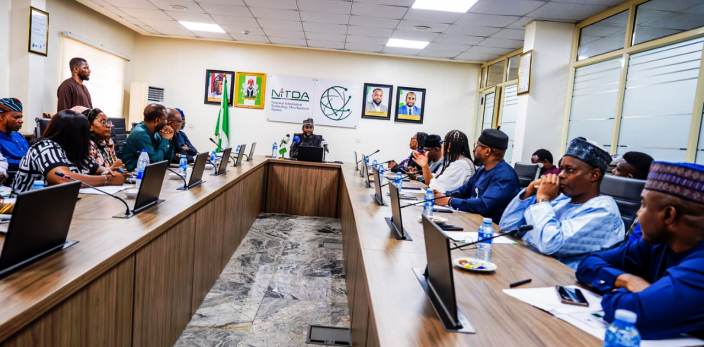
AI Reshaping Nigeria’s Cybersecurity Landscape
The Director General of the National Information Technology Development Agency (NITDA), Kashifu Inuwa Abdullahi, has raised alarm over the fast-growing cybersecurity risks fueled by artificial intelligence (AI), urging urgent and coordinated action at the national level.
RELATED: Why AI education should be integrated into Nigeria’s school curriculum
According to cybersecurity experts, AI has become a double-edged sword—strengthening defensive capabilities while also empowering cybercriminals to automate, scale, and sophisticate attacks.
ALSO READ: EXECUTIVE NOTE: Redefining Nigeria’s Economic Future: Benue State and the Rise of the Digital Economy
Recent assessments suggest that nearly 60 percent of organizations may have experienced at least one AI-powered cyberattack within the past year.


Government Moves to Deepen Stakeholder Collaboration
Speaking ahead of the planned inauguration of a cybersecurity advisory council, Abdullahi revealed that the Ministry of Communications, Innovation and Digital Economy will convene at least two additional stakeholder engagement sessions.
He said the approach reflects the inclusive and transparent process adopted in developing Nigeria’s National AI Strategy, ensuring that both public and private sector voices shape the country’s cybersecurity direction.
AI: A Game-Changer for Cyber Threats
Abdullahi explained that the widespread integration of AI into everyday digital systems has fundamentally altered the cybersecurity threat environment.
“AI is changing the game and elevating the threat landscape. The more we integrate AI into our lives, the more we need to change the way we look at cybersecurity,” he said.
He noted that threats are now emerging on two fronts. One is direct attacks on AI systems themselves. The other are attacks executed using AI technologies—dramatically expanding the scale and complexity of vulnerabilities.
Deepfakes and AI-Driven Social Engineering on the Rise
One of the most troubling developments, according to the NITDA boss, is the rapid growth of AI-enabled social engineering attacks, particularly deepfake technology.
“We are witnessing increasingly sophisticated AI-driven social engineering. Deepfakes make it difficult to distinguish between AI-generated audio or video and authentic content, even during live virtual calls,” he warned.
Such tactics have already been linked globally to large-scale financial fraud and executive impersonation scams.
Cybersecurity Is a Shared Responsibility
Abdullahi stressed that no single organization can tackle AI-driven cyber threats alone, emphasizing the need for strong collaboration between government and the private sector.

“We are only as strong as our weakest link. If one entity is compromised, it creates risks for others within the network,” he said, citing incidents where financial institutions were exploited as gateways into broader payment systems and government infrastructure.
Advisory Council Seen as Critical National Platform
Commending the minister for initiating the cybersecurity advisory council, Abdullahi described it as a vital platform for information sharing. The council will broaden inter-agency cooperation, and help in building a more resilient national digital ecosystem.
He reaffirmed NITDA’s commitment to supporting the council and working with stakeholders across sectors to strengthen Nigeria’s cybersecurity framework amid rapidly evolving AI-driven threats.
Key Evolving AI-Driven Cyber Risks
- Hyper-Personalized Phishing and Social Engineering: Generative AI enables highly convincing, personalized scam messages that mimic trusted colleagues or executives.
- Deepfakes and Identity Fraud: AI voice cloning and video deepfakes are used to impersonate executives during virtual meetings, enabling large-scale fraud.
- Automated Malware and Vulnerability Discovery: AI tools rapidly identify zero-day vulnerabilities and adapt malware to evade detection in real time.
- Adversarial Machine Learning (Model Poisoning): Manipulation of AI training data causes security systems to misclassify threats.
- Autonomous Attack Bots: AI-powered agents can independently navigate networks to steal data without human oversight.
How Cybersecurity Tactics Are Shifting
- Speed as the New Battleground: AI-driven attacks can unfold within minutes, overwhelming manual defenses.
- AI-as-a-Service (AIaaS): Easy access to AI tools has lowered entry barriers for cybercriminals.
- Targeting AI Systems: As organizations deploy AI for defense, these systems themselves become prime targets, including risks from “shadow AI.”
Defensive Challenges and Strategic Responses
- Widening Defense Gap: While AI-enabled attacks surge, only a small fraction of organizations have deployed AI-powered security tools.
- Fighting Fire with Fire: Adoption of AI-driven threat detection and behavioral analytics is becoming essential for real-time defense.
- Human-in-the-Loop Approach: Despite automation, human expertise remains critical for validating alerts and managing complex threats.