By
By 
By Osasome, C.O
After IBEDC Exit, Asset Recovery Agency Seeks Strategic Investors to Unlock NTEL’s Digital Infrastructure Potential
The Asset Management Corporation of Nigeria (AMCON) has officially commenced the divestment of its stake in NTEL/NATCOM, the successor to the defunct Nigerian Telecommunications Limited (NITEL), marking a significant milestone in Nigeria’s telecommunications and infrastructure investment landscape.
RELATED: ntel relaunches: ‘BETs’ on broadband, MVNO model as Nigeria’s data-centric telecom market opens new growth opportunities
The move comes shortly after AMCON successfully completed the divestment of the Ibadan Electricity Distribution Company (IBEDC), reinforcing the Corporation’s mandate to recover distressed assets, maximise value for taxpayers, and attract private-sector investment into strategic sectors of the economy.


Announcing the development during a media interactive session in Lagos, AMCON Managing Director and Chief Executive Officer, Gbenga Alade, described NTEL’s ongoing transformation as one of the Corporation’s most promising turnaround stories.
“The remarkable transformation of NTEL is poised to become one of AMCON’s most notable success stories in the telecommunications sector. We have full confidence in the board and management of NTEL/NATCOM as they continue to demonstrate experience, innovation, diligence and commitment towards positioning this Nigerian-owned company to compete favourably with its peers both locally and internationally,” Alade said.
He noted that the divestment would follow a transparent and structured investment process designed to attract technically competent and financially strong investors capable of repositioning NTEL for long-term commercial sustainability.
AMCON Repositions NTEL Ahead of Investor Exit
According to Alade, AMCON has implemented a comprehensive three-pronged transformation strategy aimed at significantly enhancing NTEL’s valuation before the sale.
Rather than competing directly in Nigeria’s saturated retail mobile market, NTEL is repositioning itself as a digital infrastructure company focused on enterprise connectivity, wholesale telecommunications services, infrastructure leasing, and property development.
The restructuring strategy seeks to improve operational efficiency, diversify revenue streams and create a more attractive investment proposition for local and international investors.
“The repositioning effort is designed to maximise value, strengthen operational competitiveness and prepare the business for long-term sustainability under new investment,” Alade added.
Three Strategic Pillars Driving NTEL’s Turnaround
1. Leadership Renewal and Commercial Repositioning
AMCON has strengthened NTEL’s corporate governance through a restructured board led by respected investor General T.Y. Danjuma (Rtd.), while appointing telecommunications executive Soji Maurice-Diya as Chief Executive Officer to spearhead the company’s commercial revival.
The new management has shifted focus from competing with dominant mobile operators to building a sustainable infrastructure-led telecommunications business.

2. Monetising High-Value Real Estate Assets
NTEL is unlocking significant value from its nationwide property portfolio through its real estate subsidiary, Eden, which is developing commercial and residential projects across Lagos, Abuja and Port Harcourt.
The strategy creates diversified income sources beyond traditional telecom services while improving overall asset valuation.
3. Leveraging Strategic Digital Infrastructure
One of NTEL’s strongest competitive assets remains its extensive telecommunications infrastructure, including:
- More than 3,500 kilometres of fibre-optic backbone
- Over 600 telecommunications base stations
- Premium spectrum assets
- Strategic urban network locations
To improve liquidity pending full divestment, AMCON has already leased portions of NTEL’s spectrum to MTN Nigeria, demonstrating the commercial value of the company’s infrastructure assets.
Why the Divestment Matters for Nigeria’s Digital Economy
Industry analysts believe the divestment extends beyond the sale of a telecommunications company.
It represents an opportunity to unlock dormant national digital infrastructure that could accelerate broadband expansion, enterprise connectivity, cloud services, smart city development and digital transformation initiatives.
A successful transaction could:
- Attract fresh foreign direct investment into Nigeria’s ICT sector
- Improve utilisation of existing telecommunications infrastructure
- Enhance wholesale broadband capacity
- Support Nigeria’s National Broadband Plan
- Create employment opportunities across telecommunications and digital services
- Reduce pressure on government-owned legacy assets
The exercise also aligns with Nigeria’s broader economic reforms aimed at increasing private-sector participation in critical infrastructure.
AMCON Records Strong Debt Recovery Performance
Beyond the NTEL divestment, AMCON disclosed significant progress in its core debt recovery mandate during the first half of 2026.
Between January and June 2026, the Corporation recovered ₦165 billion, representing a 64 per cent increase compared to the ₦107 billion recovered during the corresponding period in 2025.
The agency also maintained an impressive 2.3 per cent cost-to-recovery ratio, highlighting improved operational efficiency.
Debt recovery efforts received additional legal backing following a recent Supreme Court judgment affirming AMCON’s statutory powers, including its authority to liquidate collateral assets and exemption from certain stamp duty obligations.
What New Investors Will Face in the NTEL Acquisition
Although NTEL possesses valuable infrastructure assets, prospective investors will enter one of Africa’s most competitive telecommunications markets.
Dominance of MTN and Airtel
Nigeria’s mobile market remains heavily concentrated.
MTN Nigeria and Airtel Nigeria collectively control more than 85 per cent of mobile subscribers and industry revenues, while Globacom and T2 (formerly 9mobile) account for much smaller market shares.
According to Nigerian Communications Commission (NCC) industry data, NTEL has recorded virtually no active retail mobile subscribers for an extended period, prompting its strategic shift away from consumer mobile services.
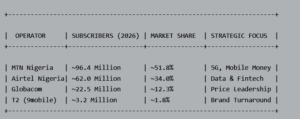
(Data Source: NCC Industry Statistics 2026)
Growing Competition from MVNOs
Nigeria’s telecom landscape is also evolving with the licensing of more than 40 Mobile Virtual Network Operators (MVNOs).
These digital-first operators are introducing innovative data products, making direct competition in retail mobile services increasingly challenging.
Instead, NTEL’s strategy focuses on becoming an infrastructure partner that supports telecom operators, enterprise customers and specialised niche markets.
Data Economy Driving Infrastructure Demand
The Nigerian telecommunications market has shifted decisively toward broadband, fibre infrastructure and data services.
With national data consumption exceeding 1.3 million terabytes monthly, operators continue investing heavily in fibre deployment and network expansion.
The Federal Government’s ongoing 90,000-kilometre National Fibre Optic Backbone Project is expected to further accelerate broadband penetration nationwide.
Within this evolving ecosystem, NTEL’s preserved fibre network and telecommunications assets could become highly valuable to operators seeking wholesale capacity rather than building new infrastructure from scratch.
Macroeconomic and Operational Challenges
Potential investors must also prepare for significant industry headwinds, including:
- Rising energy and diesel costs
- Foreign exchange volatility
- Fibre vandalism and infrastructure theft
- High capital expenditure requirements
- Intense regulatory oversight
- Increasing competition in broadband services
These factors will require substantial long-term investment and operational expertise to unlock NTEL’s full commercial potential.
Transparent Divestment Process
AMCON reiterated that the NTEL divestment would follow a transparent and competitive process aimed at attracting credible investors capable of strengthening the company’s long-term financial sustainability.
The Corporation expressed confidence that the ongoing restructuring, combined with NTEL’s strategic infrastructure assets and experienced management, would position the company as an attractive investment opportunity within Nigeria’s rapidly expanding digital economy.
The divestment also reflects AMCON’s broader strategy of recovering value from legacy assets while supporting private-sector-led growth across critical sectors of the Nigerian economy.
COVER PHOTO: Oyinlola Adebayo, Company Secretary, Asset Management Corporation of Nigeria (AMCON) (right); Aminu Mukhtar Dan’amu, Executive Director, Asset Management Directorate (second right); Gbenga Alade, Managing Director/CEO (third right); Adeshola Lamidi, Executive Director, Resolution Directorate (third left); Albert Nwanozie, Head, Legal Department (second left), and Jude Nwauzor, Head, Corporate Communications Department, at AMCON media parley in Lagos at the weekend.