By
By 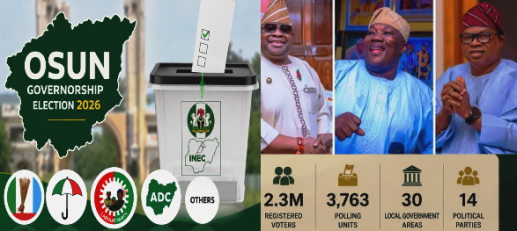
Matters eRising with Olusegun Oruame
As voters across Osun State head to the polls today, August 15, 2026, the contest for the governorship is unfolding on more than streets, campaign grounds and polling units.
RELATED: Nigeria’s 2027 election enters the AI Era as Bloomwit Africa warns of deepfake threats to businesses, institutions and political communication
It is also playing out on smartphones.


For millions of voters, the first election-related message they see in the morning, the latest claim about a candidate or the video purporting to show an incident at a polling unit may arrive through WhatsApp, Facebook, X, TikTok, Instagram or YouTube.
ALSO RELATED: Matters eRising — The politics of data: Why 2027 will be won long before election day
That has made the digital information space an increasingly important part of the electoral process, placing technology at the centre of mobilisation, political persuasion, election monitoring and the fight against misinformation.
The Independent National Electoral Commission (INEC) has scheduled the Osun governorship election for August 15, 2026, and has established digital channels for election information, including its myINEC application and online election resources.
But while digital tools are helping citizens participate and monitor the election, they are also creating new avenues for manipulation.
The Election Before the Election
Long before voters arrive at polling units, political battles have already been fought online.
Campaign messages, claims about government performance, allegations of electoral manipulation, reports of insecurity and arguments over candidates are being circulated at extraordinary speed.
A claim made at a political rally can become a 30-second TikTok video. A WhatsApp message can be forwarded into hundreds of groups before anyone establishes whether it is true. An old photograph can resurface with a new caption and suddenly appear to document an event that never happened.
This speed has changed the traditional relationship between elections and information.
In previous elections, voters often depended heavily on newspapers, radio, television, campaign rallies and conversations within their communities. Today, a voter can receive political information from an influencer thousands of kilometres away, a party supporter in another local government or an anonymous account whose identity is difficult to establish.
That democratises access to information — but it also makes the information environment harder to police.
Social Media Is Now a Major Political Information Source
Research by the Centre for Journalism Innovation and Development (CJID) has previously highlighted the growing role of social media in how Nigerians consume political information.
The organisation’s research has found that platforms including WhatsApp, Facebook, Instagram, TikTok and X are increasingly important channels for political communication, while also creating challenges around information disorder.
For Osun voters, the implications are significant.
Political communication is no longer simply about who can reach the largest crowd at a rally. It is increasingly about who can produce the most compelling video, dominate a conversation online, mobilise influencers and respond fastest when a narrative begins to spread.
The result is a campaign environment in which attention itself has become political currency.
AI Raises the Stakes
Artificial intelligence is adding another layer of complexity.
Generative AI has lowered the technical barriers to producing convincing images, audio and video. Political actors and online communities can potentially manipulate existing material or create synthetic content that looks and sounds increasingly authentic.
That creates a difficult problem for voters.
The danger is not only that people may believe fake content. It is also that genuine evidence can be dismissed as fake.
This is sometimes described as the “liar’s dividend” — the ability of people facing authentic evidence to simply claim that it was generated or manipulated by AI.
In an election environment already characterised by political suspicion, that can make it increasingly difficult for citizens to distinguish between evidence, propaganda, satire, misinformation and deliberately manufactured deception.
From Political Mobilisation to Digital Influence
Social media has also changed how campaigns mobilise voters.
Influencers, entertainers, political commentators and other public figures can reach large audiences without going through traditional media organisations.
Campaign teams can also use targeted digital advertising and audience segmentation to deliver different messages to different groups of voters.
The advantage is obvious: campaigns can communicate directly with voters.
The risk is that citizens may receive highly personalised political narratives without understanding why a particular message was presented to them or who financed it.
For an election with millions of registered voters, digital platforms therefore provide political parties with a powerful mechanism for persuasion and mobilisation.
When Citizens Become Election Observers
But technology is not only being used by political campaigns.
It is increasingly allowing ordinary citizens to become part of the election-monitoring process.
One example is iReportINEC, a citizen-led election reporting platform deployed by the Tap Initiative for Citizens’ Development for the Osun election.
The organisation said more than 20 per cent of polling units had already been covered ahead of election day and appointed actress and activist Kate Henshaw as an ambassador to encourage citizen participation.
The idea is relatively simple: citizens can document incidents, submit reports and provide eyewitness accounts from polling locations.
Tap Initiative Executive Director Martin Obono said the objective was to ensure that civic participation did not end when voters cast their ballots.
“Democracy does not end with casting a vote,” Obono said, urging citizens to witness, document and responsibly report what happens during the electoral process.
The significance of such platforms is that election monitoring is no longer necessarily confined to accredited observers carrying notebooks and moving between polling units.
A citizen with a smartphone can potentially become an additional source of real-time information.
AI Is Also Watching the Digital Election
Technology is being deployed on the other side of the information battle as well.
The Centre for Information Technology and Development (CITAD) has deployed PAWSOM-Monitor, an AI-based platform designed to monitor digital rights, data protection and privacy issues surrounding political actors and their digital platforms.
According to CITAD’s preliminary monitoring, some political party websites recorded unavailability, degraded performance and DNS anomalies during the monitoring period.
The organisation’s broader objective is to examine potential digital rights violations, data and privacy breaches and the accessibility of political parties’ digital platforms.
The platform is also intended to assess whether political parties and candidates enjoy a relatively fair digital environment before, during and after the election.
CITAD has indicated that the Osun deployment is a pilot that could inform the use of the technology during the 2027 general elections.
That represents an important development. Election observation is increasingly expanding from what happens at the polling unit to what happens inside the digital infrastructure surrounding an election.
The Information Environment Can Influence Turnout
The stakes are particularly high because misinformation does not always need to persuade voters to support a particular candidate.
Sometimes, it only needs to frighten them.
A false report of violence can discourage voters from travelling to a polling unit. A fabricated claim about polling arrangements can cause confusion. An allegation that an election has already been rigged can weaken confidence before voting even begins.
The Nigerian Democratic Report has identified information manipulation and interference as a growing threat to the Osun election. It documented the use of misleading political content, manipulated images, false security claims and other narratives. All of these could significantly influence voter behaviour and undermine trust in electoral institutions.
The organisation has also warned that information manipulation can discourage participation and intensify political tensions.
That concern has been echoed by election stakeholders. A July policy dialogue in Osogbo brought together election officials, security agencies, civil society organisations, media professionals and other stakeholders, who warned that misinformation, disinformation and hate speech could undermine public confidence and contribute to electoral violence.
Digital Tools Cannot Replace Human Judgement
The growing role of technology does not mean that every digital report should automatically be treated as evidence.
A photograph may be genuine but taken years earlier. A video may show a real incident but from another state. A voice recording may sound convincing but have been synthetically generated.
Even citizen-generated reports require verification.
That makes journalists, fact-checkers, election observers and citizens more important — not less — in the digital age.
Technology can help collect information faster, map incidents, preserve evidence and connect observers. But people still have to establish context, authenticate claims and determine what actually happened.
From Ballot Box Security to Information Security
The evolution of digital technology has therefore expanded the meaning of election integrity.
Protecting an election is no longer exclusively about securing ballot papers, polling units and result sheets.
It increasingly involves protecting the information environment in which voters make decisions.
That means ensuring citizens have access to accurate election information, strengthening rapid fact-checking, monitoring coordinated disinformation, protecting political parties’ digital infrastructure, safeguarding voters’ personal data and encouraging responsible use of social media.
It also means ensuring that digital monitoring tools themselves are transparent, secure and responsibly used.
The Human Side of the Digital Election
For the ordinary Osun voter, all of this may sound like technology jargon.
But the consequences are deeply personal.
It could determine whether a voter believes it is safe to leave home. Whether someone trusts an election result. Whether a young first-time voter believes a viral video. Whether a community decides to participate or stay away.
The person scrolling through WhatsApp in the early hours of election day is therefore not simply consuming content.
They are navigating an information environment that could influence how they understand their candidates, their community and the election itself.
And that is why the digital space has become an electoral battleground in its own right.
The New Election Frontline
The Osun governorship election offers a glimpse of how Nigeria’s future elections may increasingly be contested.
Campaigns will still require rallies, grassroots mobilisation and face-to-face engagement. Voters will still queue at polling units. Election officials will still have to manage the physical process.
But alongside those traditional elements will be an increasingly sophisticated digital layer — one capable of mobilising citizens, exposing irregularities, amplifying political messages and, at the same time, spreading fear and falsehood.
The challenge is no longer simply to put technology into elections.
It is to ensure that technology strengthens democracy rather than becoming another instrument for manipulating it.
For today’s Osun election, the question is therefore not only who wins at the polling unit.
It is also whether voters can navigate the digital noise well enough to make informed choices.