By
By 
By Aboubakr Kaira Barry, CFA, Managing Director, Results Associates and Chair of the Omou Financial Literacy Center
The IMF’s 2026 Article IV consultation on Nigeria includes a dedicated annex on the rapid spread of cryptocurrencies in the country.


RELATED: Why regulators remain cautious as Stablecoins gain traction in Africa’s digital payments push
Between July 2023 and June 2024, Nigeria received approximately $59 billion in crypto-asset value, according to Chainalysis data cited by the IMF. Stablecoins accounted for more than 65 percent of crypto inflows in 2024, and Nigeria represented around 60 percent of all stablecoin inflows into Sub-Saharan Africa between late 2019 and early 2025.
ALSO READ: Stablecoins enter financial mainstream as Mastercard acquires BVNK in record $1.8bn deal
What Are Stablecoins?
Stablecoins are digital tokens designed to hold a stable value against a reference asset—most commonly the U.S. dollar. For most users, they function as digital dollars: an asset that can be held in a wallet, transferred across borders, or exchanged into naira.
According to the IMF, Nigeria’s stablecoin market is dominated by two dollar-denominated tokens: Tether (USDT) and USD Coin (USDC).
USD Coin (USDC): Issued by Circle, which states that USDC is redeemable one-for-one for U.S. dollars and backed by highly liquid reserve assets—principally short-dated U.S. government securities and cash held with regulated financial institutions.
Tether (USDT): Issued by Tether, which reports that USDT is backed by a broader reserve portfolio including U.S. Treasuries, cash and cash equivalents, repo arrangements, money-market exposure, secured loans, gold, and bitcoin.
How the Market Operates
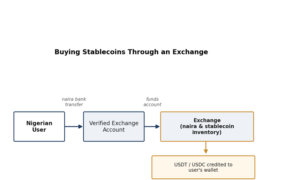
A Nigerian user can buy stablecoins through a crypto exchange that offers naira-to-crypto conversion. On mainstream platform-based routes, users generally open and verify an account, fund it through a naira bank transfer or another permitted payment method, and purchase USDT or USDC. The exchange acts as a market maker, holding an inventory of stablecoins and naira from which it meets customer demand.

Peer-to-Peer Trading
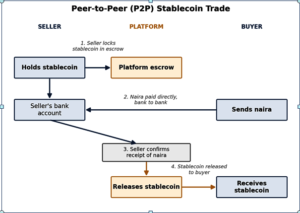
An alternative route is peer-to-peer (P2P) trading, in which individuals transact directly with one another through a crypto platform. On major exchange-operated P2P platforms, users must still hold a verified account, even though the naira payment itself passes directly between the buyer’s and seller’s bank accounts.
In a typical transaction, a seller places stablecoins in platform escrow. The buyer transfers naira directly to the seller’s bank account, and once the seller confirms receipt, the platform releases the stablecoins.
This structure protects the seller through escrow, but the buyer carries counterparty risk in the interim: fraudulent claims of non-payment, delayed bank transfers, and disputes over proof of payment are common friction points. Buyer protection rests on the exchange’s dispute-resolution process rather than any government guarantee.
The P2P model expanded after the CBN’s February 2021 directive instructing banks to stop servicing crypto exchanges and users. Rather than eliminating crypto activity, the restriction pushed much of it into less regulated channels, especially P2P markets.
A Broader Pool of Dollar Liquidity
Stablecoins have widened access to dollar-linked assets beyond the traditional channels of commercial-bank allocations, bureaux de change, international money-transfer operators, and the parallel cash market.
They connect Nigerian users to a global pool of private digital-dollar liquidity, supplied by diaspora remitters, remote workers, traders, exporters, importers, and businesses that receive or hold stablecoins for cross-border transactions. A freelancer paid in USDT, for example, can sell those tokens for naira through a platform or P2P transaction; a small importer may acquire USDT to pay an overseas supplier.
Selling a stablecoin for naira is, in effect, selling dollars and buying naira—which increases demand for the currency and can help stabilize the exchange rate, provided sales run net positive: more coins moving into naira than naira into coins.
Similarly, the same mechanism gives ordinary Nigerians easier access to dollar liquidity, letting them hold digital dollars in their wallets for transacting or saving. The reverse also holds: in periods of high inflation or capital flight, demand to convert naira into stablecoins can exceed the reverse flow, adding to pressure on the parallel exchange rate rather than relieving it.
Why Users Turn to Stablecoins
- Faster, potentially cheaper cross-border payments: Stablecoins can enable near-instant international transfers at low network cost. Traditional remittances remain expensive, particularly in Sub-Saharan Africa—though total stablecoin costs still depend on network fees, exchange spreads, and the cost of converting between naira and stablecoins.
- Access for traders and remote workers: Stablecoins help small importers pay foreign suppliers and let freelancers and remote workers receive international payments where formal banking channels are slow, costly, or inaccessible.
- A hedge against monetary instability: During periods of high inflation, naira depreciation, FX scarcity, or general uncertainty, a dollar-linked digital asset becomes an attractive store of value—giving Nigerians a practical alternative when confidence in the naira weakens.
This is where stablecoins stop being merely a payments technology. They become a rival to the naira.
Regulation, Risks, and Monetary Sovereignty
In July 2026, President Bola Tinubu signed the Presidential Executive Order on Virtual Assets Coordination, establishing a CBN-chaired Virtual Asset Council to improve coordination among the institutions responsible for virtual-asset policy and regulation. Under this framework, cryptocurrencies can be traded through licensed Virtual Asset Providers (VAPs), which are authorized to pool customer funds and supply the naira leg of each transaction.
A customer wanting to buy USDC, for instance, can instruct his bank to send naira to the VAP’s account; the VAP transmits the funds to the exchange, which then sends the crypto coin to the buyer. The government has taken the farsighted approach of improving transparency in crypto dealing rather than banning it outright.
To my mind, the most important consequence is this: by giving Nigerians regulated access to cryptocurrencies, the government has—wittingly or unwittingly—created an external anchor against which the naira can be judged. If inflation is not brought under control, Nigerians will move their naira into digital dollars in their wallets.
And because the naira’s exchange rate against these cryptocurrencies is visible in real time, it transmits a shadow price for the naira that reflects underlying supply and demand—one that can, in turn, influence the exchange rate in the parallel market, incentivizing the government to pursue corrective action to stabilize the exchange rate.
“Banks reporting little migration of deposits into stablecoins”
Evidence to date suggests limited bank disintermediation in Nigeria, with banks reporting little migration of deposits into stablecoins. That matters: Nigeria is not yet experiencing a large-scale exodus from bank deposits into digital dollars.
But the absence of major deposit flight today does not eliminate the risk tomorrow. If inflation accelerates, the naira comes under renewed pressure, or FX shortages worsen, Nigerians will have every incentive to save in digital dollars instead—and it will be very difficult for the government to stop them, since stablecoins serve a genuine need and entrepreneurial Nigerians will always find a way to meet the demand.
So the best course of action is to preserve and expand the benefits cryptocurrencies provide to Nigeria, while working aggressively to consolidate fiscal and monetary reforms that bring down inflation and ultimately restore price stability. And here, more work still needs to be done.
The Hidden Fiscal Gap: Nigeria’s “Residual Deficit”
The same Article IV report flags a related fiscal problem: a “residual deficit,” or spending that left the treasury but was never recorded in the official budget—mainly infrastructure projects and crude-debt servicing executed outside government tracking systems (GIFMIS).
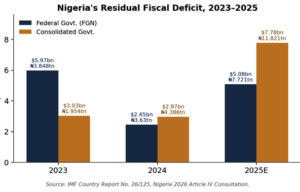
Nigeria’s authorities attribute much of this gap to petroleum-sector project financing that ran outside the formal budget, and have since committed to bringing priority national projects fully on-budget going forward. The 2026 budget already reflects this shift, folding major infrastructure spending into the official appropriations process at ₦24.7 trillion, or 4.4 percent of GDP.
The implication: a growing share of public money moved outside formal, audited channels—weakening budget oversight and control over the quality of expenditure, and undermining exactly the fiscal discipline that price stability depends on. Loose fiscal management of this kind erodes the very foundation needed to keep Nigerians from fleeing the naira for digital dollars.
Even so, the Nigerian government deserves credit for embracing cryptocurrencies rather than suppressing them. My hope is that the risk of digital dollars emerging as a primary store of value will give the government further incentive to accelerate the reforms needed to maintain confidence in the naira—while still capturing the benefit that a net increase in cryptocurrency sales in Nigeria can deliver: naira demand that functions much like the central bank selling down its own reserves to defend the currency, except funded by offshore, privately held dollars rather than the government’s own reserves.

Author: Aboubakr Kaira Barry