By
By 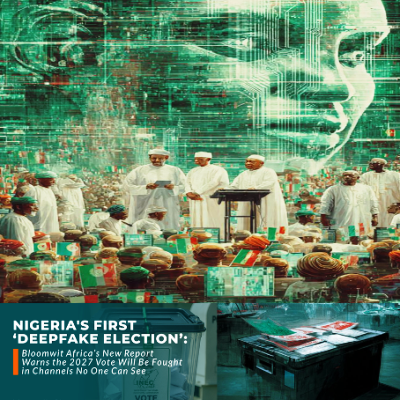
By Osasome, C.O
New report urges organisations to prepare for AI-driven misinformation, encrypted social media campaigns and reputation attacks ahead of Nigeria’s 2027 general election.
2027 General Election: Prepare for AI-driven misinformation, encrypted social media campaigns and reputation attacks
Nigeria’s 2027 general election is shaping up to be the country’s first electoral cycle conducted in the age of mainstream generative artificial intelligence (AI), with experts warning that deepfakes, AI-generated misinformation and sophisticated digital manipulation could redefine political communication, public trust and corporate reputation.

RELATED: AI-driven disinformation threatens Nigeria’s 2027 elections, social stability and economy, warns Crisis Communication Centre
These concerns are contained in “Navigating Nigeria 2027,” a new strategic communications and reputation report released by Bloomwit Africa, which argues that organisations, investors, political actors and public institutions must urgently prepare for an information environment where convincing fabricated content can be created within minutes and spread at unprecedented speed.
ALSO READ: Matters eRising — The politics of data: Why 2027 will be won long before election day
According to the report, the country’s digital ecosystem has already witnessed the emergence of fabricated audio recordings, manipulated videos and AI-generated images involving Nigerian public figures, underscoring how rapidly generative AI is reshaping political discourse and public perception.
Generative AI Reshaping Nigeria’s Information Landscape
Bloomwit Africa notes that Nigeria’s electoral and data protection authorities have already identified AI-generated misinformation, political profiling and deepfake technologies as emerging risks capable of undermining public confidence during elections.
The report warns organisations to assume that fabricated statements, fake videos or manipulated messages attributed to their executives, brands or institutions can be produced cheaply, distributed instantly and amplified across multiple digital platforms before official responses are ready.
Rather than reacting after misinformation has gone viral, the report recommends that organisations develop robust monitoring, verification and rapid-response capabilities well ahead of the election cycle.
The New Information Asymmetry
A central finding of the report is what it describes as a growing structural imbalance in today’s digital communication ecosystem.
While advances in generative AI have dramatically reduced the cost and speed of producing convincing fake content, encrypted messaging platforms have equally lowered the barriers to distributing misinformation at scale.

However, the time and resources required to detect, verify and correct false narratives remain largely unchanged.
According to Bloomwit Africa, this widening gap makes preparation the most effective defence.
“The danger is no longer simply the existence of fabricated content,” the report argues. “The greater challenge is discovering and countering false information before it becomes accepted as fact.”
Why Most Organisations Are Monitoring the Wrong Platforms
The report suggests that many organisations continue to focus their monitoring efforts on mainstream media and open social media platforms while overlooking where influential conversations increasingly begin.
Among its findings:
- 96.5 per cent of Nigerian internet users actively use WhatsApp, making it the country’s most widely used digital platform.
- TikTok follows with 89.7 per cent penetration.
- Facebook and Instagram each record 89.2 per cent usage.
- Nigerians use an average of 8.1 digital platforms every month and spend approximately 29 hours weekly on social media.
- Nigeria now has approximately 109 million internet users, representing about 45.5 per cent of the population.
Bloomwit Africa argues that many politically sensitive narratives first emerge inside private WhatsApp groups, encrypted communities, regional language forums and voice-note conversations long before appearing on public platforms or traditional media.
This means organisations relying solely on conventional media monitoring may already be several hours behind when misinformation becomes publicly visible.
Multilingual Conversations Add Another Layer of Complexity
The report highlights Nigeria’s linguistic diversity as another major consideration for election communication.
Stories often originate in Hausa, Yoruba or Igbo before eventually appearing in English-language media.
Without multilingual monitoring capabilities, organisations risk missing early warning signs of emerging narratives that could later gain nationwide traction.
Bloomwit Africa therefore recommends expanding monitoring beyond English-language conversations to include regional languages and local digital communities.
AI Has Changed the Speed of Reputation Management
Commenting on the report, Bloomwit Africa Executive Director, Oti Egwu, said the speed at which misinformation now spreads has fundamentally changed crisis communication.
According to him, organisations can no longer assume they have several hours to verify emerging claims before responding.
“The danger in 2027 isn’t that fabrications exist; it’s the gap between the moment a lie starts spreading and the moment you discover it,” Egwu said.
He observed that while misinformation once took hours to gain traction, AI-powered content generation combined with encrypted messaging platforms has reduced that window to mere minutes.
Egwu noted that organisations cannot prevent fabricated content from being created but can significantly reduce its impact through proactive planning, continuous monitoring and rapid response capabilities.
He advised institutions to understand where conversations are taking place, in every relevant language, and prepare communication strategies before the election season reaches its peak.
A New Benchmark for Election-Year Communication
To strengthen organisational readiness, the report introduces what it calls the Bloomwit Africa Monitoring Standard, recommending that organisations should be capable of detecting potentially damaging narratives and briefing response teams within one hour, regardless of the platform or language involved.
The framework also encourages institutions to develop pre-approved protocols for responding to synthetic media attacks across multiple communication channels simultaneously.
Beyond reactive communication, the report recommends that organisations consistently build authentic brand voices and trusted public engagement, making AI-generated fabrications easier for audiences to recognise as inauthentic.
Trust Remains Nigeria’s Greatest Strength—and Greatest Vulnerability
Bloomwit Africa also points to Nigeria’s strong public trust environment as both an opportunity and a potential risk.
According to the report, Nigeria ranked fourth among 28 markets in the 2026 Edelman Trust Index, reflecting relatively high levels of institutional trust compared to many global markets.
However, the report argues that societies with higher trust can become particularly vulnerable to sophisticated misinformation because fabricated content often gains credibility more quickly when audiences generally trust familiar institutions and personalities.
As Nigeria prepares for its presidential election scheduled for January 16, 2027—the earliest presidential poll since the country’s return to democratic rule in 1999—the report concludes that the window for building resilient communication systems is rapidly narrowing.
Preparing for an AI-Driven Election
Bloomwit Africa concludes that Nigeria’s 2027 election will test not only political campaigns but also the resilience of businesses, regulators, investors and public institutions operating in an increasingly AI-driven information environment.
The report argues that reacting to misinformation is a losing strategy. Real success lies in anticipating risks through continuous monitoring, multilingual intelligence, digital verification, and coordinated crisis communication.
The rise of generative AI and increasingly sophisticated misinformation is changing the trust landscape. For organisations operating in Nigeria, the stakes couldn’t be higher during an election cycle of this magnitude. Those that act now to build digital reputation resilience will be ahead of the curve when it matters most.
Download the Report: Navigating Nigeria 2027