By
By 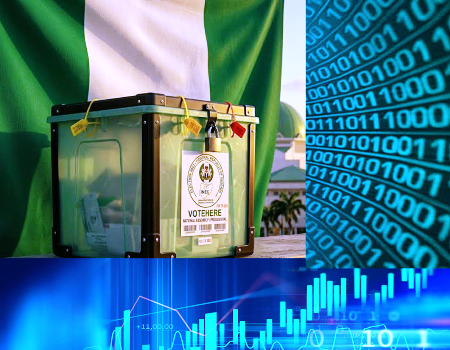
Olusegun Oruame | Matters eRising
This week brought two announcements that, on the surface, appeared administrative but may ultimately prove politically consequential.
RELATED: Nigeria 2027: How data, not noise, may decide the most consequential election since 1999
The National Identity Management Commission (NIMC) disclosed that enrolment into Nigeria’s National Identity Database has surpassed 136 million people. Around the same period, the Nigeria Inter-Bank Settlement System (NIBSS), working with the Central Bank of Nigeria (CBN), reported continued growth in Bank Verification Number (BVN) registrations. Alongside these databases sits the Independent National Electoral Commission’s (INEC) ever-expanding register of eligible voters.


Viewed together, these developments tell a larger story. Nigeria is becoming a data-driven society.
Across government institutions, databases are increasingly shaping planning, budgeting, social intervention programmes, financial inclusion and public service delivery. The long-term ambition appears to be greater interoperability among identity, financial and governance systems, allowing policymakers to understand demographic patterns with greater precision.
Politics cannot remain insulated from that transformation.
Politics Is Becoming a Data Business
For decades, Nigerian elections largely revolved around personalities, patronage networks, rallies, slogans and what many describe as “stomach infrastructure.”
Those factors have not disappeared. But they are no longer sufficient.
Modern political campaigns increasingly depend on identifying who votes, who does not vote, where support is strongest, where persuasion is possible, and where resources are best deployed. Around the world, successful campaigns increasingly combine traditional grassroots mobilisation with sophisticated voter analytics.
Ultimately, elections are won by converting eligible citizens into actual voters. Not merely generating online excitement or dominating news headlines.
Votes are numbers. And numbers increasingly come from data.
Digital Footprints Every Day
The market woman in Kano, the student in Makurdi, the farmer in Benue, the teacher in Enugu and the fintech entrepreneur in Lagos increasingly leave digital footprints every day. They leave markers not merely through banking transactions or mobile phones, but through identity registration, government services and digital payments.
Individually these records mean little. Together they tell powerful stories about how Nigerians live, work, migrate and vote. A quiet shift is redefining the political landscape, and it’s happening right under everyone’s noses. The people driving it are figuring out, in real time, which messages resonate and which voters actually turn out.
But here’s the thing: most political parties are still in the dark. That oversight is handing a golden opportunity to the few strategists who are already paying attention. They are using every data point they can find to nudge voters their way before the polls even open.
Structure Often Matters More Than Sentiment
Nigeria’s 2023 presidential election illustrated this reality.
President Bola Ahmed Tinubu secured about 8.79 million votes, while Atiku Abubakar received approximately 6.98 million and Peter Obi about 6.10 million.
One frequently cited observation is that the combined votes of the two leading opposition candidates exceeded the APC’s total. That is factually correct. However, it is equally true that elections are contested by individual parties and candidates rather than hypothetical coalitions.
Since 2023, Nigeria’s political landscape has continued to evolve, with defections, internal disputes and attempts at coalition-building reshaping opposition politics.
Whether those developments ultimately favour one party over another remains uncertain.
What can reasonably be observed, however, is that organisational strength often proves more decisive than public enthusiasm alone.
Why the APC Appears Organisationally Better Positioned
Any assessment of the 2027 contest is necessarily speculative.
Nevertheless, based on publicly observable developments, the ruling All Progressives Congress (APC) appears to have devoted considerable attention to rebuilding its organisational structures after the 2023 elections.
That should not be interpreted as evidence that the APC possesses superior proprietary data or guaranteed electoral advantage. Rather, it is an analytical judgement based on visible organisational activity, leadership appointments, grassroots engagement and sustained political restructuring.
Since assuming office as National Chairman, Professor Nentawe Yiltwada—a digital technology expert by training—has repeatedly emphasised organisation, technology and structured engagement.
The electoral impact of that will become clear after the 2027 election.
But it suggests an appreciation that future elections may increasingly reward parties capable of combining political mobilisation with disciplined planning.
Data Is More Than Technology
Data is not simply about computers. It is about understanding people.
Governments already use demographic information to improve healthcare planning, social investment programmes and financial inclusion. Telecommunications data, mobility patterns and economic indicators increasingly help policymakers understand communities more accurately than assumptions alone.
Political organisations may similarly seek to understand where voter registration is low, which communities participate least, and which demographic groups remain politically disengaged.
That is not unique to Nigeria. It is becoming standard democratic practice across many countries.
The Untapped Electoral Force: Non-Voters
Perhaps the biggest opportunity in Nigerian politics is not persuading committed supporters to change sides. It may be engaging citizens who rarely vote at all.
Millions of eligible Nigerians stay away from polling units for different reasons: disillusionment, insecurity, logistical challenges, or the belief that their votes make little difference.
Every political party should be asking the same questions: Who are these citizens? Why don’t they participate? How can they be meaningfully engaged?
The party that answers those questions most effectively could gain a significant advantage.
The Opposition’s Challenge
The opposition still possesses opportunities. Economic hardship, public frustration and demands for better governance remain important political variables that no ruling party can ignore.
However, translating public dissatisfaction into electoral victory requires far more than criticism of incumbents. It requires organisation. Yes! It requires candidate coordination. It requires voter registration drives. And Yes! It requires polling-unit structures. 1000% Yes! It requires disciplined messaging.
Most importantly, it requires converting potential supporters into verified voters who actually turn out on election day. That challenge confronts every opposition party, regardless of ideology.
The Middle Belt May Become a Critical Battleground
Analytically, North-Central Nigeria deserves particular attention. The region is politically competitive, religiously diverse and often less predictable than conventional electoral maps suggest.
Unlike areas with long-established voting patterns, the Middle Belt frequently rewards parties perceived as inclusive, responsive and locally engaged.
That makes it an ideal testing ground for data-informed campaigning. Not because data determines outcomes, but because voter behaviour there appears more fluid than in some other regions.
Data Will Not Replace Politics
None of this suggests elections can be won by algorithms alone.
Leadership still matters. Performance still matters. Trust still matters. Economic realities still matter. Campaigns remain fundamentally human enterprises.
Data simply enables political actors to make better-informed decisions. A party with excellent analytics but poor governance may still lose public confidence.
Conversely, a party with compelling ideas but weak organisational capacity may struggle to convert support into votes. The two must work together.
Looking Beyond 2027
The broader lesson extends beyond any political party.
Nigeria’s expanding identity, financial and electoral databases represent a profound shift in national governance.
If managed responsibly; with strong privacy protections, transparency and legal safeguards; they can improve planning, public service delivery, financial inclusion and democratic participation.
Politics is merely one beneficiary of this transformation.
As 2027 approaches, analysts will continue debating personalities, alliances and campaign rhetoric. Those conversations matter. But the quieter story may prove more consequential.
The real contest could increasingly revolve around which political organisations best understand citizens. Not merely as audiences for campaign speeches, but as communities whose aspirations, concerns and participation can be measured, understood and meaningfully engaged.
Whether that ultimately benefits the APC, the opposition or another political force remains an open question.
What seems increasingly clear is that Nigerian politics is entering an era where data complements democracy; not replacing political ideas, but reshaping how those ideas are organised, communicated and converted into electoral outcomes.
When the votes are finally counted in 2027, the biggest surprise may not simply be who wins. It may be how much of the campaign was quietly won long before election day.
“The election where data quietly outperformed rhetoric”
Nigeria’s 2027 election may ultimately be remembered not as the contest with the loudest rallies or the biggest social media campaigns, but as the election where data quietly outperformed rhetoric. The parties that best understand people. Not simply as crowds but as citizens with identifiable needs, aspirations and voting behaviour. It is these parties that will possess a strategic advantage.
In the digital age, political intelligence increasingly begins with data. Whether that data is deployed responsibly, transparently and within the bounds of democratic norms may determine not only who wins elections, but how effectively Nigeria is governed thereafter.