By
By 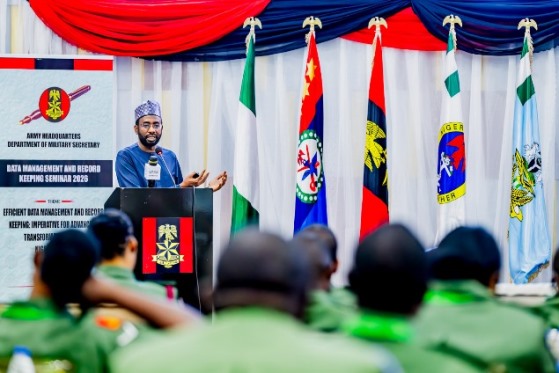
RELATED: NITDA signs MoUs with Canadian tech firms to advance AI, financial inclusion and digital economy
The Director-General of NITDA, Kashifu Inuwa Abdullahi, gave the charge while delivering a keynote presentation titled “From Data to Decision Advantage: Digital Transformation, Artificial Intelligence, and the Future of Warfare” at the Data Management and Record-Keeping Seminar organised by the Army Headquarters Department of Military Secretary in Abuja.
Abdullahi said the ability of modern military institutions to collect, analyse, verify and transform data into actionable intelligence would increasingly determine their operational advantage.
NITDA Calls for Strategic Use of Military Data
The NITDA Director-General said data should no longer be viewed primarily as information to be stored for administrative and record-keeping purposes.

Instead, he said, properly managed data could become a critical resource for intelligence, strategic planning and military operations.
According to Abdullahi, technology is rapidly reshaping the global defence industry, making it necessary for military institutions to rethink how they collect, manage and deploy information.
“Globally, the defense industry is changing due to the disruptive power of technology. So we need to look beyond just using data for record-keeping to start thinking of using data management for intelligence and strategic military operations,” he said.
He stressed that data, when combined with advanced analytical tools, could help military institutions develop a clearer understanding of operational environments and support faster decision-making.
AI Can Transform Data into Actionable Intelligence
Abdullahi also called on the Nigerian Army to adopt artificial intelligence as both a strategic and tactical decision-support tool.
He said AI could assist military institutions in collating, analysing, verifying and applying large volumes of data to support operations.
“Today, we can use Artificial Intelligence (AI) to help us collate, analyse, verify, and apply data in our military operations. We can integrate AI to help transform data into strategic and tactical information for decision-making,” he said.

The NITDA boss said AI-driven systems could strengthen the speed and accuracy of decision-making at both operational and command levels.
He added that emerging technologies should be integrated more broadly into Nigeria’s security and defence architecture, rather than being treated as peripheral upgrades.
Digital Transformation Must Combine People, Processes and Technology
According to Abdullahi, successful digital transformation requires more than simply acquiring new technology.
He said institutions must pay equal attention to the people operating the systems, the processes guiding their use and the technologies being deployed.
“So, it is important to rethink the way we use technology to transform our institutions. To transform an organization, you need to take cognisance of the people, the process, and the proper technology to adopt,” he said.
The approach, he noted, is particularly important for the military as it seeks to build the institutional capacity required to operate effectively in an increasingly data-driven security environment.
Nigerian Army Urged to Build Defence Digital Infrastructure
Abdullahi also emphasised the need for the Nigerian military to develop dedicated digital infrastructure, including defence-focused data centres.
He noted that the armed forces currently depend partly on partnerships with civilian entities in the development of technologies needed for defence operations.
The NITDA Director-General urged the Nigerian Army to strengthen collaboration with other government agencies and Nigeria’s indigenous technology and innovation ecosystem to build locally relevant defence technologies.
“The Nigerian Army has to consider ways of collaborating with other government agencies and the indigenous tech innovation ecosystem to build defense technology that can help us defend our nation,” he said.
The call highlights the growing importance of indigenous technological capacity as governments around the world seek greater control over critical digital infrastructure, data and emerging technologies.
NITDA Pledges Digital Skills Training for Military Personnel
On capacity development, Abdullahi said the Nigerian military would need to strengthen the digital competence of its personnel to fully take advantage of data analytics, artificial intelligence and other emerging technologies.
He described human capacity as a critical foundation for any successful digital transformation strategy, particularly within institutions operating in complex and rapidly changing environments.
The NITDA boss announced that the agency would support the military through training and capacity-building initiatives designed to equip personnel with relevant digital skills.
The intervention, he said, forms part of NITDA’s broader commitment to supporting Nigeria’s national security through technology and digital innovation.
Data and AI Set to Shape Future of Defence
As military operations around the world become increasingly dependent on digital systems, artificial intelligence, data analytics and advanced communications infrastructure, the ability to convert information into timely and actionable insight is becoming a critical institutional capability.
For the Nigerian Army, Abdullahi’s message points to a broader transformation in the role of technology in national defence.
The future advantage, he suggested, will not lie in simply collecting and storing vast amounts of information, but in developing the infrastructure, skills, processes and technological capacity needed to transform that data into intelligence that can support better and faster decisions.
With NITDA pledging to support capacity development, the push could also strengthen collaboration between Nigeria’s technology ecosystem and its defence institutions as the country explores the role of artificial intelligence and digital transformation in strengthening national security.