By
By 
Nigerian-born mobility fintech company Moove has joined Africa’s unicorn club after raising $250 million in a Series C funding round that values the company at $2.1 billion.
RELATED: Nigeria is Africa’s private equity and venture capital powerhouse — Rome Business School report
The latest investment, led by Mubadala and co-led by Woven Capital and Ion Pacific, marks a major leap for Moove, whose last publicly disclosed valuation stood at $750 million in 2024.
ALSO READ: Moove unveils ‘N500m Moove Cares’ for customers in Nigeria in response to escalating prices
Founded by Nigerian entrepreneurs Ladi Delano and Jide Odunsi, Moove has grown from a mobility-financing startup into a global platform providing financial and vehicle-access solutions to drivers and mobility operators.


ALSO RELATED: Why the smart capital is moving into how Africa moves?
The company, which is now headquartered in the United Arab Emirates, was established in 2019 and launched commercially in 2020.
Moove’s Valuation Nearly Triples in Two Years
Moove’s new $2.1 billion valuation represents a significant increase from the $750 million valuation disclosed in 2024.
The six-year-old company has therefore crossed the $1 billion threshold in a relatively short period, placing it among Africa’s fastest-growing technology ventures to achieve unicorn status in recent years.
Based on recently disclosed valuations, Moove now ranks among Africa’s three most valuable private technology companies, behind fintech companies Flutterwave, valued at $3.2 billion, and OPay, valued at $3.1 billion.
The milestone further strengthens Nigeria’s position as the continent’s leading source of billion-dollar technology companies, despite Moove’s current headquarters being in the UAE.
Second-Largest African Startup Equity Raise in 2026
The $250 million Series C is also significant within the broader African venture capital market.
According to data from Africa: The Big Deal, Moove’s funding round is the second-largest equity raise by an African startup so far in 2026, behind Spiro’s $270 million raise in June.

Together, the two transactions account for about 44 per cent of all equity funding raised by African startups as of August 10, highlighting the growing concentration of venture capital around a relatively small number of companies capable of attracting large institutional investments.
Before the Spiro and Moove deals, the last comparable African startup equity raise was Tyme’s $250 million Series D in December 2024.
Moove Funding Nears $700 Million
The latest investment takes Moove’s total funding to close to $700 million across equity and debt.
The company has raised roughly $500 million in equity and more than $180 million in debt, according to the figures provided.
That places Moove among Africa’s most heavily funded technology ventures when equity and debt are considered together.
Only MNT-Halan, with approximately $1.2 billion raised, and Sun King, with approximately $900 million, have raised more combined equity and debt based on the figures cited.
Moove Signals Shift Towards Capital-Intensive African Startups
Beyond Moove’s unicorn milestone, the funding round points to a broader change in the type of African startups attracting large pools of capital.
Africa’s biggest recent funding recipients are increasingly moving beyond the classic software startup model towards capital-intensive infrastructure platforms.
Moove’s mobility business requires significant investment in vehicles, financing, technology and operational infrastructure. The same pattern can be seen in the energy sector and, increasingly, in other businesses seeking to solve Africa’s physical infrastructure and access challenges.
The trend suggests that investors are increasingly willing to back businesses that combine technology with large-scale physical infrastructure, provided they can demonstrate strong growth, expansion opportunities and viable business models.
As Africa: The Big Deal observed, “Infrastructure eats capital.”
Nigeria’s Unicorn Club Expands
Moove’s milestone further adds to Nigeria’s record as Africa’s leading hub for billion-dollar private technology companies.
Depending on how recent valuation milestones are counted, Nigeria has between five and six unicorn companies.
The country’s major unicorns and former unicorns include:
- Interswitch — the digital payments pioneer and Africa’s first official unicorn, which reached a $1 billion valuation in 2019.
- Flutterwave — a financial technology and payments company.
- OPay — a mobile banking and digital financial services platform.
- Andela — a global technology talent platform connecting software engineers with employers.
- Moniepoint — a financial services and business banking technology company.
- Moove — a mobility fintech company that has now crossed the $1 billion valuation mark.
Paystack, another major Nigerian fintech success story, was acquired by Stripe before reaching independent unicorn status.
From Nigerian Startup to Global Mobility Platform
Moove’s journey reflects the increasing internationalisation of Nigerian technology companies.
Although founded by Nigerian entrepreneurs and rooted in the African mobility and fintech market, the company has expanded its footprint internationally and is now headquartered in the UAE.
Its latest funding round, led by major institutional investors, gives the company additional capital to pursue growth and expansion while reinforcing investor confidence in the mobility-fintech model.
The rise also demonstrates that Nigerian-founded companies can attract significant global capital when they combine technology with large, addressable markets.
Africa’s Unicorn Story Is Still Evolving
Unicorn creation remains relatively uncommon in Africa, where startups operate against a backdrop of limited venture capital, currency volatility, infrastructure constraints and challenging economic conditions.
Moove’s latest round nevertheless demonstrates that outsized technology-company valuations remain possible when rapid growth, international expansion and deep-pocketed strategic investors converge.
Its emergence alongside Spiro also suggests that Africa’s next generation of billion-dollar companies may not necessarily resemble the software and fintech startups that dominated the continent’s earlier technology boom.
Instead, mobility, energy and other infrastructure-focused platforms could increasingly occupy the upper end of Africa’s technology funding landscape.
Moove Joins Global Unicorn Race
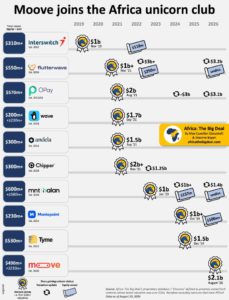
Image: The Big Deal
Moove’s $2.1 billion valuation, however, remains modest compared with the world’s most valuable private technology companies.
The global unicorn market is dominated by companies operating at extraordinary valuations, particularly in artificial intelligence, aerospace, fintech, digital infrastructure and e-commerce.
Among the companies cited in the source material, SpaceX leads at an estimated valuation of about $1 trillion, followed by Anthropic at approximately $965 billion and OpenAI at about $852 billion.
Other highly valued private companies include ByteDance, Databricks, Stripe, Ant Group, Binance, Revolut and Shein.
For Moove, however, the significance is less about competing with the world’s largest private companies and more about what its milestone represents for African entrepreneurship.
A New Benchmark for African Mobility Fintech
Moove’s progression from launch in 2020 to unicorn status in 2026 represents one of the continent’s more rapid journeys to a billion-dollar valuation.
Its $250 million Series C also arrives at a time when African startups are finding it increasingly difficult to raise large rounds compared with the funding boom of previous years.
The investment therefore provides a powerful signal that global investors remain prepared to deploy substantial capital into African-founded businesses with international ambitions.
For Nigeria’s technology ecosystem, Moove’s rise adds another major company to the country’s expanding list of billion-dollar ventures and reinforces the potential of technology-enabled businesses that address real-world infrastructure and economic challenges.