By
By 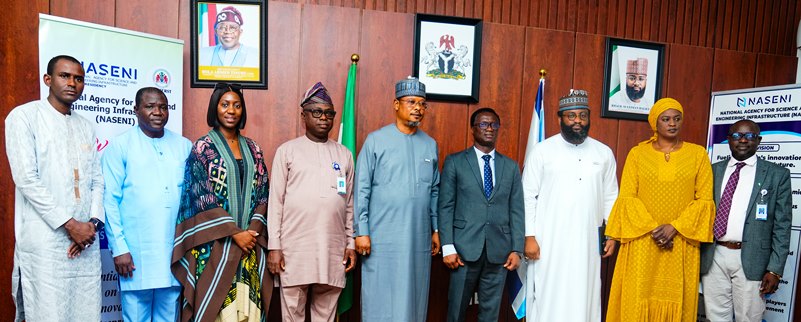
The National Agency for Science and Engineering Infrastructure (NASENI) and the Republic of The Gambia have moved to strengthen cooperation in technology development, research, innovation, Technical and Vocational Education and Training (TVET), skills development and technology commercialisation.
RELATED: NASENI boss calls for local manufacturing of clean energy technologies to secure Nigeria’s energy future
The proposed partnership will be formalised through a comprehensive Memorandum of Understanding (MoU), following a high-level experiential learning visit by The Gambia’s Minister of Higher Education, Research, Science and Technology, Professor Pierre Gomez, and his delegation to NASENI headquarters in Abuja.
ALSO READ: NASENI empowers Osun youth, women with advanced tech skills under sustainable empowerment programme
The visit took place on Wednesday, August 12, 2026, and provided the Gambian delegation with an opportunity to examine NASENI’s technology ecosystem, research capabilities and network of specialised development institutes.

Gambia Explores NASENI’s Technology Development Model
Before the Abuja engagement, the Gambian delegation visited selected NASENI facilities, including the Centre of Excellence and NASENI Solar Energy Limited (NSEL).
During the visits, the delegation received briefings on NASENI’s interventions in several technology and engineering fields, including renewable energy, agricultural mechanisation, electronics, power systems, advanced manufacturing, scientific equipment, aeronautics, solid minerals, machine tools and drone technology.
The engagement is expected to provide a basis for identifying areas where NASENI’s experience and technical capabilities can be adapted to support The Gambia’s technology and skills development priorities.
NASENI Positions Itself as African Technology Development Platform
Representing NASENI Executive Vice Chairman and Chief Executive Officer, Khalil Suleiman Halilu, the Director of Technology Business Development and Special Adviser on General Matters to the EVC/CEO, Ozigi O. Benard, said the agency was positioned to support Nigeria and other African countries seeking to develop indigenous technological capacity.
Benard said NASENI operates through a network of specialised Development Institutes that provides an integrated platform covering research and development, prototyping, testing, manufacturing, technical training, technology transfer and commercialisation.
He said the agency’s strategic direction is anchored on the 3Cs — Creation, Collaboration and Commercialisation, with growing emphasis on moving research outputs beyond laboratories and prototypes into the marketplace.
Renewable Energy, Agriculture and Drones Among Potential Areas
According to Benard, NASENI has identified several areas with significant potential for cooperation with The Gambia.

These include renewable energy and solar photovoltaic systems, power electronics, embedded systems, industrial automation, agricultural engineering, advanced manufacturing and scientific equipment.
Other potential areas include materials development, aeronautics, drone technology, solid minerals processing and technical skills development.
The breadth of the proposed cooperation reflects the two countries’ interest in building technological capacity across multiple sectors rather than limiting the partnership to a single area of research or innovation.
NASENI Highlights University and Private Sector Partnerships
Benard also highlighted NASENI’s growing partnerships with universities, polytechnics, research institutions and indigenous private-sector companies.
According to him, the partnerships have enabled the agency to support curriculum development, technical training, certification, joint research, technology development and commercialisation of locally developed technologies.
He added that NASENI’s commercialisation drive had recorded significant progress since Halilu assumed office as EVC/CEO in 2023, reflecting the agency’s increasing focus on translating research and engineering development into practical economic outcomes.
Gambia Seeks Practical Approach to Higher Education and TVET
Earlier, Professor Gomez said The Gambia was seeking to transform its higher education and TVET ecosystem through practical learning, institutional partnerships and stronger African cooperation.
He said the delegation’s visit to Nigeria was intended to provide an opportunity to learn from NASENI’s practical approach to research, development, manufacturing and technology transfer.
According to Gomez, The Gambia hopes to identify relevant models that can be adapted to its own higher education, research, technology and skills-development environment.
The proposed NASENI-Gambia partnership could therefore provide a framework for knowledge exchange and institutional cooperation while strengthening links between research, technical education and industrial development.
Building African Capacity Through Technology Cooperation
The planned MoU comes as both sides seek to deepen practical cooperation around indigenous technological development and human-capital development.
For NASENI, collaboration with The Gambia offers an opportunity to extend its technology development and commercialisation experience beyond Nigeria. For The Gambia, the engagement provides access to an established Nigerian institution working across research, engineering, manufacturing, technical training and technology transfer.
The partnership could also create opportunities for joint research, skills development, technical training and the adaptation of locally relevant technologies to address development challenges in both countries.
NASENI Team Participates in Engagement
Other NASENI officials who participated in the meeting included the Acting Managing Director of the Solid Minerals Machinery and Equipment Development Institute (SOMMEDI), Professor Ikyo Barnabas Achakpa; the Overseeing Officer of the Scientific Equipment Development Institute (SEDI), Minna, Dr Mahmoud Jafar; and the Coordinator of the Implementation Management Office (IMO) and Special Adviser on Institutional Reforms, Yusuf Kasheem.
The engagement represents another step towards developing stronger institutional links between Nigeria and The Gambia in science, technology, innovation and technical education, with the proposed MoU expected to provide the framework for deeper cooperation.