 By
By 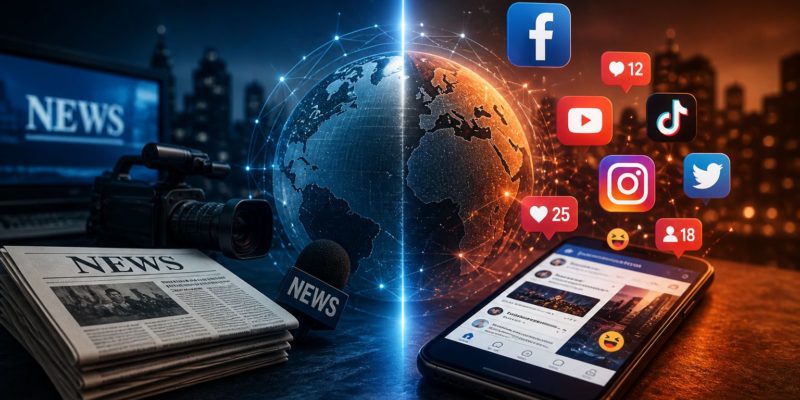
By Ayopopoola, Moyinoluwa Vincent
In today’s hyperconnected world, social media has evolved far beyond a simple communication tool. It has become the digital heartbeat of modern society, shaping how people interact, share ideas, and consume information. From breaking news to viral trends, conversations now unfold in real time, often reaching global audiences within seconds. A single post can spark debate, mobilize communities, or influence public opinion across continents.
RELATED: Truth and misinformation: social media in the Jos crisis


At the same time, media houses continue to play a crucial role as the custodians of credible information. They remain responsible for verifying facts, providing context, and delivering balanced reporting in a world increasingly driven by speed. The relationship between social media and traditional media is no longer separate; it is deeply intertwined, constantly evolving, and often complex. As technology continues to reshape communication, the challenge lies in balancing immediacy with accuracy, and accessibility with responsibility.
The Evolution of Media Communication
The story of modern media is one of continuous transformation, shaped by innovation and changing human needs. In its earliest form, communication was largely oral. Information was shared through town criers, community gatherings, and royal messengers. News traveled slowly, but it carried authority within local communities.
The introduction of the printing press in the 15th century marked a turning point. It made mass communication possible and gave rise to newspapers as a structured means of information sharing. By the 17th and 18th centuries, newspapers had become essential tools for public awareness, documenting political events, social issues, and economic developments.
The Industrial Age further expanded the reach of media through the rise of the Penny Press, which made newspapers more affordable and accessible to the general public. This period democratized information, allowing a broader audience to stay informed.
The 20th century ushered in the Electronic Age, introducing radio and television. These platforms transformed media into a real-time experience, bringing news and entertainment directly into people’s homes. For the first time, audiences could witness events as they happened, creating a stronger emotional connection to global happenings.
The arrival of the internet in the early 1990s marked another major shift. It turned media into a global digital network, enabling instant access to information across borders. This digital foundation eventually paved the way for social media platforms, which would go on to redefine how content is created, distributed, and consumed.
Social Media as the Digital Pulse of Society
Social media platforms such as Facebook, X, Instagram, and TikTok have fundamentally changed the way people engage with the world. These platforms provide instant connectivity, allowing users to share opinions, experiences, and information without barriers.

One of the most powerful aspects of social media is its ability to turn ordinary users into active participants in information sharing. People are no longer passive consumers of news; they are creators, commentators, and distributors. A protest can gain traction online before it materializes on the streets. A breaking story can surface on social media long before it appears on traditional news outlets.
Social media has also amplified voices that were previously unheard. Young people, in particular, have embraced these platforms as tools for expression, advocacy, and civic engagement. Through hashtags, campaigns, and viral content, individuals can raise awareness about social issues, mobilize support, and demand accountability from leaders and institutions.
This democratization of communication has reshaped public discourse. It has made information more accessible, diverse, and immediate. However, it has also introduced new challenges that cannot be ignored.
The Challenge of Misinformation
While social media has made information more accessible, it has also made it more vulnerable to distortion.
The same speed that allows news to spread quickly also enables misinformation to travel just as fast if not faster. Ayopopoola, Moyinoluwa Vincent
Emotional and sensational content often gains more traction than factual reporting. Edited videos, misleading headlines, and unverified claims can circulate widely before they are corrected. This creates confusion, fuels misinformation, and sometimes erodes public trust in credible sources.
The rise of fake news highlights the urgent need for media literacy. Users must learn to question sources, verify information, and think critically about what they consume and share. At the same time, it reinforces the importance of professional journalism, which remains grounded in verification, accountability, and ethical standards.
How Social Media is Reshaping Media Houses
The influence of social media has fundamentally altered the structure and operations of traditional media houses. In the past, media organizations held a near monopoly over information. They controlled how news was gathered, produced, and distributed.
Today, that monopoly no longer exists. Anyone with a smartphone and internet access can report events, share opinions, or broadcast live updates. This shift has created a highly competitive information environment where traditional media must compete not only with each other but also with millions of individual content creators.
Breaking news often appears first on social media, forcing media houses to adapt to faster news cycles. The pressure to remain relevant has pushed many organizations to rethink their strategies, focusing on speed without compromising accuracy.
Social media has also become an essential distribution channel for media houses. Platforms are now used to share news, engage audiences, and amplify stories. Metrics such as likes, shares, comments, and engagement rates have become key indicators of reach and impact.
In addition, the economic model of media has changed significantly. Advertising revenue, once dominated by traditional platforms, has shifted toward digital and social media spaces. This has led media organizations to explore alternative revenue streams, including digital subscriptions, sponsored content, and strategic partnerships.
The Changing Role of Journalism
As the media landscape evolves, the role of journalism is being redefined. The focus is no longer just on being the first to report a story, but on being the most accurate and reliable source of information.
Journalists now operate in an environment where information is abundant but not always trustworthy. Their responsibility is to filter noise, verify facts, and provide context that helps audiences understand complex issues.
This shift places greater emphasis on credibility and trust. In a world where misinformation is widespread, audiences increasingly rely on reputable media houses for clarity and truth. The value of professional journalism lies in its commitment to accuracy, ethics, and accountability.
Striking a Balance Between Speed and Accuracy
One of the biggest challenges in the modern media landscape is balancing speed with accuracy. Social media thrives on immediacy, rewarding content that is timely and engaging. Media houses, on the other hand, are built on principles of verification and responsibility.
Finding the right balance is essential. Reporting too quickly without proper verification can damage credibility, while being too slow can result in losing audience attention. Successful media organizations are those that can navigate this tension effectively, delivering timely news without compromising on quality.
Technology can play a role in achieving this balance. Tools for fact-checking, data analysis, and audience engagement can help media houses stay competitive while maintaining high standards.
The Future of Media in a Digital Age
The future of media will be shaped by how well it adapts to the realities of the digital age. Social media is not going away; it will continue to evolve, influencing how stories are told and consumed.
Media houses that embrace innovation while upholding their core values will remain relevant. They must leverage digital platforms to reach wider audiences, experiment with new formats, and engage with communities in meaningful ways.
At the same time, they must remain committed to the principles that define journalism: accuracy, fairness, and accountability. These values are what distinguish professional media from the vast sea of online content.
Conclusion
Social media represents a defining shift in the evolution of communication. It has broken down barriers, empowered individuals, and transformed the way information flows in society. Yet, with this power comes responsibility.
Media houses remain essential in this landscape. Their role is not just to report news, but to provide clarity in a world filled with noise. By balancing speed with substance and innovation with integrity, they can continue to shape informed societies and meaningful conversations.
Ultimately, while technology may change how stories are told, it is integrity that determines which stories endure. In a fast-moving digital world, credibility remains the most valuable currency, and those who uphold it will continue to lead the future of media.