 By
By 
By Nana Theresa Timothy
When tensions began to rise, information does not wait. It moves fast, faster than official statements, faster than verification, and sometimes even faster than the truth itself. Within minutes, posts, videos, and voice notes flood platforms like Facebook, WhatsApp, and X, shaping public understanding of events long before the full picture becomes clear.


In moments like these, social media becomes more than a communication tool. It becomes a powerful force capable of informing, connecting, and protecting people.
RELATED: Silicon Plateau on life support: How 25 years of crisis is strangling Jos’s thriving tech talent ecosystem
At the same time, however, it can mislead, inflame, and escalate already fragile situations and this was evident during the recent unrest in Jos.
Understanding the Jos Crisis
Jos, the capital of Plateau State in Nigeria, has a long history of ethno-religious tensions. While the recent crisis had specific triggers, the underlying issues remain unclear, even though multiple online posts pointed to ethno-religious differences as a possible cause of the unfortunate incident.
As reports of unrest emerged, residents turned to their phones not only to communicate, but to make sense of what was happening around them. In the absence of immediate verified information, social media quickly became the primary source of updates for many people.
The Positive Side: A Lifeline in Chaos
Despite its risks, social media played a vital role in helping people navigate the crisis.
For many residents, platforms like WhatsApp became emergency communication channels. People shared real-time updates about safe routes, areas to avoid, and locations of security checkpoints. Families checked on loved ones with urgent messages such as “Are you safe?” or “Don’t go out, there’s trouble in this area.”

An example is a post from a Facebook group (Plateau the Beautiful):
“URGENT SECURITY ALERT
All students residing around Angwa Rukuba, Eto Baba, and nearby school environments are strongly advised to stay indoors and restrict movement immediately, Stay safe.”
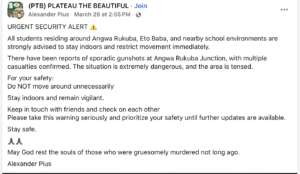
At one point, “Stay safe” became the anthem.
In some cases, local communities organized themselves through social media. Volunteers coordinated support, shared resources, and helped displaced individuals find temporary shelter. Journalists and citizen reporters also used these platforms to amplify updates, attracting national and international attention.
In a crisis where every second matters, this speed of communication saved both time and lives.
The Dark Side: When Misinformation Spreads
But the same speed that made social media useful also made it dangerous.
As the crisis unfolded, unverified posts circulated widely. Old videos from previous conflicts were reshared as though they were current events. Images from unrelated locations were used to fuel fear and anger. Emotional voice notes also spread rapidly, many containing exaggerated or completely false claims.
These pieces of misinformation did not just confuse people they heightened tension. In some cases, they triggered panic, causing residents to flee areas that were actually safe. In others, they fueled anger and led to retaliatory actions based on false narratives.
One critical case involved conflicting figures about casualties during the crisis in Jos. One user on Facebook claimed 26 individuals were killed, while others posted different figures such as 28, 30, and 35.
One of the most dangerous aspects is how quickly such messages spread on platforms like WhatsApp, where information often circulates in closed groups without verification. By the time the truth emerges, the damage is already done.
Why People Believe and Share False Information
To understand the impact of social media during such situations, it is important to first examine how human behavior changes under fear and uncertainty.
In moments of crisis, people develop an intense need for information. They seek clarity, reassurance, and a way to protect themselves and their loved ones. However, this urgency often comes at the expense of critical thinking. When emotions are heightened, decisions become fast rather than careful.
As Daniel Kahneman explains:
A general limitation of the human mind is its imperfect control over attention.” Daniel Kahneman
This limitation becomes more visible during emergencies. Attention narrows, emotions take over, and people act on instinct rather than verification.
For instance, when someone receives a message saying, “Stay indoors, there’s an attack happening nearby,” the immediate reaction is rarely to verify. Instead, the instinct is to forward it not necessarily to spread falsehood, but to warn others quickly.
In emotionally charged environments, fear, anxiety, and anger strongly influence behavior. Social media platforms further amplify this effect, as algorithms prioritize content that triggers strong reactions. As a result, dramatic or alarming posts gain more visibility than calm, verified updates.
This combination of human emotion and algorithmic amplification creates an environment where misinformation does not merely spread, it thrives.
The Role of Authorities and Platforms
During the crisis, government agencies and security forces attempted to provide official updates and reassurance. However, their messages often struggled to match the speed and volume of social media content.
Fact-checking efforts were made, but they faced a major challenge: by the time misinformation was debunked, thousands of people had already seen and shared it.
Social media platforms also have systems to flag or remove misleading content, but these measures are not always fast enough during rapidly evolving crises especially in regions where digital literacy is still developing. Many users may not easily recognize false information when they encounter it.
This gap between information and verification highlights a critical reality: in moments of crisis, speed often wins over accuracy.
Impact on Society
The influence of social media during the Jos crisis extended beyond immediate reactions it affected trust, relationships, and community stability.
Misinformation deepened suspicion among groups, reinforcing existing divisions. People began questioning not only online content but also neighbors and even official authorities.
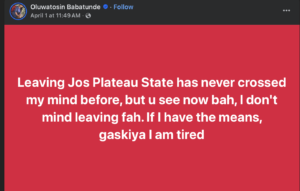
A user on Facebook wrote:
Leaving Jos plateau state has never crossed my mind before, but you see now bah, I don’t mind leaving fah, if I have the means to, gaskiya I am tired” Oluwatosin Babatunde
At the same time, the crisis revealed how dependent society has become on digital platforms for information. When used responsibly, these platforms can unite communities and provide support. When misused, they can divide people and escalate conflict.
The Need for Digital Responsibility
The Jos crisis offers important lessons about social media use during conflict;
- First, there is a strong need for digital literacy. People must learn to question information before sharing it. Even in tense situations, simple actions like checking sources or waiting for official confirmation can make a difference.
- Second, content creators, influencers, and media organizations must prioritize accuracy and balance. In a crisis, every post carries weight.
- Third, authorities need to improve communication speed and clarity online to counter misinformation more effectively.
- Finally, individuals must recognize their responsibility in the information ecosystem. Every share, repost, or forward contributes to how information spreads. Responsible behavior online can help save lives.
A Tool That Reflects Us
Social media did not cause the Jos crisis, but it significantly shaped how it unfolded.
It connected people, provided support, and delivered critical information in real time. At the same time, it spread fear, amplified falsehoods, and deepened tensions. Ultimately, social media is a tool and its impact depends on how it is used.
The real question remains: how will it be used, to help, or to harm?