By
By 
Strategic Partnership Targets Tech-Driven Energy Innovation
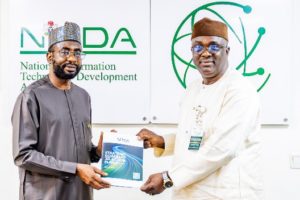
Abdullahi and Olaniyi
The National Information Technology Development Agency (NITDA) and the Research, Technology and Innovation (RTI) Unit of the Nigerian National Petroleum Company Limited (NNPC) are set to deepen collaboration to accelerate digital transformation across Nigeria’s energy sector.
RELATED: AI emerges as critical energy manager for Nigeria’s data centres amid grid instability
The proposed partnership took centre stage during a recent engagement between both organisations. Both entities seek to explore ways to deploy emerging technologies to reposition Nigeria’s oil, gas, and energy value chain.
From Resource Exploitation to Technology Exploration
Speaking at the meeting, NITDA Director General Kashifu Inuwa Abdullahi urged NNPC to priotise transition processes. NNPC must transit from traditional dependence on oil and gas “exploitation” to a future-focused strategy anchored on the “exploration” of advanced technologies. Emerging technologies such as Artificial Intelligence (AI), the Internet of Things (IoT), and robotics are tools modern enterprises need to invest in.
Abdullahi stressed that information technology has become a critical enabler across all sectors,. He noted that innovation will increasingly define energy efficiency, sustainability, and competitiveness.
Digital Sovereignty and Homegrown Innovation in Focus
The NITDA boss outlined the agency’s strategic priorities, which include expanding digital literacy, nurturing local talent, strengthening research ecosystems, and promoting indigenous technology solutions.
According to him, reducing reliance on foreign technologies while encouraging local innovation is essential to achieving digital sovereignty and long-term economic growth.
Linking NNPC to Nigeria’s Startup Ecosystem
Abdullahi also revealed plans for NITDA to support NNPC in building a stronger innovation pipeline by connecting the national energy company with Nigeria’s fast-growing startup ecosystem.
Through incubation programmes, innovation challenges, and collaborative research, startups will be encouraged to develop practical, industry-specific solutions tailored to the oil and gas sector.
He added that NITDA’s youth-focused initiatives, particularly those engaging members of the National Youth Service Corps (NYSC), are already producing innovative solutions to real-world challenges, which could be adapted for the energy industry.

NNPC RTI Seeks Co-Creation Across the Energy Value Chain
Earlier, Director of NNPC RTI Olatomiwa Olaniyi said the engagement was aimed at co-creating solutions and building a strong partnership framework to accelerate innovation across the energy value chain.
He emphasised that sustained collaboration among government agencies, industry stakeholders, and the technology ecosystem is critical to achieving sustainable innovation.
Innovation Framework Targets Efficiency and Growth
Presenting the mandate of the RTI Unit, Olaniyi said its focus is on driving excellence through innovation to improve operational efficiency, boost revenue generation, and support sustainable growth across NNPC’s business areas, including upstream operations, gas, power, and new energy.
He explained that the unit operates a structured innovation framework centred on strengthening research capacity, developing prototypes, attracting talent, fostering partnerships, and embedding a culture of continuous innovation.
Policy Support and Startup Act Implementation Key
Both organisations highlighted the importance of enabling policies and regulatory frameworks in driving innovation. Abdullahi noted that effective implementation of the Nigerian Startup Act will be critical to supporting emerging technology ventures and scaling innovative ideas into commercially viable solutions.
Technology Seen as Catalyst for Energy Sector Transformation
The planned partnership between NITDA and NNPC RTI is expected to strengthen the role of technology and innovation as key drivers of efficiency, diversification, and sustainable growth in Nigeria’s energy sector—positioning the industry for a more resilient, technology-led future.