By
By 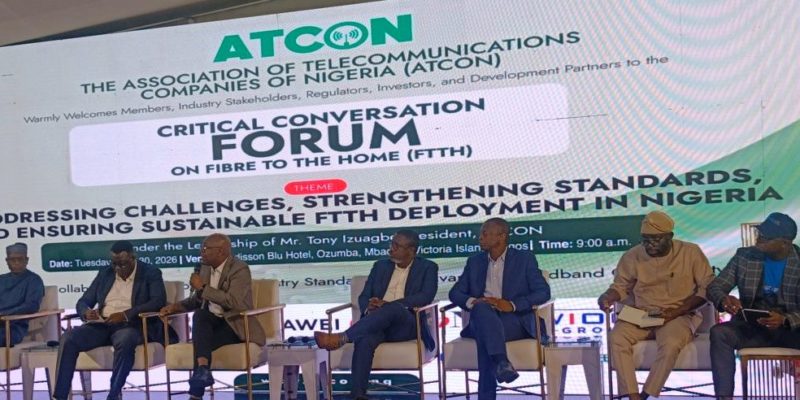
By Dayo Fadairo and Hassan U. Ahmed
Fixed Broadband Bottleneck Threatens Digital Growth
The Nigerian Communications Commission (NCC) has expressed serious concern over Nigeria’s underdeveloped fixed broadband ecosystem.
RELATED: NCC intensifies drive to fix network quality, boost infrastructure and skills as 75 million subscribers receive compensation
It is urging the accelerated deployment of Fibre-to-the-Home (FTTH) infrastructure to address this deficiency. The NCC regards FTTH as a critical enabler of national economic growth.


ALSO READ: NETSCOUT helps reduce fibre-to-the-home costs and customer churn
Speaking at a telecom industry forum organised by the Association of Telecommunication Companies of Nigeria (ATCON) in Lagos, NCC Executive Vice Chairman and CEO, Aminu Maida, said Nigeria’s ambition to build a $1 trillion economy will remain elusive without robust, high-capacity fibre networks.
27,000 Fibre Cuts Expose Infrastructure Crisis
Maida disclosed that telecom operators recorded over 27,000 fibre cuts between January and November 2025, alongside more than 27,000 cases of access denial and over 4,000 theft incidents nationwide.
“These incidents disrupt services, inflate repair costs, undermine network reliability and ultimately discourage investment,” Maida warned.
He added that vandalism and access constraints pose a serious threat to broadband expansion and Nigeria’s digital economy ambitions.
Nigeria’s Fibre Penetration Lags Far Behind
The NCC highlighted a stark broadband deficit:
- Low Penetration: About 265,000–275,000 active FTTH subscriptions nationwide
- Below Africa Average: Less than 2.8% penetration, compared to Africa’s 2.5–2.8% average
- Global Gap: Far behind 47% penetration in mature broadband markets
- Mobile Network Strain: Over-reliance on mobile broadband has driven 170% growth in data demand, worsening congestion and service quality
According to Maida, the figures underscore both the scale of Nigeria’s broadband challenge and the vast opportunity for investment in fixed internet infrastructure.
Key Roadblocks to Fibre Expansion
The NCC identified several persistent barriers slowing FTTH rollout:
- Vandalism and Theft: Tens of thousands of fibre cuts and access denials annually
- Right-of-Way (RoW) Challenges: Fragmented state policies, slow approvals and excessive fees
- Multiple Taxation: Overlapping levies increasing deployment costs
- Planning Gaps: Telecom infrastructure often excluded from urban and real estate planning
Maida stressed that broadband should be treated as a core public utility, not an afterthought.
Government Pushes Structural Interventions
To address these challenges, the NCC and the Federal Government are advancing targeted reforms:
- Project BRIDGE: Deployment of 90,000 kilometres of fibre-optic backbone across all 774 local government areas
- Ease of Doing Business Portal: Centralised tracking of RoW charges and approval timelines across states
- Wholesale Broadband Assessment: Promoting infrastructure sharing among ISPs to lower costs and boost competition
- Quality Enforcement: Crackdown on substandard cable installations that lead to network failures
Maida also revealed that a joint standing committee involving the Federal Ministries of Works, Communications and Digital Economy, and the NCC has been established to protect fibre infrastructure before, during and after road construction.
Protecting Telecom Assets as Critical National Infrastructure
The NCC boss reiterated the need for stronger enforcement of Nigeria’s Critical National Information Infrastructure (CNII) framework, noting ongoing collaboration with security agencies and government institutions to safeguard telecom assets nationwide.
“ Nigeria does not just need fibre. We need fibre that is properly installed, properly documented and properly protected,” he said.
States Urged to Prioritise Digital Infrastructure
On right-of-way reforms, Maida said 13 states have fully waived RoW charges, while 16 others have adopted the nationally recommended rates, urging remaining states to follow suit.
“The economic value of broadband expansion far outweighs revenues from right-of-way charges,” he argued.
Industry Backs Shared Infrastructure Model
Also speaking at the forum, Founder and CEO, Wave5 Wireless Limited Ayọ̀wándé Àdalémọ, advocated a federated infrastructure-sharing model among internet service providers.
According to Adalemo, collaboration could reduce deployment costs, improve service continuity during fibre outages, unlock new revenue streams and accelerate broadband penetration.
“This represents a shift from pure competition to collective innovation,” he said.
Àdalémọ noted that shared infrastructure could extend digital services to millions of Nigerians without duplicating capital expenditure.
Fibre Seen as Backbone of Nigeria’s Digital Economy
Maida concluded by stressing that as homes increasingly become centres for work, learning and service delivery, FTTH remains the most resilient and scalable solution to meet Nigeria’s growing data needs.
“A one trillion-dollar economy depends on productivity, innovation and efficient markets—and all of these rely on fibre,” he said.
COVER PHOTO: BusinessDiary.ng