 By
By 
By Nana Theresa Timothy
The Joint Admissions and Matriculation Board (JAMB) has announced a slight adjustment to the scheduled arrival time for candidates sitting for the 2026 Unified Tertiary Matriculation Examination (UTME), a move widely seen as a response to growing security concerns across parts of the country.
RELATED: JAMB uncovers AI-driven exam fraud syndicate, targets over 100 UTME candidates for sanctions


In a statement shared on its official X (formerly Twitter) page on April 13, the examination body informed candidates of the revised timing, particularly for the first session of the day. The adjustment shifts the arrival time from 6:30 a.m. to 7:00 a.m., while maintaining the examination start time at 8:30 a.m.
Jamb on their x page on 13th of April
“Attention 2026 UTME Candidates: This is to notify you of a slight adjustment to the arrival scheduled time, particularly for the first session, which is now 7:00am as against the earlier published 6:30am, while the scheduled start time for the session is now 8:30 am and end time. Dear Candidates, kindly note that the newly adjusted 2026 UTME timetable for Monday to Thursday examination sessions is also applicable to examination schedules for Saturday. Thank you.”
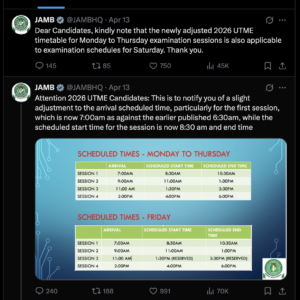
Screenshot of JAMB’s official X update on the revised 2026 UTME schedule.
The announcement also clarified that the updated timetable for Monday through Thursday sessions will now apply to Saturday examinations as well, ensuring uniformity across all testing days.
Security Concerns Prompt Change
Although JAMB did not explicitly state the reason behind the adjustment, the decision comes at a time when security concerns have heightened in several parts of Nigeria. Observers and candidates alike have linked the change to ongoing safety challenges, particularly in areas that have recently experienced unrest.
In cities like Jos, where tensions have escalated in recent weeks due to violent incidents, candidates have voiced fears about traveling long distances in the early hours of the morning. The initial 6:30 a.m. arrival time had raised concerns about exposure to potential risks, especially for those assigned to examination centers far from their homes.
For many candidates, the revised time offers a measure of relief. While the change is only a 30-minute shift, it reduces the need to leave home at extremely early hours, particularly in regions where transportation and security conditions remain unpredictable.

Candidates React on Social Media
Following the announcement, reactions quickly spread across social media platforms, with many candidates welcoming the decision while also calling for further adjustments.
Several candidates from Jos took to X and other platforms to share their experiences and concerns. Some noted that beyond timing, the allocation of distant examination centers remains a major challenge.
“I was posted to a center that is almost two hours away from where I live. With everything happening in Jos recently, leaving home before dawn was honestly scary,” one candidate wrote.
Another candidate highlighted the financial and logistical burden, explaining that insecurity has made transportation both more expensive and less reliable.
Despite these concerns, the adjustment by JAMB has been largely seen as a step in the right direction. Many candidates expressed appreciation that the board appears to be listening to feedback and adapting to current realities.
Ongoing Concerns About Exam Logistics
While the timing adjustment addresses part of the problem, stakeholders say broader issues still need attention. Chief among them is the allocation of examination centers, which often places candidates in unfamiliar or distant locations.
Education analysts argue that in times of insecurity, proximity should be a key consideration in assigning centers. Reducing travel distance not only improves safety but also helps candidates perform better by minimizing stress and fatigue.
Parents have also raised concerns, particularly for younger candidates who may have to navigate unsafe routes alone. Some have called on JAMB to collaborate more closely with local authorities to ensure adequate security around examination venues.
Balancing Examination Integrity and Safety
JAMB has long maintained strict examination protocols designed to uphold the integrity of the UTME. Early arrival times, for instance, are intended to allow for biometric verification and prevent malpractice.
However, the current security climate presents new challenges that require a balance between maintaining standards and ensuring candidate safety.
The recent adjustment suggests that the board is willing to make practical changes where necessary. Still, experts say a more comprehensive review of examination logistics may be needed if insecurity persists.
Final Stretch
As the 2026 UTME approaches, candidates across Nigeria continue their preparations amid mixed feelings of anticipation and concern. While the revised schedule has eased some anxieties, many are hoping for additional measures to address lingering challenges.
For candidates in sensitive areas like Jos, the situation remains particularly delicate. The intersection of academic pressure and security risks underscores the need for responsive and flexible planning by examination authorities.
Ultimately, the success of the UTME this year will depend not only on the preparedness of candidates but also on the ability of institutions like Joint Admissions and Matriculation Board to adapt to evolving circumstances.
For now, the adjusted timing stands as a small but meaningful step one that signals awareness, responsiveness, and a willingness to prioritize the well being of candidates in challenging times.