By
By 
By Osasome, C.O
Nigeria’s digital economy has emerged as a core stabilising force behind President Bola Tinubu’s assertion that the country has moved away from the brink of economic crisis and is on a path to structural recovery.
RELATED: IT Edge News.Africa Report — Nigeria’s Digital Economy Outlook: Q1 2026 Snapshot
As the administration marked its third anniversary, Tinubu said difficult but necessary fiscal and monetary reforms had restored confidence and prevented financial collapse.

“Today, on the occasion of the third anniversary of our administration, I speak to you not only as your President but also as a fellow citizen who understands the sacrifices many families have made in recent years and shares your hopes for a better Nigeria,” Tinubu stated.
ALSO READ: Why WACC 2026 matters now: New report shows Meta injects $820m annually into Nigeria’s digital economy
Data from the National Bureau of Statistics (NBS) and the Federal Ministry of Communications, Innovation and Digital Economy (FMCIDE) strongly indicate that the Information and Communications Technology (ICT) sector has become one of the most resilient pillars of Nigeria’s non-oil growth.
Digital Economy Anchors GDP Growth and Stability
While inflation and cost-of-living pressures persist, the ICT sector has consistently outperformed many traditional industries, acting as a buffer against oil revenue volatility and currency shocks.
- Rising GDP Contribution: The ICT sector contributed 10.07% annually to Nigeria’s real GDP, with quarterly peaks of up to 11.18%, reflecting sustained expansion driven by telecoms, digital platforms, and technology services.
- Non-Oil Growth Engine: The broader non-oil sector accounted for 96.08% of total GDP, underscoring the growing shift away from hydrocarbon dependence.
- Medium-Term Ambition: Under the policy roadmap of Minister Bosun Tijani, the administration is targeting 21% GDP contribution from ICT over the medium term through infrastructure, skills, and regulatory reforms.
Foreign Capital Flows Signal Renewed Investor Confidence
A central plank of the administration’s stabilisation narrative is the return of foreign investment—particularly into the digital economy.
- FDI Surge: Foreign Direct Investment into communications and the digital economy jumped from $22 million in Q1 2023 to $191 million in Q1 2024, a nearly ninefold increase.
- Strategic Global Funding: Nigeria also secured a €45 million European Union Digital Economy Package under the Global Gateway initiative to strengthen foundational digital infrastructure and regional connectivity.
These inflows have reinforced external reserves and improved Nigeria’s balance-of-payments outlook.
Infrastructure Rollout Backs Trillion-Dollar Economy Vision
To translate digital growth into long-term macroeconomic stability, the government has prioritised large-scale infrastructure deployment.
- Project BRIDGE: The Nigeria Sovereign Fibre Project aims to roll out 90,000 kilometres of fibre-optic cable, expanding broadband penetration nationwide.
- Rural Connectivity: The Federal Executive Council approved 4,000 new telecom towers to close digital gaps in rural and security-challenged areas, improving inclusion and productivity.
Human Capital Development and Global Talent Export
The digital economy strategy places strong emphasis on people as economic assets.
- 3MTT Programme: The 3 Million Technical Talent (3MTT) initiative is training Nigerians in software engineering, AI, cloud computing, and data science.
- Global Job Pipelines: Partnerships with international talent platforms are positioning Nigeria as a net exporter of digital skills, supporting remittances and employment.
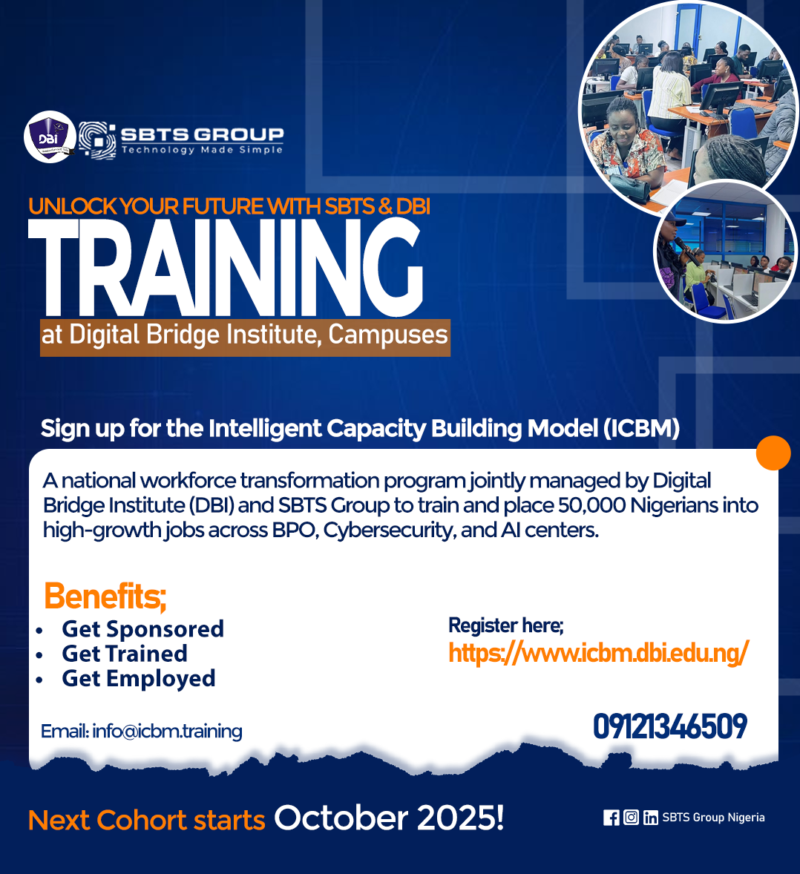
- The Intelligent Capacity Building Model (ICBM) initiative, a national workforce transformation program in Nigeria jointly managed by the Digital Bridge Institute (DBI) and SBTS Group, a US-based technology and consulting firm
AI Adoption and E-Governance Drive Efficiency
Digital transformation of government operations is another stabilising factor.

- Digitised MDAs: Tinubu directed all Ministries, Departments, and Agencies to transition from manual systems to data-driven digital operations, improving transparency and efficiency.
- AI-Powered Public Services: Through collaboration with global technology firms, government launched AI-enabled platforms such as GovGuide Nigeria to improve citizen access to services.
Macroeconomic Indicators Reinforce Recovery Claims
Beyond the digital sector, the administration points to broader economic signals:
- External Reserves: Stabilised at around $23 billion.
- GDP Growth: Sustained by services and non-oil activities.
- Trade Balance: Consecutive trade surpluses recorded.
- Capital Markets: The Nigerian Stock Exchange All Share Index surged from 53,000 in 2023 to about 250,000, with market capitalisation rising from ₦30 trillion to ₦160 trillion.
The Paradox: Digital Growth Amid Household Pressure
Despite these gains, challenges remain. Fuel subsidy removal and foreign exchange unification have increased living costs, while growth remains uneven across labour-intensive sectors such as agriculture.
Tinubu acknowledged the strain on households but maintained that the reforms were unavoidable.
“We chose reform over ruin,” he said,
The President insisted that early signs show the sacrifices are beginning to pay off.
Digital Economy as the Backbone of Recovery
Ultimately, Nigeria’s digital economy has become the backbone of macroeconomic stabilisation, cushioning fiscal reforms, attracting foreign capital, and driving GDP growth.
Translating digital-led growth into inclusive, everyday economic relief remains the central policy challenge ahead. Policymakers must ensure that technology-driven billions actually improve livelihoods, reaching households, regions, and sectors that have yet to feel the benefits of digital expansion.