By
By 
Markets are questioning the payoff of massive AI infrastructure spending. The conversation is no longer about hype. It’s about measurable revenue growth across the AI stack.
RELATED: Leveraging artificial intelligence for business growth: Blending innovation with purpose
In this context, BestBrokers lays out the details in its latest report on the fastest-growing companies by AI revenue and the supply chain segments driving the next phase of AI expansion.
Over the past three years, the AI build-out has translated into rapid revenue acceleration across semiconductor designers, memory producers, hyperscale cloud platforms, and emerging infrastructure providers.


Companies leading in AI-related revenue
To analyse these trends, the team at BestBrokers compiled and standardised AI-related revenue or the closest disclosed segment data from StockAnalysis across 20 publicly listed companies operating within the global AI supply chain.
The data shows how monetisation is distributed across the ecosystem and which segments have captured the strongest growth between 2022 and 2025. The data we collected can be accessed on Google Drive via this link.
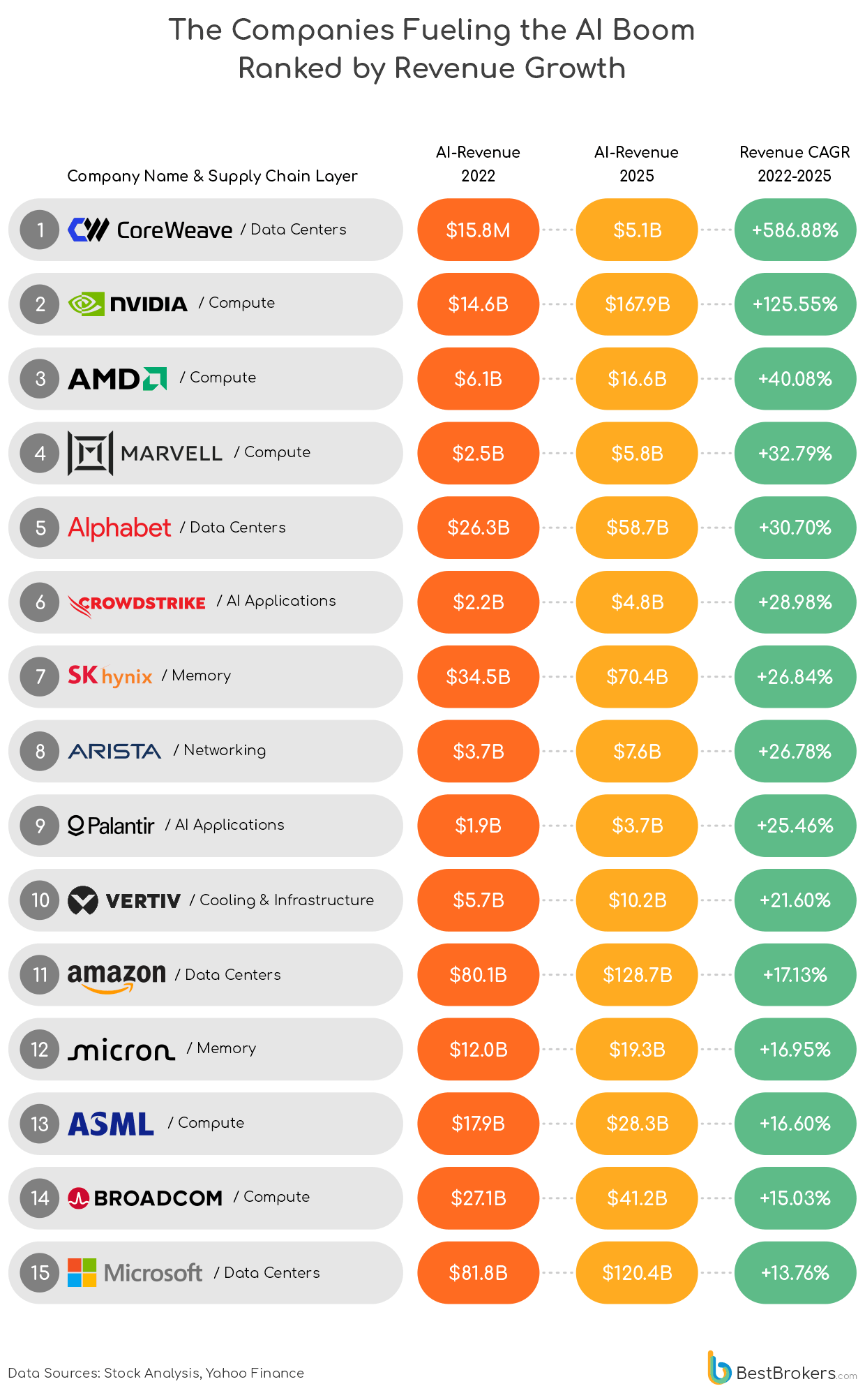
Data shows that NVIDIA increased its data centre and AI-related revenue the most, by more than $150 billion from 2022 to 2025. In calendar year 2022, it generated $14.6 billion in AI-related sales, compared to $167.9 billion in 2025.
When we look at the compound annual growth rate (CAGR), however, which eliminates the effect of volatility over a longer period of time, AI cloud-computing company and key NVIDIA partner CoreWeave posted the most significant growth, a 586.88% CAGR between 2022 and 2025.
The Companies That Profited the Most From The AI Boom Between 2022 and 2025
- CoreWeave / Data Centers – $15M to $5.13B – 586.88% growth
- NVIDIA / Compute – $14.6B to $167.9B – 125.55% growth
- AMD / Compute – $6.1B to $16.63B – 40.08% growth
- Marvell Technology / Compute – $2.5B to $5.82B – 32.79% growth
- Alphabet / Data Centers / Hyperscalers – $26.3B to $58.7B – 30.70% growth
- CrowdStrike / AI Applications – $2.2B to $4.81B – 28.98% growth
- SK Hynix – Memory – $34.5B to $70.4B – 26.84% growth
- Arista Networks / Networking – $3.7B to $7.58B – 26.78% growth
- Palantir Technologies / AI Applications – $1.9B to $3.74B – 25.46% growth
- Vertiv Holdings / Cooling & Infrastructure – $5.7B to $10.23B – 21.60% growth
Other highlights from our report
- NVIDIA led the AI revenue expansion cycle in terms of sheer monetary growth, with AI-related revenue rising from $14.6B in 2022 to $167.9B in 2025, up $153.3 billion (+125.55%) within just 3 years. The surge reflects its position as the dominant supplier of GPUs powering training and inference workloads across hyperscale and enterprise AI systems.
- CoreWeave recorded the fastest growth in the dataset, seeing its revenue rise from just $15.8 million in 2022 to $5.13 billion over the same period (+586.88% CAGR). The rise reflects the rapid emergence of GPU-as-a-service infrastructure as hyperscalers and AI labs outsourced compute capacity amid tightening supply.
- Semiconductor and computing service providers saw broad-based but uneven growth. AMD increased from $6.1B to $16.6B (+40.08%), Marvell Technology from $2.5B to $5.8B (+32.79%), and Broadcom from $27.1B to $41.2B (+15.03%), reflecting demand for GPUs, custom silicon, and interconnect systems supporting large-scale AI clusters.
- Memory and bandwidth constraints became increasingly structural. South Korean semiconductor company SK Hynix grew from $34.5B to $70.4B (+26.84%), the United States’ Micron from $12.0B to $19.3B (+16.95%), and Samsung Electronics from $76.2B to $94.3B (+7.36%), driven by accelerating demand for high-bandwidth memory used in model training.
Networking wins big, hyperscalers expand, AI monetisation accelerates from a smaller base
- Networking and infrastructure providers captured steady upside from data centre scaling. Arista Networks expanded from $3.7B to $7.6B (+26.78%), while Vertiv rose from $5.7B to $10.2B (+21.60%), reflecting rising demand for high-speed connectivity and advanced cooling systems in high-density AI environments.
- Hyperscale cloud platforms showed strong absolute expansion but more moderate percentage growth. Amazon increased from $80.1B to $128.7B (+17.13%), Microsoft from $81.8B to $120.4B (+13.76%), and Alphabet from $26.3B to $58.7B (+30.70%), reflecting AI being layered into already diversified cloud, enterprise, and advertising businesses.
- At the application layer, AI monetisation is still scaling from a smaller base but accelerating rapidly. Palantir Technologies grew from $1.9B to $3.7B (+25.46%), while CrowdStrike increased from $2.2B to $4.8B (+28.98%), reflecting growing enterprise adoption of AI-enabled security, analytics, and decision systems.
What looks like software disruption is actually industrial construction
‘What we’re seeing is less of a software revolution and more of an industrial build-out. As AI application companies continue to scale, so do the chipmakers, memory manufacturers, and infrastructure companies. The AI economy runs on physical bottlenecks, and the market is rewarding whoever can remove them’
– comments Paul Hoffman from BestBrokers.com.
Additional information on VC investments, major AI deals, and the full research methodology is available in the complete report. The dataset was compiled from StockAnalysis and company-reported financial disclosures, focusing on AI-relevant revenues, companies’ monetisation of the AI boom across the supply chain, and related stock performance trends for publicly listed firms operating within the global AI ecosystem.
The raw dataset is also available on Google Drive at the following link.