By
By 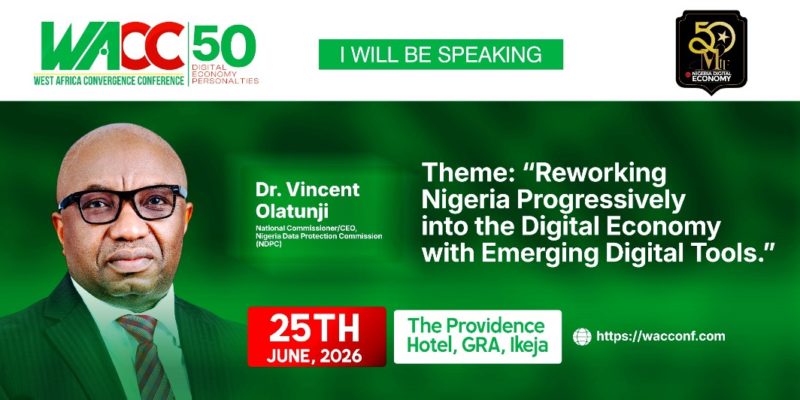
Digital Economy, Politics and Regulation Converge at WACC 2026
As Nigeria intensifies preparations for the 2027 general elections, technology policy, political leadership and digital economy regulation will converge at the West Africa Convergence Conference (WACC) 2026 and the 50 Most Influential Figures in Nigeria’s Digital Economy, scheduled for June 2026 in Lagos.
RELATED: Why WACC 2026 matters now: New report shows Meta injects $820m annually into Nigeria’s digital economy
Now in its 15th edition, WACC 2026 comes at a defining moment for Nigeria’s fast-growing digital economy, where innovation, investment, and political governance increasingly depend on strong regulatory trust frameworks—especially around data protection and privacy compliance.
ALSO READ: Yilwatda, Takang, Olatunji, Abdullahi and Nnamani to shape Nigeria’s digital economy discourse ahead of 2027 at WACC 2026
NDPC’s Strategic Role in Nigeria’s Digital Future
With digital services expanding across fintech, telecoms, e-commerce, healthtech, and public-sector platforms, the Nigeria Data Protection Commission (NDPC) is emerging as one of the most critical regulators shaping investor confidence and citizen trust.

At the centre of WACC 2026’s regulatory discourse, Dr. Vincent Olatunji, National Commissioner/CEO of the NDPC, will deliver an Executive Regulatory Address titled:
“From Awareness to Accountability: Strengthening Data Protection Compliance in Nigeria’s Digital Economy.”
The address will examine how Nigeria can balance rapid digital growth with enforceable privacy standards under the Nigeria Data Protection Act (NDPA) 2023.
From Data Awareness to Enforceable Accountability
The NDPC is driving a decisive shift from voluntary compliance to mandatory accountability across Nigeria’s digital ecosystem. Under the NDPA 2023, organisations are now required to formally register, implement privacy governance frameworks, and appoint certified Data Protection Officers (DPOs).
According to Dr. Olatunji, WACC provides a critical platform for reinforcing a national culture of privacy compliance and accountability, particularly as digital platforms increasingly intersect with governance, elections, and public trust.
Key Pillars Shaping Nigeria’s Data Protection Ecosystem
1. Building Institutional Capacity
- National Identity Security: In collaboration with the National Identity Management Commission (NIMC), the NDPC has trained and certified nearly 4,000 staff members as DPOs to secure Nigeria’s core identity databases.
- Workforce Development: Ongoing certified training programmes across ministries, agencies, and state governments—including initiatives in Ekiti and Anambra States—are addressing the national shortage of qualified privacy professionals.
- Public–Private Alignment: Strategic MoUs with regulators such as the National Broadcasting Commission (NBC), Bureau of Public Procurement (BPP), and the Nigeria Governors’ Forum (NGF) are embedding privacy compliance across government operations.
2. Enforcing the Accountability Mandate
- Mandatory Registration: Data Controllers and Processors of Major Importance (DCPMIs) must register with the NDPC under the NDPA 2023.
- Stronger Enforcement: Organisations that mishandle personal data face audits, enforcement orders, and administrative fines of up to ₦10 million or 2% of annual gross revenue.
- Data Subject Rights: Citizens now enjoy enforceable rights, including access, rectification, and erasure, compelling organisations to maintain documented proof of lawful data processing.
3. Safeguarding the Next Digital Generation
- Child Online Protection: Through collaborations with global platforms such as Meta, the NDPC is advancing a duty-of-care framework to protect children online.
- Ethical Skills Development: Initiatives like Microsoft AI Skills Week support ethical data use and privacy-conscious innovation, reinforcing trust in emerging technologies.
Technology, Politics and Investment Alignment
The keynote address and headline policy colloquium at WACC 2026 will be delivered by Nentawe Yilwatda, National Chairman of the All Progressives Congress (APC), under the theme:
“Leveraging Technology for Development in Nigeria, 2027–2031: Delivering the Renewed Hope Agenda.”

Yilwatda has described WACC as a strategic platform for aligning technology-driven development with Nigeria’s post-2027 governance priorities.
Regulation as a Catalyst for Investment Confidence
Investment-focused discussions will also feature Armstrong Ume Takang, CEO of Ministry of Finance Incorporated (MOFI), the Strategic Partner of WACC 2026.
On the IT regulatory front, Kashifu Inuwa Abdullahi, Director General of National Information Technology Development Agency (NITDA), will deliver an Executive Regulatory Address titled:
“Digital Convergence and the Confidence Mandate: NITDA’s Vision for a Competitive, Innovative and Trusted Nigerian IT Ecosystem.”
Data Protection at the Heart of Nigeria’s $1 Trillion Ambition
As Nigeria targets a $1 trillion GDP by 2036, the digital economy has become a stabilising pillar of economic recovery. President Bola Ahmed Tinubu has repeatedly underscored the sector’s role in driving productivity, attracting foreign investment, and supporting structural reforms.
At WACC 2026, the NDPC’s strategic role highlights a growing reality: without strong data protection enforcement, Nigeria’s digital growth risks eroding public trust, investor confidence, and democratic resilience ahead of the 2027 elections.