By
By 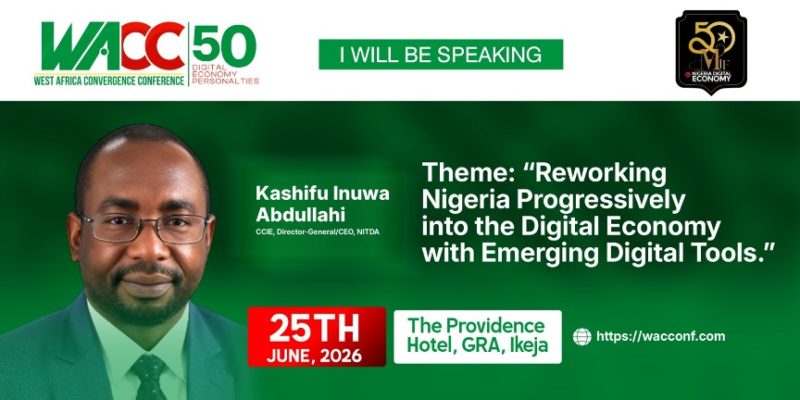
With the 2027 general elections on the horizon, Nigeria’s political leadership, regulatory direction, and digital economy strategy will intersect at the 15th West Africa Convergence Conference (WACC) 2026 and the 50 Most Influential Figures in Nigeria’s Digital Economy, set for Lagos in June 2026.
RELATED: WACC 2026: NDPC takes centre stage as data protection pressures mount in Nigeria’s rapidly expanding digital economy
The twin events will explore how emerging digital technologies can drive inclusive growth, governance reform, and national competitiveness.
ALSO READ: WACC 2026: Nentawe Yilwatda charts APC’s vision at Lagos convergence of tech, policy, and politics ahead of 2027 polls
Discussions will also centre on ensuring compliance with Nigeria’s evolving regulatory landscape. Key areas of focus include data protection, cybersecurity, and digital governance frameworks.

ALSO RELATED: Takang leads MOFI’s strategic investment push at WACC 2026 as Nigeria charts digital economy path for 2027–2031
ICT now accounts for over 18 per cent of Nigeria’s GDP. Against this backdrop, WACC 2026 serves as a high-level forum where technology, policy, and politics converge. The conference is set to influence the direction of Nigeria’s digital economy beyond 2027.
NITDA at the Heart of Nigeria’s Digital Governance Conversation
Policy dialogue at WACC 2026 will focus on IT regulation and standardisation, local content development, IT project clearance, cybersecurity and internet governance, digital literacy, and digital skills development. The National Information Technology Development Agency (NITDA) will be central to these discussions. The Agency’s participation is expected to shape the direction of Nigeria’s digital governance framework.
The Director General and Chief Executive Officer of NITDA, Kashifu Inuwa Abdullahi, will deliver an Executive Regulatory Address titled:
“Digital Convergence and the Confidence Mandate: NITDA’s Vision for a Competitive, Innovative and Trusted Nigerian IT Ecosystem.”
The address is expected to outline key strategies for sustaining Nigeria’s digital economy momentum. These include regulatory clarity, standards enforcement, skills development, and trust infrastructure. Together, these pillars aim to maintain investor confidence and encourage continued investment in the sector.
Driving Regulation, Skills and Local Innovation
As the federal agency responsible for implementing Nigeria’s ICT policy, NITDA has emerged as a cornerstone institution in the country’s digital transformation agenda. Under Abdullahi’s leadership, the agency is executing its Strategic Roadmap and Action Plan (SRAP 2.0) across several critical pillars:
- Digital Literacy and Capacity Building: Scaling digital fluency nationwide with the ambition to skill over 50 million Nigerians, including flagship interventions such as the 3 Million Technical Talent (3MTT) programme.
- IT Regulation and Standardisation: Enforcing standards, clearing public-sector IT projects, and reducing duplication to improve efficiency and value-for-money in government technology spending.
- Local Content Development: Strengthening indigenous technology adoption and ensuring Nigerian participation across the digital value chain.
- Cybersecurity and Internet Governance: Deepening digital trust through policy coordination, cyber resilience frameworks and secure authentication systems.
- Emerging Technologies and AI Integration: Promoting homegrown applications of artificial intelligence across healthcare, agriculture, finance and public services.
Through SRAP 2.0, NITDA is working to bridge Nigeria’s digital divide by promoting inclusive access to digital infrastructure. The Agency is also collaborating with global hyperscalers to ensure Nigerian data is locally hosted.

Startup Growth, Trust and the Nigerian Digital Future
A major focus of NITDA’s engagement at WACC 2026 will be its role in implementing the Nigerian Startup Act, which provides legal certainty, incentives and an enabling environment for tech entrepreneurs.
The agency’s focus on cybersecurity and digital trust is strengthened by its operation of Nigeria’s National Public Key Infrastructure (PKI). This system provides a foundation for secure digital transactions. It enables authentication across a wide range of digital services in the country.
Abdullahi has consistently reflected on Nigeria’s digital future. He stresses that human capital will define national competitiveness rather than natural resources. This perspective underpins his vision for the country’s long-term digital growth and innovation agenda.
“Nigeria’s greatest resource is not oil but its people. Our ability to develop digital talent, foster innovation and create enabling ecosystems will determine our competitiveness in the digital age,” he said, underscoring why platforms like WACC are critical to advancing national digital priorities.
Technology, Politics and Policy Alignment
The keynote policy colloquium at WACC 2026 will be delivered by Nentawe Yilwatda, National Chairman of the All Progressives Congress (APC), under the theme:
“Leveraging Technology for Development in Nigeria, 2027–2031: Delivering the Renewed Hope Agenda.”
Yilwatda stated that WACC aligns closely with the APC’s vision for inclusive growth and long-term national development. He described the conference as a credible platform for meaningful engagement.
The forum brings together policymakers, investors, innovators, and ecosystem builders to discuss technology-driven governance beyond 2027.
Investment, Regulation and Operator Insights
Investment-focused discussions at WACC 2026 will be driven by Ministry of Finance Incorporated (MOFI), led by its Chief Executive Officer, Dr. Armstrong Ume Takang, the Strategic Partner of the conference.
On the regulatory front, Nigeria Data Protection Commission (NDPC) will deliver insights on strengthening accountability and compliance in Nigeria’s data-driven economy.
Operator perspectives will be provided by industry leaders including Internet Exchange Point of Nigeria (IXPN), Digital Realty Nigeria, and PFS Limited, reflecting how infrastructure, data centres and payments convergence are reshaping Nigeria’s digital services landscape.
Recognising Digital Economy Trailblazers
WACC 2026 will also host the 50 Most Influential Figures in Nigeria’s Digital Economy Awards, recognising individuals and institutions driving innovation, regulation, investment and capacity building across Nigeria’s digital ecosystem.
Why WACC 2026 Matters Now
With Nigeria’s digital economy emerging as a stabilising pillar of national growth and the country approaching a decisive election cycle, WACC 2026 stands out as a policy-shaping and investment-defining forum.
Regulators like NITDA will take centre stage at the conference. The goal is to translate strategy, regulation, and skills development into coordinated national action. This should help build stronger confidence in Nigeria’s digital future.