By
By 
By Osasome, C.O
Nigeria’s Market Reform Reaches a Critical Inflection Point
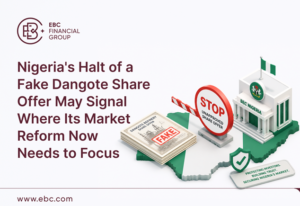
Nigeria’s decision to halt a fake share offer linked to Dangote Petroleum Refinery is about more than stopping a single fraudulent promotion. It signals a deeper challenge confronting the country’s capital-market reforms: as trading systems become faster through digital technology, regulatory scrutiny and conduct enforcement must become even stronger.


RELATED: Digital technology powers Nigeria’s capital market shift to T+1 settlement cycle
In less than seven months, Nigeria compressed its securities settlement cycle from T+3 to T+1—meaning eligible trades now settle within one business day. The reform, powered by upgraded digital infrastructure, was designed to boost efficiency, liquidity and global competitiveness. But the Dangote incident shows that speed without strict oversight can amplify risk rather than reduce it.
Why Faster Digital Settlement Raises the Stakes
According to David Precious, Senior Market Analyst at EBC Financial Group, the T+1 settlement framework is fundamentally sound. However, shorter settlement timelines leave far less room to detect misconduct after a transaction has begun.

David Precious, Senior Market Analyst, EBC Financial Group
“Completing a trade in one day instead of three makes the market run more smoothly,” Precious said. “The trade-off is that it leaves less time to catch a fake offer before money changes hands. That makes pre-approval checks more critical than ever.”
In a digitally accelerated market, errors and misconduct can cascade quickly. Once funds move, reversing damage becomes significantly harder—especially when licensed intermediaries are involved.
The SEC Intervention That Changed the Conversation
On 23 June 2026, the Securities and Exchange Commission issued a cease-and-desist order clarifying that no initial public offering (IPO) application had been filed or approved for Dangote Petroleum Refinery and Petrochemicals FZE.
More concerning was the SEC’s finding that licensed capital-market operators—including stockbrokers and digital investment platforms—had collected advance payments from investors for the unapproved offer. The regulator ordered immediate refunds within 24 hours and warned of sanctions under the Investments and Securities Act 2025.
The timing was significant. The directive came less than a month after Nigeria’s T+1 settlement officially went live on 1 June 2026, highlighting how conduct failures can become more damaging in faster markets.
From Technology Reform to Conduct Reform
So far, Nigeria’s capital-market reforms have focused heavily on infrastructure and rules:
- Shorter settlement cycles
- Upgraded clearing and settlement systems
- A modernised securities law
This episode suggests the next reform frontier is behaviour. The weakness did not lie in the trading technology itself but in the actions of licensed intermediaries operating on top of it.
When regulated firms—rather than anonymous fraudsters—solicit funds for unapproved offers, the credibility of the entire market is put at risk. In a T+1 environment, there is little margin to correct such failures after the fact.
Why Trusted Brands Can Be the Biggest Risk
The fake Dangote offer spread partly because it seemed plausible. A genuine Dangote listing had long been anticipated, making the rumour easy to believe. Trusted brand names and widely expected deals are precisely where verification matters most—yet they are often where investors and intermediaries feel least compelled to double-check.
The SEC’s findings shift the focus away from investor naivety and toward intermediary accountability. This was not just a case of online misinformation; it involved regulated entities moving ahead of regulatory approval.
Investor Confidence Is the Bigger Prize
Nigeria has spent the past year rebuilding investor confidence through currency reforms, improved reserves and a sovereign credit rating upgrade. The move to T+1 settlement fits neatly into that modernisation narrative.
However, investors—local and foreign—do not separate market technology from market conduct. To them, system efficiency and operator integrity are a single risk equation. A fast, modern trading platform loses its appeal if licensed operators can still collect money for offers that do not exist.
This is why the SEC’s reliance on the Investments and Securities Act 2025 matters. As one of the first major enforcement actions under the new law, it sets an early tone for how misconduct will be treated in Nigeria’s faster, more digital market.
What This Means for Platforms and Market Operators
The lesson is not to slow reform but to embed safeguards into the system itself. In a one-day settlement environment, verification cannot be an afterthought. It must function as a real-time control at every stage—promotion, onboarding and payment.
The implied standard is clear:
- No funds should be collected
- No accounts opened
- No shares promised
Until an offer has been formally filed, reviewed and approved by the regulator.
The Real Test of Nigeria’s Digital Market Reform
“Nigeria’s move from three-day to one-day settlement is a major achievement,” Precious noted. “The real test now is whether licensed intermediaries can be trusted to act properly when there is far less room to correct mistakes.”
As Nigeria’s capital market accelerates through digital reform, regulatory oversight must evolve just as quickly. Speed may define the future of trading—but trust will determine whether that future is sustainable.