By
By 
By Osasome, C. O
President Bola Ahmed Tinubu has signed into law the repealed and re-enacted National Identity Management Commission (NIMC) Act, 2026, marking a major milestone in strengthening Nigeria’s digital identity and trust infrastructure.

RELATED: NIMC, NDPC train 4,000+ staff nationwide to strengthen data protection and NIN security
The new legislation completely repeals and replaces the 19-year-old NIMC Act of 2007, transforming the Commission from a basic identity registration agency into a central regulator of Nigeria’s digital trust architecture and Digital Public Infrastructure (DPI).
RELATED: All telecom operators now on NINAuth platform, says NIMC
The signing ceremony took place at the Presidential Villa, Abuja, with the President of the Senate, Godswill Akpabio, and other top government officials in attendance.
A Modern Law for a Digital Nigeria
Announcing the development, President Tinubu said the former law was designed for a different era and could no longer support Nigeria’s digital ambitions.
“For nearly twenty years, Nigeria’s identity system operated under a law written for a different era. That era is over. This new Act gives our country a modern, secure, inclusive and digital identity framework fit for the Nigeria we are building—a Nigeria on the path to becoming a one-trillion-dollar economy,” the President stated.
NIMC Now Central to Digital Trust Architecture
Under the NIMC Act 2026, the Commission is empowered to harmonise identity records, synchronise government databases, and enforce interoperability across public and private institutions.
According to the President, the law formally positions NIMC at the heart of Nigeria’s Digital Public Infrastructure (DPI) and National Public Key Infrastructure (PKI), providing the trust foundation for verified identities, secure transactions, digital signatures, and the broader digital economy.
Security Gains Already Emerging
Senate President Akpabio confirmed that NIMC–Ministry of Interior database integrations are already yielding national security dividends. The enhanced data sharing, he told journalists, is strengthening identity verification and security coordination.
“Just last week, we were able to apprehend terrorist chiefs arriving from Saudi Arabia. Once their names were entered into the system, their criminal records were revealed, and they were arrested,” he said.
Key Reforms Under the NIMC Act 2026
The new law introduces far-reaching reforms designed to strengthen identity management, security, and inclusion:

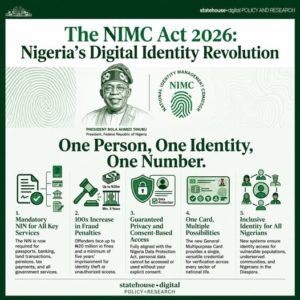
- Root Certification Authority: Establishes NIMC as Nigeria’s foundational authority for the National PKI and DPI.
- Database Interoperability: Mandates the harmonisation and synchronisation of identity records across all ministries, departments, agencies, and relevant private institutions.
- Stronger Legal Mandate: Confirms the National Identification Number (NIN) as the definitive anchor for identity verification nationwide.
- Data Privacy Guardrails: Aligns identity operations with the Nigeria Data Protection Act, reinforcing consent, lawful access, and purpose limitation.
- Strict Anti-Fraud Measures: Introduces tougher penalties for identity theft, multiple registrations, and unauthorised system access.
- General Multipurpose Card: Officially backs the “One Card, Multiple Possibilities” model for physical and digital transactions.
- Inclusive and Global Reach: Expands access for vulnerable groups and Nigerians in the Diaspora.
Strengthening Governance and Accountability
The Act also strengthens governance by expanding representation on the NIMC Board. This will help in improving institutional accountability, and tightening sanctions against system abuse.
“We will not tolerate those who forge identities, steal the identities of others, or exploit the system,” President Tinubu warned.
NIMC DG Commends Presidential Assent
The Director-General of NIMC, Abisoye Coker-Odusote, praised the President for signing the Act. She noted that it firmly positions Nigeria for a future driven by innovation, trust, and inclusion.
Coker-Odusote described the law as a critical enabler of secure digital services across sectors. From finance and telecommunications to governance and social protection, there is now an Act for secured digital services.
NIN as Gateway to Critical Services
President Tinubu explained that with the new law, the National Identification Number will serve as a stronger gateway to essential services, including passports, voter registration, bank accounts, land transactions, telecommunications, pensions, insurance, taxation, consumer credit, and government services.
“One person. One identity. One number,” the President declared.
He added that specific instructions have been given to ensure the law protects the vulnerable, the underserved, and Nigerians in the Diaspora.
“No Nigerian should be locked out of opportunity because they lack a trusted identity,” he said.
National Impact and Economic Outlook
According to the State House, the NIMC Act 2026 represents a legislative cornerstone for Nigeria’s ambition to build a $1-trillion economy.
Early results from database synchronisation efforts are already supporting border security and counter-terrorism operations, underscoring the Act’s immediate national impact.
“Together, we are building a more secure, inclusive and prosperous Nigeria. This is the Renewed Hope Agenda at work,” President Tinubu concluded.