By
By 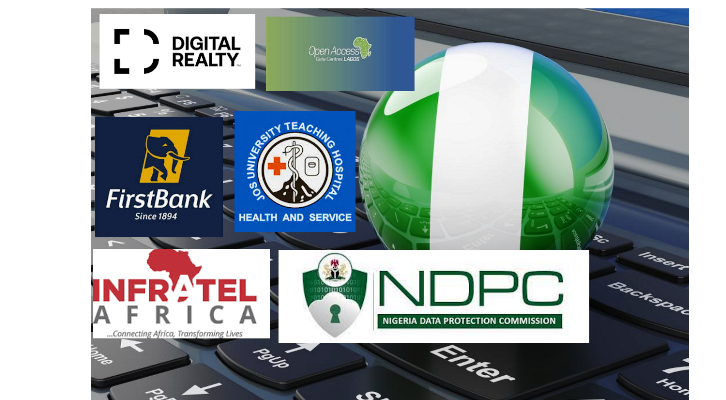
SPECIAL REPORT:
Nigeria’s Digital Economy at an Inflection Point: How Regulators, Banks, Healthcare and Infrastructure Leaders Are Powering Transformation in 2026
Nigeria’s Digital Economy Outlook: Q1 2026 Snapshot
As of Q1 2026, Nigeria’s digital economy is entering a decisive acceleration phase contributing an estimated 20% to national GDP. It is projected to generate $18.3 billion in revenue by the end of 2026. This growth is being shaped by three defining forces. They are tighter regulatory compliance, rapid expansion of digital infrastructure, and deepening technology adoption across critical sectors such as finance and healthcare.

RELATED: Nigeria digital economy diagnostic: A plan for building Nigeria’s inclusive digital future
At the centre of this transformation are cross-sector institutional actors. Their collective impact is redefining trust, access, resilience, and competitiveness within Nigeria’s digital economy.
Institutional Focus – IT Edge News.Africa Q1 2026 Report
Regulation as a Trust Anchor: Nigeria Data Protection Commission
Data protection has evolved from a compliance requirement into a strategic pillar of Nigeria’s digital economy. The Nigeria Data Protection Commission (NDPC) has emerged as a central trust-building institution, anchoring investor confidence and citizen protection.
By Q1 2026, the Commission had generated over ₦5.2 billion in compliance-related revenue. Nigeria’s data protection ecosystem is now valued at more than ₦16.2 billion. In a landmark enforcement move, the NDPC initiated sector-wide compliance investigations across 649 tertiary institutions. This action is reinforcing the reach of the Nigeria Data Protection Act, 2023.
Beyond enforcement, the Commission has driven capacity-building for Data Protection Officers (DPOs). It has launched the National Data Challenge for secondary schools. The Commission has equally pioneered sub-national data privacy governance models—particularly in northern Nigeria. Under the leadership of Dr Vincent Olatunji, the NDPC is steadily embedding privacy, accountability, and transparency into Nigeria’s digital growth narrative.
Digital Finance and Enterprise Transformation: FirstBank Nigeria
As confidence and resilience become defining currencies of economic growth, FirstBank continues to play a pivotal role in redefining Nigeria’s digital financial services landscape.
In Q1 2026, the Bank deepened automation across its service channels, sustaining a fully automated Digital Experience Centre powered by artificial intelligence and humanoid robotics. With over 15 million active users on its *894# USSD platform and more than 3 million users on its FirstMobile app, FirstBank is scaling secure, AI-driven banking while reducing physical branch congestion.

Beyond transactions, the Bank is strengthening fraud prevention, enterprise digitisation, and customer experience. The Bank is cementing its role as both a financial institution and a digital transformation enabler within Africa’s largest economy.
Healthcare Innovation Beyond the Coast: Jos University Teaching Hospital
Innovation leadership in Nigeria’s digital economy is no longer confined to commercial hubs. Jos University Teaching Hospital (JUTH) stands out as a national model for technology-led healthcare reform.
Once challenged by fragmented and missing patient records, JUTH has undergone a sweeping digital transformation under the leadership of Dr Pokop Wushipba Bupwatda. By Q1 2026, the hospital had integrated biomedical informatics, genetics, and digital diagnostics into routine clinical practice. All of these have significantly improve care coordination and outcomes. JUTH now leverages radio communication-systems to provide real-time visibility into space availability, effectively closing gaps between operational-performance and work-assessment.
JUTH also partnered with the Federal Ministry of Health to deliver North-Central free cancer screening programmes, supported by digital data capture and reporting tools—demonstrating how health technology can scale access, accuracy, and trust in public healthcare systems.
Data Centres as Digital Spine: Digital Realty
Nigeria’s data-centre-market is entering a high-growth phase, projected to expand from 56MW in 2025 to over 218MW by 2030. The sector is driven by cloud adoption, fintech growth, data localisation requirements, and AI workloads.
Within this landscape, Digital Realty Nigeria—formerly Medallion Data Centres—has evolved into the most interconnected digital infrastructure hub in West Africa. Acting as the region’s primary peering and interconnection nexus, the company underpins subsea cables, cloud providers, telcos, and enterprise platforms that power Nigeria’s digital economy.
Its investment strategy aligns closely with national objectives around digital sovereignty, latency reduction, and scalable infrastructure, positioning Nigeria as a core connectivity gateway for Africa and emerging global markets.
Open Access Infrastructure and Cloud Readiness: Open Access Data Centres
As Nigeria’s digital economy advances into 2026, Open Access Data Centres (OADC) is emerging as a pioneer redefining data centre access, neutrality, and scale. Backed by the WIOCC Group, OADC is investing over $240 million to expand its Lagos data centre campus to 24MW by 2027.
This expansion—part of a broader $500 million pan-African investment programme—is designed to support a range of services. They include cloud services, AI-driven workloads, and digital sovereignty. By strengthening local hosting and interconnection capacity, OADC is positioning Nigeria as a strategic node in Africa’s data-driven future.
Closing the Digital Divide: Infratel Africa
While data centres anchor urban digital growth, inclusive connectivity depends on reaching underserved communities. Infratel Africa is emerging as a transformational enabler of rural connectivity and digital inclusion.
Through an integrated telecom and power infrastructure model, the company has delivered connectivity to more than 400 rural communities across Nigeria’s six geopolitical zones—many previously considered commercially unviable. By combining open-access infrastructure with renewable energy solutions, Infratel is closing Nigeria’s digital divide. It is also laying the foundation for long-term socio-economic development.
Q1 2026 Digital Economy Signals
- Regulatory Shift: The Nigerian Communications Commission revised the National Telecommunications Policy for the first time in 26 years, integrating 5G, AI-enabled services, and cloud computing.
- Investor Pivot: Capital is increasingly flowing toward sustainable, profitable digital ventures rather than growth-at-all-costs models.
- Workforce Evolution: New digital roles—such as AI ethics consultants, Data Protection Officers (DPOs), and prompt engineers—are becoming mainstream.
Outlook: A Converging Digital Future
Nigeria’s digital economy in 2026 is no longer defined by isolated sectoral advances. But it is defined by by convergence of regulation, finance, healthcare, infrastructure, and inclusion. Institutions such as NDPC, FirstBank, JUTH, Digital Realty, OADC, and Infratel Africa collectively demonstrate that sustainable digital growth depends on trust, access, resilience, and long-term investment.
As these forces align, Nigeria is steadily repositioning itself as a leading digital economy in Africa. A country capable of supporting innovation, attracting investment, and delivering inclusive national growth.
Institutional Focus – IT Edge News.Africa Q1 2026 Digital Economy Report is the first of a quarterly outlook report under the microscopic lens of its think tank. Full report is available as print edition. Editor: Olusegun Oruame