By
By 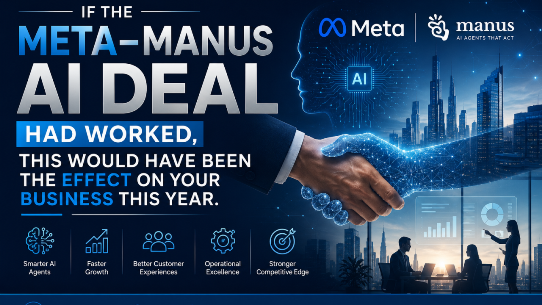
What happened?
In late 2025, Meta announced it was acquiring Manus for roughly $2–3 billion. Manus had become one of the hottest AI startups because of its autonomous AI agents that could perform multi-step tasks like research, planning, coding, and analysis.
RELATED: Unleashing Possibilities: How Meta AI empowers everyday life
Meta wanted Manus to strengthen its AI agent strategy across products like Facebook, Instagram, WhatsApp, and Meta AI.
Why did China stop it?
Although Manus had moved its headquarters to Singapore, Chinese authorities argued that:

- The company was originally built by Chinese founders.
- Some of the technology and talent originated in China.
- The deal involved strategic AI capabilities that Beijing considers sensitive.
In April 2026, China’s National Development and Reform Commission (NDRC) formally blocked the acquisition and ordered the transaction to be unwound.
The messy part
The deal had already progressed significantly:
- Some Manus employees had reportedly moved into Meta’s Singapore operations.
- Integration work had already started.
- Founders had taken roles connected to Meta’s AI organization.
That made the order to “unwind” the acquisition extremely complicated. Some reports also said key founders faced travel restrictions while regulators investigated the deal.
Why this matters
This wasn’t just about one startup.
The Manus case became a signal that:
- China now views advanced AI talent and AI agents as strategic national assets.
- Simply relocating a Chinese AI company to Singapore may no longer avoid Chinese oversight.
- Cross-border AI acquisitions between American and Chinese-linked firms will face much heavier scrutiny going forward.
What if the deal had gone through?
As business leaders, marketers, and entrepreneurs, it is worth understanding what could have happened because the impact would not have been limited to Silicon Valley. It would have affected how businesses operate, market, sell, and serve customers.
Here are a few ways your business could have felt the impact this year.

1. AI Would Have Become More Than Just a Chat Tool
Today, many people use AI to write emails, create content, summarize reports, or answer questions.
Manus AI was built to do much more.
Instead of simply giving answers, it could take actions. It could perform research, analyze data, create reports, plan projects, and complete multiple tasks with little supervision.
If Meta had successfully integrated Manus into its ecosystem, businesses could have had access to powerful AI assistants directly inside the tools they already use every day.
Imagine an AI assistant that doesn’t just suggest a marketing plan but actually helps execute parts of it.
That is where the industry is heading.
2. Marketing Teams Would Have Moved Faster
Every marketing professional knows how much time is spent on repetitive work:
- Researching competitors
- Building reports
- Monitoring campaigns
- Creating first drafts
- Analyzing customer feedback
An advanced AI agent could automate many of these activities.
Instead of spending days gathering information, teams could focus more on strategy, creativity, and decision-making.
The result?
Faster campaigns, quicker insights, and improved productivity.
3. Small Businesses Would Have Gained Enterprise-Level Capabilities
One of the biggest advantages of AI is that it helps smaller teams do the work of larger organizations.
A small company with five employees could suddenly operate with the efficiency of a team of twenty.
Customer service, content creation, data analysis, proposal writing, and lead qualification could all become significantly easier.
This would have helped many businesses compete at a higher level without increasing headcount.
4. Customer Expectations Would Have Increased
Whenever technology improves, customer expectations rise.
If AI agents become common, customers will expect:
- Faster responses
- More personalized experiences
- Better service
- Quicker problem resolution
Businesses that embrace AI will meet these expectations.
Businesses that ignore it may struggle to keep up.
The lesson is simple: customers rarely compare you to your competitors anymore. They compare you to the best experience they have had anywhere.
5. The Race for Attention Would Become Even Tougher
AI makes content creation easier.
But when everyone can create content quickly, attention becomes harder to earn.
The winning businesses will not necessarily be those with the most content.
The winners will be those with:
- Clear positioning
- Strong expertise
- Original thinking
- Authentic human insight
AI can help create content, but it cannot replace trust, experience, and genuine relationships.
6. Leadership Visibility Would Become More Important
As AI-generated content floods the internet, people will pay more attention to real voices.
Customers want to know:
- Who leads the company?
- What do they stand for?
- What expertise do they bring?
This is why executive visibility on platforms like LinkedIn is becoming increasingly important.
People buy from people before they buy from brands.
The Real Lesson for Businesses
Whether the Meta–Manus deal happened or not is no longer the most important question.
The bigger question is:
Is your business preparing for a future where AI can perform tasks, make decisions, and automate entire workflows?
The companies that win over the next few years will not be those that simply use AI.
They will be those that redesign their processes, customer experiences, and business models around AI.
The future is not about replacing people.
It is about helping people achieve more with the support of intelligent systems.
And that future is arriving much faster than many businesses realize.
To your success!