By
By 
By Osasome C.O
Nigeria Moves from Strategy to Action on Digital Economy
Nigeria’s ambition to build a fully digital economy is gaining momentum as the Federal Government intensifies work on the National Digital Economy and e-Governance Bill 2025. A landmark legislation, it is designed to strengthen regulation for emerging technologies and accelerate public sector innovation.
RELATED: Ministry of Communications advances nationwide consultations on digital economy and e-Governance bill in Lagos

Kashifu Inuwa Abdullahi


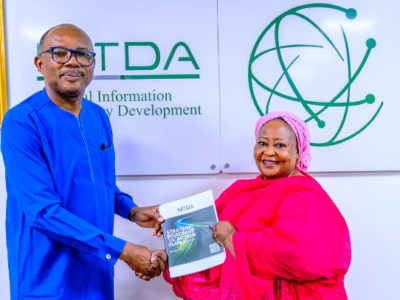
Speaking at the Global Partnership for Human-Centric ICT Standardisation (GIST) Nigeria Introductory Stakeholder Workshop in Abuja, the Director-General of the National Information Technology Development Agency (NITDA), Kashifu Inuwa Abdullahi, representing the Minister of Communications, Innovation and Digital Economy, Bosun Tijani, said Nigeria has moved beyond policy formulation to active implementation of its national Artificial Intelligence (AI) roadmap.
Digital Economy and E-Governance Bill 2025: What It Means
The proposed National Digital Economy and e-Governance Bill 2025 aims to establish a unified legal and regulatory framework to support AI adoption, cloud computing, and digital public sector transformation.
The bill mandates comprehensive digital transformation across Ministries, Departments, and Agencies (MDAs). NITDA will have oversight responsibilities to improve efficiency, transparency, and service delivery.
Key Impacts of the Proposed Legislation
- Stronger Regulation for Emerging Technologies:
The bill enhances legal certainty for AI, cloud services, and digital platforms, supporting a secure and competitive digital ecosystem. - Legal Recognition of Digital Transactions:
Electronic communications, digital records, and e-signatures gain full legal backing, boosting trust in e-commerce and digital services. - Mandatory Digital Transformation of MDAs:
Government institutions will be required to establish ICT units and digital transformation plans under NITDA supervision. - Improved Data Sharing and Integrity:
The legislation supports the creation of the Nigeria Data Exchange (NDE) to enable secure data sharing and reduce fragmentation across agencies. - Consumer Protection and Digital Rights:
New provisions address consumer protection, online dispute resolution, and the safeguarding of digital rights.
Why the Bill Is Critical in 2026
With the digital economy now a growing contributor to national GDP, the bill is seen as essential for providing legal clarity. It will enable cross-border digital trade, protecting users, and supporting job creation. The National Assembly has already held public hearings as part of efforts to finalise the framework.
Ethical AI, Cloud-First Policy, and Data Readiness
Abdullahi explained that the current implementation phase prioritises clear guidelines to ensure AI deployment aligns with ethical standards, accountability, and strong safeguards.
He added that government is advancing data classification initiatives to ensure the availability of clean, reliable datasets for AI training. At the same time, government is promoting cloud adoption across public institutions to improve scalability and efficiency.
Emphasising a “cloud-first” policy, Abdullahi warned that continued reliance on on-premise systems could slow large-scale digital transformation. However, he stressed that cloud integration would be implemented cautiously to protect Nigeria’s digital sovereignty and sensitive national data.

Progress in E-Governance and Interoperability
Nigeria is also recording progress in e-governance through the development of an interoperability framework and the Nigerian Government Enterprise Architecture. In addition is a data exchange platform to support Government Statistics Digital Public Infrastructure (DPI).
These initiatives are expected to harmonise public sector digital projects, reduce duplication, and open new opportunities for private sector participation.
Call for Stronger Public-Private Collaboration
Abdullahi underscored the need for deeper collaboration between government, industry, and other stakeholders to build resilient digital infrastructure. He expressed confidence that the proposed bill and supporting initiatives would enhance Nigeria’s global standing in digital governance. It will at the same time help in driving innovation, transparency, and inclusive growth.
EU Backs Human-Centric Digital Standards
Earlier, the European Commission’s Team Leader for Digital Governance, Peter Marien, of European Commission DG INTPA, highlighted the importance of international cooperation in shaping global digital standards.
He noted that the EU’s digital strategy prioritises partnerships and ecosystem alignment across regions, including Nigeria and the United Kingdom. Marien referenced a recent e-governance engagement in Brussels organised with Smart Africa. He described Nigeria’s participation in the GIST initiative as a strong signal of its commitment to global digital governance.
According to him, standards are the “invisible backbone” of modern societies. They support critical systems across sectors and enabling cross-border digital integration.