By
By 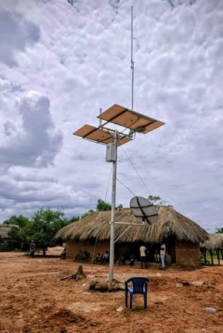
SES and AMN Expand Rural Connectivity in the DRC
SES and Africa Mobile Network (AMN) have reached a major connectivity milestone in the Democratic Republic of Congo (DRC), delivering mobile network access to 5.8 million people and significantly expanding coverage in underserved rural communities.
RELATED: Mobility fintech GoCab raises $45m to scale electric mobility and financial inclusion across Africa
The collaboration has strengthened telecommunications infrastructure across the country, supporting more than 1,100 mobile base stations and increasing population coverage by 27%, bringing first-time mobile access to millions previously beyond the reach of traditional networks.
292 New Base Stations Deployed in 90 Days
As part of the latest expansion phase, AMN installed 292 additional mobile network base stations using satellite capacity provided by SES. Remarkably, the sites were deployed in just 90 days, delivering essential voice and data services to communities often cut off by geography and lack of infrastructure.
For SES and AMN, the achievement goes beyond statistics—it represents millions of people gaining access to mobile connectivity for the first time, enabling communication, commerce, education, and healthcare.
Overcoming Extreme Terrain to Connect Communities
“This is what happens when determination meets purpose,” said Michael Darcy, CEO of Africa Mobile Network. “Building nearly 300 sites in just three months under some of the toughest conditions imaginable is an extraordinary achievement. AMN exists to connect even the most remote communities sustainably, reliably, and at scale.”

Installation teams navigated impassable roads and, in many cases, hand-carried equipment through dense bush when vehicles could go no further. Despite these challenges, the teams successfully extended mobile services to an additional 1.3 million people across rural DRC.
Solar-Powered, Satellite-Backed Connectivity
At the core of AMN’s model is the belief that connectivity is a fundamental human right. Its sites are entirely solar-powered and use VSAT satellite backhaul, enabling deployment without reliance on power grids, fibre networks, or existing infrastructure.
This independence allows AMN to reach areas “where the map ends,” but it also presents logistical hurdles, with engineers often becoming the first to establish access routes into isolated regions.
Innovation Driving Scalable Network Expansion
Innovation underpins AMN’s approach to rural connectivity. The company developed the AMN Radio Node (ARN)—a multi-technology solution that supports 2G, 3G, 4G, and future 5G services from a single unit.
By designing the ARN in-house, AMN has reduced capital expenditure and power consumption while delivering high-performance, energy-efficient connectivity that can scale with demand.

SES Multi-Orbit Satellites Enable Ubiquitous Coverage
According to Jean-Philippe Gillet, President of Fixed Data at SES, AMN’s access to SES’s multi-orbit satellite network—spanning GEO, MEO, and LEO constellations—has been critical to the project’s success.
“Connecting to SES’ multi-orbit satellite network provides data connectivity services to over one billion people worldwide, including some of the most remote and unreachable regions. It is inspiring to see how digital transformation is reshaping daily life across the DRC,” Gillet said.
Real Impact on Lives and Local Economies
The benefits of expanded connectivity are already evident. In Bompensole, a village connected in November 2025, a local resident explained how daily life has changed—from traveling 30 kilometres for basic communication or banking to managing finances instantly from a mobile phone.
Reliable connectivity is also empowering local entrepreneurs with access to real-time market information, enabling students to use online learning resources, and transforming healthcare delivery by allowing clinics to consult specialists remotely for improved diagnoses and patient outcomes.
Looking Ahead
With the SES–AMN partnership demonstrating that mobile connectivity can be delivered anywhere with populations of 1,000 or more, stakeholders say the model could be replicated across other unconnected regions in Africa and beyond—accelerating digital inclusion and socio-economic development.