By
By 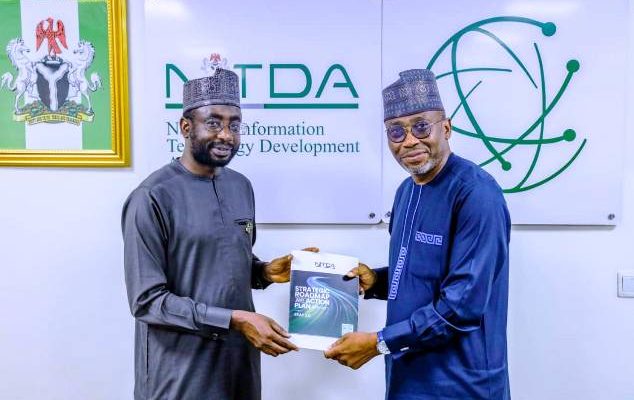
Abdullahi Says Digital Transformation and Regulation Must Go Hand in Hand
The Director General of the National Information Technology Development Agency (NITDA), Kashifu Inuwa Abdullahi, has reaffirmed the agency’s commitment to deepening inter-agency collaboration, as NITDA received the Director General of the National Broadcasting Commission (NBC), Mr Charles Ebuebu, on a courtesy visit focused on strategic partnerships in digital transformation and regulatory reform.
RELATED: Nigeria’s NITDA deepens U.S. alliance for data Privacy, AI, and cyber defense
Speaking during the meeting, Abdullahi stressed that digital transformation and regulation are inseparable in Nigeria’s fast-evolving digital ecosystem, adding that transformation is not a one-off initiative but a continuous journey requiring constant improvement, adaptive leadership, and periodic target-setting.
Repositioning NITDA as a Smart Public Sector Organisation
Abdullahi explained that NITDA deliberately embarked on a comprehensive organisational transformation to reposition itself from a traditional civil service structure into a high-velocity, smart public sector institution.
According to him, over 70 to 80 per cent of the agency’s workforce originated from the mainstream public service, bringing entrenched bureaucratic mindsets and rigid operational practices that required deliberate reform.

“More than 70 or 80 per cent of our staff came from the mainstream public service, so we intentionally focused on people, mindset reset, capacity building, and fostering a culture that supports innovation and accountability,” he said.
People, Processes and Technology as Core Pillars
The NITDA boss noted that the agency’s digital transformation strategy is anchored on three core pillars: people, processes, and technology, emphasising that technology alone cannot deliver value without the right human capacity and efficient workflows.
He disclosed that NITDA carried out extensive cultural reorientation programmes, supported by cultural audits, to create psychological safety within the organisation.
“This enables staff to freely contribute ideas, challenge processes constructively, and collaborate across departments without fear of reprisal,” he stated.
He added that organisational culture remains the foundation of any successful strategy, warning that even the best strategies fail without the right culture to support execution.
Process Optimisation and Automation Drive
Providing insight into the agency’s internal reforms, Abdullahi said NITDA adopted an integrated transformation framework covering people, process, culture, content, and technology.
Through this approach, the agency identified and addressed deep-rooted bureaucratic challenges such as command-and-control structures, excessive risk aversion, and over-centralised decision-making.

As part of the reforms, NITDA documented over 396 internal processes and streamlined them to eliminate inefficiencies and repetitive executive approvals.
Routine tasks that previously required multiple approvals at the Director General’s level were redesigned to empower departments as gatekeepers, allowing leadership to focus on strategic priorities. This, he noted, also laid the foundation for automation and digital tool integration.
Mandatory AI Training and Value-Driven Technology Deployment
On capacity development, Abdullahi disclosed that all NITDA staff underwent mandatory artificial intelligence (AI) training, reinforcing the agency’s position that AI is a productivity-enhancing tool rather than a replacement for human capital.
He noted that staff now leverage AI to improve workflows, generate ideas, and transition from manual administrative roles to AI-enabled system administration.
According to him, technology deployment at NITDA is driven by business value, not trends, stressing that digital tools must align with clearly defined processes and organisational objectives.
Digital Transformation Playbook and NBC Partnership
The NITDA DG announced that the agency has developed a comprehensive digital transformation playbook, documenting lessons learned from its reform journey, which it is willing to share with NBC and other government institutions.
He proposed specific areas of collaboration with NBC, including:
- Sharing NITDA’s digital transformation playbook
- Delivering tailored training and capacity-building programmes
- Enrolling NBC staff in digital literacy initiatives with global partners such as Cisco
- Providing technical support for modernising regulatory frameworks to reflect the evolving digital and media ecosystem
NBC Calls for Institutionalised Collaboration
Earlier, NBC Director General Charles Ebuebu called for closer institutional collaboration between both agencies, describing the partnership as long overdue given the rapid convergence of media and technology.
He said that while he has had several engagements with the NITDA DG, it was important to formalise cooperation to address emerging issues in media regulation, technology, data governance, and Nigeria’s digital future.
Ebuebu stressed that a strong NITDA-NBC partnership is critical to:
- Effectively regulate the evolving media ecosystem
- Harness technology for content creation and distribution
- Promote local media growth
- Facilitate knowledge transfer
- Protect Nigeria’s cultural and national interests