By
By 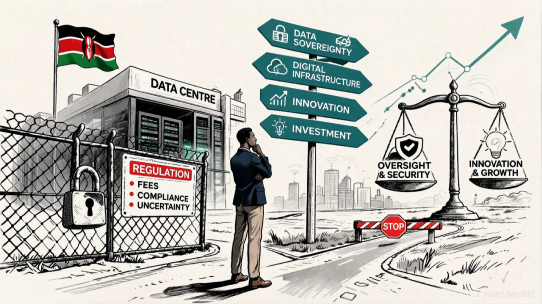
By Fintech Association of Kenya
Kenya’s mobile‑money pioneers built an entire fintech ecosystem on trust that the physical plumbing of the internet would eventually catch up. As “Silicon Savannah” matured, entrepreneurs plugged into cloud platforms and API layers with an almost blind faith that someone somewhere was keeping the servers running.
RELATED: How data centers are reshaping Africa’s power market
Until recently, those servers sat in a regulatory blind spot. The Unified Licensing Framework adopted in 2008 and amended in 2012 and 2014 created broad, technology‑neutral categories — network facilities providers, community networks, and terminal equipment vendors — but it never addressed the humble data centers. Operators negotiated with the regulator on a case‑by‑case basis, like hoteliers pleading for building permits.
This year, the Communications Authority of Kenya (CA) closed that loophole. In its Revised Telecommunications Market Structure for 2024/2025, the Authority formally recognized data centers as a regulated activity. The move has been hailed as a sign of regulatory maturity. But beneath the apparent clarity lies an epistemological misstep: the CA is treating passive real‑estate providers as active telecom operators. To understand why this matters, we must return to first principles.
What is a data center?
Imagine a data center stripped of jargon. It is, at its core, a concrete and steel warehouse with industrial‑grade power, cooling, and connectivity. Tenants — cloud providers, banks, fintech start‑ups — roll in their own servers and plug into that infrastructure. The operator does not inspect packets or route traffic; it keeps the ping, power, and pipe working.

To use a simple analogy, if the data flowing through these servers is the lifeblood of the digital economy, the data center is the heart muscle — pumping but never deciding where the blood goes. This distinction between active (decision‑making) and passive (housing) infrastructure is crucial.
Under the CA’s earlier proposal, the Authority attempted to split data centers into two licenses: those building terrestrial or satellite links into their facilities would need a Network Facilities Provider – Tier 3 (NFP‑T3) license; those providing only power, space, and servers would obtain an Application Service Provider (ASP) license.
Industry players pointed out that an ASP licence, designed for software and services, was a category error for a colocation landlord. In its final structure, the CA pivoted. Data centers, whether hyperscale or simple colocation, must now operate under the NFP‑T1 or NFP‑T2 licences — the same tiers used for national network operators.
The Authority justifies this by arguing that data-center operators exercise “significant control over their clients’ access to physical infrastructure, network resources and data… in the same manner that tower companies are regulated”. Tower companies are indeed licensed under the network‑facilities regime.
But a radio mast that holds an antenna aloft is not the same as a building full of servers. Data centers are more energy‑intensive and operationally complex; they do not route traffic and have no discretion over the data flowing through them. In treating them as active operators, the state blurs the line between the infrastructure of the mind — the data itself — and the concrete shell that houses it.

The financial architecture: gross‑revenue levies and the “makers vs takers” debate
The sting of this misclassification lies in the financial obligations attached to the NFP licences. Under Kenya’s Unified Licensing Framework, NFP licensees must pay an annual operating levy of 0.4% of gross turnover. By shoehorning data centers into this category, the CA subjects them to a telecom‑style revenue tax. The Authority’s own consultation matrix reveals that similar fee structures for satellite landing rights would raise initial licence fees by nearly 1 000% and impose the same annual 0.4 % levy.
Stakeholders warned that such levies could create barriers for small operators and new entrants, limiting competition and innovation. For data‑center investors, the dynamics are comparable: heavy levies compress already thin margins and can deter the very capital the policy seeks to attract.
Why is this tax so problematic? Consider that electricity can comprise more than half of a data centre’s turnover. Operators typically bill power at cost — a pass‑through expense to the tenant — because they cannot predict how much computation each customer will consume. When the CA applies a 0.4% tax on gross revenue, it effectively taxes the pass‑through electricity bill.
A customer who consumes KSh 10 million worth of power is now indirectly paying KSh 40,000 to the regulator for electricity purchased from Kenya Power. This is not taxation on value added; it is a levy on raw utility consumption. In a business where net profit margins may hover around 5%, a 0.4% top‑line tax can equate to an 8% tax on bottom‑line profits. The CA defends the policy as a means of ensuring “technology neutrality,” but neutrality should not mean ignoring economic reality.

At the heart of this debate is a tension between makers and takers. Makers are builders: engineers, entrepreneurs, and investors who deploy capital to create infrastructure — the resilient bedrock upon which the digital economy runs. Takers, by contrast, extract rents through regulation, levies, or monopoly power.
By treating data centers as a cash cow for telecom‑style licensing revenue, the state risks becoming a taker. It prioritizes short‑term fiscal extraction over long‑term infrastructural resilience. The 0.4% turnover tax may look trivial to a bureaucrat, but in a high‑capex, low‑margin business, it is devastating. Gross‑revenue taxes are mathematically regressive: the larger the energy bill, the larger the tax, irrespective of profitability. That model may work for voice and SMS in a monopoly era, but it makes little sense for hyperscale infrastructure.
The global techlash and lighter approaches.
Kenya is not alone in grappling with how to regulate the digital economy. Around the world, a “techlash” has sparked concern over Big Tech’s power, data privacy, and the environmental impact of hyperscale computing. But outside Kenya, regulators have tended to focus on resilience and sustainability, not revenue extraction.
In the United States, a 2023 executive order prioritizes AI infrastructure and fast‑tracks permitting for data-center construction. The Environmental Protection Agency has even proposed allowing construction to begin before air permits are finalized. States such as Virginia, Texas, and Ohio offer massive sales‑and‑use tax exemptions for servers and cooling equipment, recognizing that data centers are foundational infrastructure.
The United Kingdom has designated data centers as critical national infrastructure, unlocking billions of pounds in public investment for AI growth zones and preferential access to the grid. Across Asia‑Pacific, countries including Japan, Singapore, and South Korea compete via tax incentives, fast‑track zoning, and AI‑specific subsidies. These jurisdictions regulate for environmental efficiency, cybersecurity, and zoning; they do not levy turnover taxes on passive infrastructure.
Even where data centers are brought under telecom law, governments temper regulation with investment incentives. Vietnam’s 2023 Telecommunications Law formally defines data centres and allows foreign investors to hold 100% stakes. Projects located in high‑tech zones enjoy a preferential corporate tax rate of 10% for 15 years, with full tax exemptions for 4 years and a 50% reduction for the next 9 years. Regulation and fiscal support go hand in hand. Kenya’s proposed regime is an outlier in imposing telecom‑style levies without equivalent incentives.
Why the cost flows downstream.
For Kenya’s tech scene these abstractions matter greatly. Every mobile‑money transaction, micro‑loan or blockchain settlement runs on servers in a data center. When operating costs rise, they trickle down the stack. A colocation provider squeezed by a turnover levy will raise the price of rack space, power cross‑connects, and interconnection fees.
Global cloud providers such as AWS or Azure will adjust pricing for the Kenya Availability Zone. Local start‑ups, already battling currency depreciation and a tight venture capital market, will see their monthly cloud bills increase. They, in turn, may raise transaction fees or reduce free service tiers. Ultimately, the mama mboga selling vegetables in Kibera pays a few extra shillings to access her own money. This is structural adjustment disguised as licensing policy.
The CA’s revised framework also targets the sky. The Authority proposes increasing the 15‑year licence fee for satellite Internet Service Providers from roughly $12,000 to about $115,000 — a 1000% hike — while slapping a 0.4% turnover tax on top. The policy may not deter behemoths like Starlink, but it threatens smaller providers that serve remote communities.
The CA argues that it seeks technology neutrality; we see a regulatory moat protecting terrestrial incumbents. In a country where fibre networks do not yet reach every corner, punishing LEO satellite operators reduces choice for rural Kenyans and slows the march toward universal access.
A first‑principles framework for Kenya
The Fintech Association of Kenya believes regulation should reflect the natural end‑state of technology, not the legacies of voice telephony. We therefore propose a first‑principles framework that treats data centers as passive infrastructure, avoids gross‑revenue taxes, and regulates for resilience. Drawing on international best practice and our own consultations with the sector, the following recommendations:
- Reclassify data centers as passive infrastructure. Recognize the distinction between the entity that owns the building, cooling, and power, and the operator that transmits data. Use a licensing category akin to Thailand’s Type 1 telecom licence or Vietnam’s definition — a regime focused on physical standards and security audits rather than on telecommunications service provision. Let passive colocation providers register and be subject to compliance audits instead of full network‑facilities licenses.
- Replace the 0.4% turnover tax with capacity‑based or tiered flat fees. Because electricity pass‑throughs inflate gross turnover, a levy on revenue is fundamentally inequitable. A flat administrative fee based on the data center’s provisioned megawatt capacity or floor area would be simpler to administer and fairer to operators. Alternatively, adopt a tiered flat‑fee structure that scales with facility size, akin to frameworks used in Nigeria or South Africa. This would provide certainty without penalizing energy‑intensive operations.
- Regulate for environmental resilience. Focus regulatory attention on the real risks: grid strain, water consumption and carbon emissions. Kenya could mandate strict Power Usage Effectiveness (PUE) and Water Usage Effectiveness (WUE) standards, following the EU’s Energy Efficiency Directive. The CA could offer fee discounts for facilities that invest in on‑site solar generation, advanced liquid cooling or waste‑heat reuse. Such incentives align regulatory mechanisms with sustainability goals and attract environmentally conscious investors.
- Adopt a maker‑centric industrial policy. To remain competitive, Kenya must move from rent extraction to value creation. This means coordinating across government ministries to deliver stable, subsidized industrial power rates, fast‑track land‑use approvals, and targeted tax incentives for digital infrastructure. Data centers should be designated critical national infrastructure, unlocking access to concessional finance and special economic zones. Offsetting regulatory fees with energy subsidies or accelerated depreciation keeps the total cost of ownership attractive compared to South Africa or Egypt.
- Continue iterative, inclusive consultation. The CA’s public consultation process generated a wealth of input from entrepreneurs, ISPs, and investors. Yet many proposals were dismissed by invoking “technology neutrality”. Neutrality is admirable, but a dynamic digital economy often demands asymmetric regulation: different rules for passive and active actors. Ongoing dialogue should not be a formality; it must meaningfully shape policy. A standing public‑private working group could monitor implementation, adjust fees and refine classifications as the market evolves.
The path forward: building without taxing the future
Kenya’s decision to regulate data centers marks an important step toward modernizing its digital governance. Regulatory certainty is the bedrock upon which institutional capital builds infrastructure. In that respect, the CA’s move deserves credit. However, clarity must not come at the cost of competitiveness. By treating data centers as active telecom operators and taxing their gross revenue, the Authority risks strangling the very arteries of the digital economy. It turns the state into a taker, siphoning value rather than catalyzing it. Meanwhile, our competitors — from Arlington County to Singapore — are rolling out red carpets for the cloud.
It is not too late to recalibrate. M‑Pesa, mobile banking, agency networks — all were born from a regulatory environment that balanced oversight with encouragement. As we step into the AI era, we must retain that creative pragmatism. Our fintech developers, our small retailers, our university researchers — all depend on affordable, resilient local cloud infrastructure. They will carry the cost of a poorly designed levy, whether or not they realise it.
The Fintech Association of Kenya calls on policymakers to watch closely, listen intently and act boldly. Reclassify data centers as passive infrastructure, replace gross‑revenue levies with fairer fee structures, incentivize sustainability, and coordinate across government to attract investment. In doing so, Kenya can remain the heartbeat of Africa’s digital economy, a place where makers outnumber takers and where the cloud is an engine of opportunity, not a source of extraction.
As one industry leader put it during the consultation, “Most markets take a lighter approach in regulating data centres. We are watching closely to see how this balances.” Let us ensure that the balance favours resilience, affordability and growth — that we build the future without taxing it out of existence.
Source: Fintech Association of Kenya