By
By 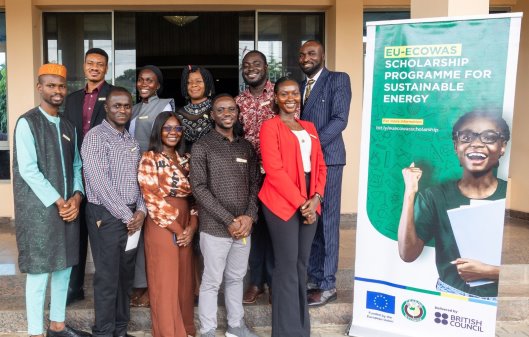
The EU–ECOWAS Scholarship Programme for Sustainable Energy is celebrating a significant milestone as its first cohort of scholars completes groundbreaking research with direct applications for West Africa’s green future. Funded by the European Union and delivered by the British Council, the programme has equipped 72 top graduates from 11 ECOWAS nations with fully-funded master’s degrees, over 40% of whom are women.
RELATED: Nigeria joins ECOWAS biometric identity revolution with ENBIC rollout
From over 10,000 applicants, these scholars studied at nine specialised institutions across West Africa, strengthening regional human capital in the critical electricity sector. Their work is now providing practical, innovative solutions to the continent’s most pressing energy challenges.
Spotlight: Five Scholars Transforming Research into Regional Impact
The programme’s success is embodied in the applied research of its scholars. Here are five whose projects are poised to influence policy, infrastructure, and technology adoption across West Africa.
1. Blessing Nneka Ben-Festus (Nigeria) – University of Ibadan
- Research: Developed a low-cost, IoT-enabled Battery Management System (BMS) for household inverter systems, using machine learning for predictive maintenance.
- Impact: Enhances safety, extends battery life, and reduces energy waste in the ubiquitous backup-power systems across the region, boosting confidence in decentralised solar.
2. Ruth Mawunyo Kokovena (Togo) – University of Lomé

- Research: Created SISEE, an affordable, multi-sensor environmental monitoring system for solar resource assessment and coastal energy planning.
- Impact: Provides a vital, low-cost tool for data collection in areas lacking expensive weather stations, directly supporting national renewable energy strategies.
3. Godwin Josiah Ajisafe (Nigeria) – University of Ibadan
- Research: Built the first data-driven model to predict Electric Vehicle (EV) lithium-ion battery end-of-life under Lagos’s unique urban driving conditions.
- Impact: Supplies crucial evidence for EV policy, fleet management, and battery recycling initiatives, paving the way for sustainable transport systems in West Africa.
4. Kevin Konan N’guessan (Côte d’Ivoire) – INP-HB
- Research: Designed TGIME-ES, an intelligent energy-management system that achieved significant electricity savings and enhanced solar integration in pilot sites.
- Impact: Offers a scalable solution to reduce national energy demand, lower consumer costs, and ease grid pressure, accelerating solar adoption.
5. Patience Yaa Dzigbordi Quashigah (Ghana) – KNUST
- Research: Evaluated and calibrated low-cost air quality sensors using machine learning, proving their viability against expensive reference stations.
- Impact: Enables affordable, large-scale air quality and emissions monitoring, informing public health policy and supporting accurate solar forecasting.
Building a Pipeline for a Sustainable Energy Future
Collectively, this research strengthens regional capacity in key areas: renewable energy optimisation, electric mobility, energy efficiency, and environmental monitoring. The programme successfully creates a pipeline of skilled experts who can translate academic innovation into tangible benefits for ECOWAS member states.
By providing scientific evidence for infrastructure planning and policy development, these scholars are actively driving West Africa’s transition towards greater energy security, reduced emissions, and sustainable economic growth.