By
By 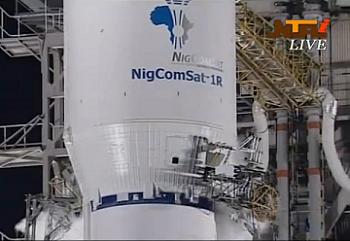
By Sonny Aragba-Akpore
A multimillion-dollar debt, a ground station crippled by lightning, and a foreign partner now holding operational control. This is the precarious reality facing NigComSat 1R, Nigeria’s flagship communications satellite, as questions mount over who truly controls the nation’s space assets.
Nigeria’s only communications satellite, NigComSat 1R, is troubled and appears to be in a wheelchair, practically struggling for survival. Its troubles began on February 14, 2014, immediately after the removal of its pioneer Chief Executive, Timasaniyu Ahmed Rufai, in alleged questionable circumstances.
RELATED: NIGCOMSAT targets new satellites for 2028/2029 as reforms drive strong turnaround under current management
His removal was ordered by the then Communications Minister, Mrs Omobola Johnson, who later appointed a team to carry out a forensic examination of the company’s books since the launch of NigComSat 1R on December 19, 2011. Johnson named Ms Abimbola Alale as Ahmed-Rufai’s replacement.
ALSO READ: CGWIC issues 30-day ultimatum to NIGCOMSAT over $11.44m debt, warns of possible satellite service suspension
Before her appointment, Alale was Executive Director (Marketing). However, not much came out of the forensic examination to date, except that the company appears to have seen better days and is swimming against the tide. With a bucket of troubles and an incorrigible wage bill, which is believed to be unsustainable, the Nigerian satellite is now being managed from Kashi, China, contrary to global standards, where communications satellites are usually managed locally by their operators from domestic ground stations.

Commercial Struggles Have Dogged NigComSat 1R Since Day One
Strangely, the Nigerian satellite has not been a commercial success since its launch. Low patronage, very little confidence by local customers and a lack of investment by its owners, the government, may have accounted for this.
But the Chinese who built it say Nigcomsat 1R has immense capacity for broadcasting and telecommunication services, with special potential for broadband connectivity, but local patronage is very poor.
“There is no problem with the market,” because countries like Bolivia, with TKSat-1, the country’s first communications satellite, built at an estimated cost of around $300 million, similar to NIGCOMSAT-1R, generate between $10 million and $20 million yearly. By 2020, it had earned more than $80 million over its first four years, averaging roughly $20 million yearly.
In South Africa, the South African National Space Agency (SANSA) and local partners such as CubeSpace, Simera Sense, and Astrofica generate revenue from satellite-based Earth-observation data, hardware components, and downstream applications. In 2023, these companies were part of Africa’s broader commercial space sector, which included 327 firms collectively earning US$309 million.
Fifteen years, zero commercial success: What went wrong with Nigeria’s satellite?
So, what is the problem with the Nigerian satellite that has not recorded any commercial success since its launch 15 years ago? Despite denials by officials of NigComSat 1R that it was not indebted to its partners, China Great Wall Industry Corporation (CGWIC), there is growing uncertainty that the satellite is swimming in troubled waters.
Reports have it that managers of the satellite, Nigerian Communications Satellite Limited, are busy defending an $11.4 million debt owed to CGWIC for services rendered in hosting the satellite in the Kashi ground station in Xichang, China, since the ground station of NigComsat was damaged in 2019. Although NigComSat Limited denied this debt, CGWIC insists there is indeed a debt, even when no official statement says whether or not a debt was outstanding. Media reports say the debt is real.
Following the damage of the ground station in Abuja in 2019, the Kashi station in China became the main controlling station instead of playing the backup role it was initially designed forCGWIC built and launched the Satellite in Kashi on December 19, 2011 and has been working closely with its Nigerian partner, NigComsat Limited to maintain the satellite from the Karshi ground station to save the satellite from premature collapse.
This help came at a cost as the NigComSat Limited entered into a management contract with CGWIC for the primary control of the satellite from Kashi in China. According to the terms of the contract, the Nigerian company was expected to pay CGWIC about $1.6m yearly for maintenance.
No payments, $11.4 million debt by December 2025
But as of December 2025, the Nigerian company allegedly failed to remit any payment and thus accumulated a debt of $11.4m. Several strategies adopted to recover the debt have failed to yield any meaningful results, including a letter of demand for payment and a threat to abort hosting the satellite if the debt was not paid.
In a letter signed by the Director, Marketing, Africa at CGWIC, Liu Lan, the Chinese company asked the management of NigComSat Limited to inform its customers of the development because it wouldn’t guarantee the performance of the satellite should it fail to pay up the debt in 30 days. The letter reads, “As of December 31, 2025, the total net outstanding debt owed by NIGCOMSAT to CGWIC stood at USD11,442,335.89.
This figure accounts for deductions for services NIGCOMSAT has been provided by us, yet the balance remains substantially unresolved.” “Regrettably, despite our continuous provision of essential Telemetry, Tracking, and Command (TT&C) services from Kashi China, no payments have been received from NIGCOMSAT Ltd. since 2019.
“For the past seven years, CGWIC has deliberately delayed standard debt collection actions out of goodwill and a desire to ensure the continuity of Nigeria’s satellite operations.
“Furthermore, despite negotiations in 2023 and early 2025, in which CGWIC agreed in principle to reduce the debt, NIGCOMSAT has repeatedly failed to meet the agreed-upon conditions to make partial payments.”
Therefore, CGWIC is hereby issuing a final thirty (30) day ultimatum. NIGCOMSAT is required to either make the payment of USD11,442,335.89 orprovide a formal, legally binding guarantee of payment within thirty (30) days of the date of this letter.
“If full payment or an acceptable guarantee is not provided within this 30-day window, CGWIC will suspend service on the active transponders of the NIGCOMSAT 1R”.
Despite the ultimatum, NigComSat maintains it owes CGWIC nothing
Nevertheless, officials of Nigcomsat Limited denied any debt to CGWIC or any friction in that regard. These debts have been hanging since 2019 when Nigeria’s ground control infrastructure located in Obasanjo Space Centre, Lugbe, Abuja, malfunctioned due to lightning.
In satellite operations, control is maintained through Telemetry, Tracking, and Command (TT&C) systems that monitor the spacecraft’s health, determine its position in orbit, and send commands to adjust its orientation and orbital slot. If the TT&C link is lost, a geostationary satellite can quickly drift out of its designated position due to gravitational and solar forces.
When that happens, services such as broadcasting, internet connectivity, and military communications can be disrupted. Nigeria’s primary TT&C facility was located at the ground station in Lugbe, Abuja. CGWIC said the facility was severely damaged by lightning in 2019.
“Lightning destroyed the Abuja ground station. After that, they could not control the satellite, so the control was transferred to our station in Kashgar,” Liu said.
The Kashgar Ground Station, also known as the Kashi Ground Station, is located in Xinchang, China. “We have controlled the satellite from 2019 until today,” Liu was quoted as explaining that the arrangement was originally allowed under a 2014 technical support agreement that established China’s ground station as a backup control facility.
However, once the Abuja system stopped functioning, CGWIC became the primary maintenance provider.
Under the 2014 agreement, Nigeria was required to pay CGWIC for both backup services and full operational control, according to Liu. Although NIGCOMSAT declined to confirm the agreement, it admitted it had a support contract in place with the vendor but gave no details.
CGWIC officials were quoted as saying that the Primary control service alone costs more than $1 million yearly, while additional charges apply for backup operations and other technical services like equipment repair and purchase. The officials said that since 2019, the company has received no payment.
“For over seven years, the unpaid fees accumulated into the $11.4 million debt now at the centre of the dispute. Despite the growing arrears, CGWIC continued providing services to avoid jeopardising the satellite. However, how long this continues remains unclear, especially as the satellite gets to its terminal date.
NIGCOMSAT plans to launch two satellites in the next four years. They have named them as Nigcomsat 2A and 2B according to the Chief Executive, Jane Egerton-Idehen.
“For 2A and 2B, we have started the process. We have closed the tender and are now back into the financing and implementation stage. 2A is built to come up in 2028, and 2B for 2029.
“When they are up and running, they are expected to provide security within the borders and neighbouring countries. They will support the security agencies because data collection and intelligence in real time is important. Satellites like communication satellites allow that, irrespective of where they are,” she said.
NIGCOMSAT: Born into Controversy
NIGCOMSAT has been embroiled in controversy since Nigeria’s quest into space.
When it first launched into space in 2007, with NigComsat 1 and the failure that occurred just after 18 months in space, in 2008, and the replacement satellite christened Nigcomsat 1R in December 2011, Nigerians have cast doubts on the satellite.
Although it has survived nearly 15 years since its return, so much mistrust has followed the company. Poor infrastructure management, fuelled by low investment and apathy in marketing the services have left the place in a near comatose. It is, however, not clear, whether the company will survive when this satellite’s lifespan elapses, since there is no backup.
In addition, the debt overhang has further diminished the status of the future of the wobbling venture. However, while dismissing the story as fake news, Head, Corporate Communications at NigComsat Limited, Stephen Kwande, said:
“It is unclear where this misleading information is coming from. We have been in touch with our business partners, the executives and representatives of CGWIC in Nigeria, and they have made it clear they are not the ones giving out such information.”
According to him, the Chinese firm also expressed concern about the spread of what it described as inaccurate reports regarding the partnership. “Our relationship with our business partners, CGWIC, is not in any crisis as reported, and we continue to remain strong in our business relationship and partnership, adding that both parties recently held discussions to reaffirm their collaboration.
NIGCOMSAT’s shaky position threatens the few who still rely on it
Despite the denials, the situation of the satellite looks precarious, as any threat to the fragile existence of the satellite spells discomfort for its few patrons.
With a lifespan of 15 years since launch on December 19, 2011, by December 2026 it would elapse, and there is no backup. This makes things more complicated. Therefore, what happens to customers using its links is a big dilemma.
Denials of Nigcomsat officials appear to be tongue in cheek, as information available further shows the debt exists and remains unpaid. In a February 28, 2026, email to Jane Egerton-Idehen, the managing director of NIGCOMSAT, CGWIC noted that the outstanding debt had reached $11,442,335.89 as of December 31, 2025. “I wrote about the outstanding payment in December 2025 and did not get any feedback from NIGCOMSAT,” stated Liu Lan, CGWIC’s Head, Africa Operations, who has worked on the project since its inception.
The debt, the email noted, rose from technical control services that CGWIC continues to provide for years without payment. The denial of Nigcomsat is a clear manifest contradiction, especially when the Chief Executive is being quoted as saying she would not want to throw figures in the open space, a veiled admission of the debts.