By
By 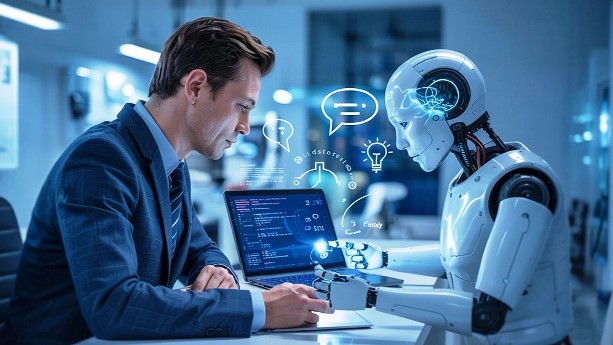
By Ifeoma Lynda Okpala
As I oversee AI counter systems at Starbucks while consistently delivering 105% of sales targets quarterly, I am witnessing the future of workplace technology integration. It is not the dystopian narrative of machines replacing humans it is a nuanced partnership that amplifies human capability while delivering measurable business results.
My journey from computerizing financial systems at Dominican University in Nigeria to managing sophisticated AI-driven retail operations in California has taught me that successful technology integration isn’t about choosing between human and artificial intelligence it is about orchestrating their collaboration to achieve outcomes neither could accomplish alone.
The Reality Check: AI in Action
The numbers tell a compelling story. According to NVIDIA’s 2025 State of AI in Retail survey, 89% of retailers are either actively using AI or assessing AI projects up from 82% in 2023. More striking still, 87% report that AI has positively impacted annual revenue, while 94% say it has helped reduce operational costs. At Starbucks alone, AI implementation has generated a reported 30% return on investment and 15% growth in customer engagement.
But behind these impressive statistics lies a complex reality that only becomes apparent when managing these systems daily. AI doesn’t operate in isolation it functions as an extension of human decision-making, requiring constant oversight, interpretation, and adjustment. The most successful implementations enhance rather than replace human judgment.

What AI Actually Does in Retail Operations
In my daily operations at Starbucks, AI counter systems process thousands of transactions, analyze customer preferences in real-time, and optimize inventory management across multiple variables simultaneously. Our Deep Brew platform analyzes data from over 34.3 million active Rewards members, enabling personalized recommendations that drive both customer satisfaction and business results.
However, the technology’s true power emerges through human interpretation and application. When our AI system identifies a potential supply shortage or customer preference trend, it requires human insight to understand context, evaluate implications, and make strategic decisions. The AI provides computational power; humans provide wisdom.
Consider a recent example: our AI system detected unusual buying patterns for cold beverages during an unseasonably warm week in Northern California. The system flagged potential inventory issues and suggested promotional adjustments. But it took human understanding of local events, seasonal marketing strategies, and brand positioning to craft the right response. The result was a 12% uptick in cold beverage sales achieved through human-AI collaboration, not AI alone.
The Sustainability Imperative
One overlooked aspect of AI discussions is sustainability. At Starbucks, our AI initiatives align with ambitious environmental goals, including cutting waste in half by 2030. Our Siren Craft System, launched in early 2024, demonstrates how AI can drive both efficiency and sustainability.
The system raised overall equipment effectiveness from 72% to 86% within two quarters while reducing energy consumption per pound of coffee roasted by 9%. More importantly, it cut product rework from 4.5% to 1.8%, translating to 3.2 million fewer discarded units and $11.4 million in cost avoidance.

These results underscore a critical point: sustainable AI implementation requires designing systems that optimize for multiple objectives simultaneously efficiency, profitability, and environmental responsibility. This complexity demands human oversight to ensure AI recommendations align with broader organizational values.
Why People Matter More Than Ever
Contrary to fears about AI displacement, my experience suggests that human skills become more valuable, not less, in AI-augmented environments. Research from Gallup indicates that technology innovation has positive effects on worker wellbeing, particularly for employees in trusting work environments.
In our stores, AI handles data processing, pattern recognition, and predictive analytics. This frees team members to focus on creativity, complex problem-solving, interpersonal communication, and nuanced decision-making skills that remain uniquely human. Our baristas spend less time on routine calculations and more time on customer engagement and creative drink customization.
The most successful team members develop what researchers call “collaborative AI literacy” the ability to effectively communicate and coordinate with AI systems while maintaining critical evaluation capabilities. This represents a fundamental shift in skill requirements rather than skill elimination.
Cross-Cultural Technology Perspective
My experience implementing digital systems in both Nigerian and American contexts reveals important insights about technology adoption across different markets. The principles of successful human-AI collaboration remain consistent, but implementation strategies must adapt to local infrastructure, cultural norms, and business practices.
In Nigeria, technology implementation often requires greater emphasis on training and change management due to varying levels of digital literacy. However, the willingness to adopt innovative solutions is remarkably high, particularly among younger demographics.
In the United States, technology infrastructure is more robust, but expectations for seamless integration are correspondingly higher. Users expect AI systems to work flawlessly from day one and provide sophisticated functionality that enhances rather than complicates workflow.
Both contexts reinforce a crucial lesson: successful AI implementation depends more on human factors training, communication, change management, and user experience design than on technology sophistication itself.
Implementation Challenges and Solutions
The path to effective human-AI collaboration faces obstacles. Recent research indicates that the most common AI challenge retailers faced in 2024 was a lack of easy-to-understand and explainable AI tools. This highlights the critical importance of designing AI systems that are transparent and comprehensible to their human partners.
Successful AI implementation requires three key components:
Transparency and Explainability: AI recommendations must be accompanied by clear explanations of underlying logic. When our system suggests inventory adjustments, it shows the data points and reasoning behind recommendations, enabling human operators to evaluate and refine decisions.
Continuous Learning and Adaptation: AI systems must learn from human feedback and improve over time. Our systems track outcomes of human-modified AI recommendations, incorporating this feedback to enhance future performance.
Human Override Capabilities: No AI system should operate without human oversight capabilities. Team members can override AI recommendations when local knowledge, customer relationships, or situational factors suggest alternative approaches.
Emerging Trends and Future Opportunities
Several trends are shaping the evolution of human-AI collaboration. Advances in natural language processing are making AI systems more conversational and intuitive. Augmented reality interfaces are creating new ways for humans and AI to collaborate in physical environments. Adaptive AI systems are becoming better at learning from human feedback.
Most importantly, we’re seeing the emergence of “hybrid intelligence systems” integrated platforms where human and artificial intelligence operate as complementary components of a unified decision-making framework. This represents a fundamental shift from viewing AI as a tool to understanding it as a collaborative partner.
The retail sector is pioneering many developments because it operates at the intersection of technology, human psychology, and business outcomes. Lessons learned in retail environments are increasingly applicable across industries.
Practical Recommendations for Technology Leaders
Based on my experience implementing AI systems across different contexts, I offer several recommendations:
Start with Human-Centered Design: Begin by understanding how people currently work and what challenges they face. Design AI systems to address these challenges rather than simply automating existing processes.
Invest in Training and Change Management: AI implementation success depends more on human adaptation than technical sophistication. Allocate significant resources to training, communication, and change management.
Design for Transparency: Ensure AI systems can explain their recommendations in terms that human users can understand and evaluate. Black-box AI systems undermine collaboration and trust.
Plan for Continuous Improvement: Design systems that learn from human feedback and improve over time. This requires robust data collection, analysis, and system update capabilities.
Maintain Human Agency: Preserve human decision-making authority and override capabilities. AI should inform and enhance human judgment, not replace it.
Measure Holistic Outcomes: Evaluate AI implementations based on comprehensive metrics including efficiency, quality, user satisfaction, and long-term sustainability, not just technical performance indicators.
The Skills Revolution
The rise of human-AI collaboration is driving a fundamental shift in workplace skills. According to recent research, 76% of employees believe that AI will create entirely new skills that don’t yet exist. The most valuable skills in an AI-augmented workplace include:
– Collaborative AI literacy
– Adaptive problem-solving combining human intuition with AI computational power
– Emotional intelligence for complex human relationships
– Systems thinking to understand AI integration with broader organizational processes
– Continuous learning capabilities as AI evolves
Measuring Success
Evaluating human-AI collaboration success requires moving beyond traditional productivity metrics to consider holistic performance measures. We track collaboration effectiveness, human satisfaction, customer experience, innovation metrics, and sustainability indicators. These comprehensive metrics provide a more complete picture of AI’s impact than traditional ROI calculations alone.
Ethical Considerations
As AI systems become more sophisticated and influential, questions of ethics and responsibility become increasingly important. The most sustainable AI implementations prioritize human welfare alongside business outcomes. This means designing systems that enhance rather than replace human capabilities, protecting customer privacy and data security, and ensuring AI recommendations are fair and unbiased across different customer segments.
Conclusion: Embracing the Partnership Revolution
The future of work is not about humans versus machines it is about humans with machines. My experience implementing AI systems across different cultural and technological contexts has convinced me that the most successful organizations will be those that master the art of human-AI collaboration.
This requires a fundamental shift in how we think about technology implementation. Instead of asking “What can AI do?” we should ask “How can AI and humans work together to achieve outcomes neither could accomplish alone?” This perspective transforms AI from a replacement threat into a capability amplifier.
The retail sector is pioneering this transformation because it operates at the intersection of technology, human psychology, and business outcomes. The lessons we’re learning about effective human-AI collaboration have implications far beyond coffee shops and customer service they’re helping to define the future of work itself.
As we advance into an AI-augmented future, the organizations that thrive will be those that invest not just in artificial intelligence, but in the human intelligence necessary to guide, interpret, and optimize AI systems. The partnership revolution is not coming it is here. The question is whether we’ll embrace it thoughtfully and responsibly, ensuring that technology serves human flourishing while driving business success.
When humans and AI work together effectively, they can achieve levels of performance, innovation, and impact that neither could reach alone. That’s not just the future of retail it is the future of work itself.

Ifeoma Lynda Okpala holds an MBA in Corporate Sustainability & Economics from Colorado State University and currently manages AI-driven operations at Starbucks in California. She previously led digital transformation initiatives at Dominican University, Nigeria, and specializes in human-centered technology implementation and sustainable business systems.