By
By 
By: Nana Theresa Timothy
Nigeria’s….ecosystem is not just growing, it’s booming. As Africa’s largest economy and most vibrant technology hub, Nigeria accounts for 28% of all fintech companies on the continent, with over 430 active startups driving innovation in digital payments, cross‑border transfers, savings, and financial inclusion. This momentum has attracted 36% of all fintech equity funding in Africa between 2020 and mid‑2024, even amid global funding contractions and economic headwinds.
In this crowded yet exciting landscape, SwiftPay is emerging not simply as another fintech app but as a comprehensive financial ecosystem that handles money exchange, transfers, savings, investments, business payments, and free invoicing in one platform. What distinguishes SwiftPay from many competitors is not just breadth of services but the strategic integration of those services, unlocking value for individuals, merchants, and businesses in markets often underserved by traditional banks or fragmented fintech tools.
A Fintech Renaissance: Why Integration Matters
In the early days of fintech, companies focused on single verticals: payments, lending, savings, or remittances. Today’s winners are platforms that weave these threads into a seamless experience, much like global leaders Stripe, PayPal, and Square have done. Users expect one place to handle receiving funds, invoicing clients, sending money locally or internationally, paying bills, managing currency exposure, and earning returns on idle balances. SwiftPay delivers precisely this kind of unified ecosystem, engineered for both personal finance and business operations.
The real significance of this integration becomes clear when viewed against global market trends. The e‑invoicing market alone is projected to reach roughly $24.18 billion by 2025 and as high as $52.43 billion by 2029, driven by regulatory mandates, digital transformation, and the drive for automation. The broader billing and invoice software space, which includes platforms for automated invoicing, payments reconciliation, and digital billing, is conservatively valued between $6.86 billion and $22.14 billion depending on market definition and timeline. AI, cloud infrastructure, and automation are accelerating this adoption globally.
SwiftPay approaches this opportunity differently by offering invoicing capabilities for free removing a cost burden that many systems pass on to businesses, and embedding it into a broader money management suite. Giving businesses the ability to issue, track, and reconcile invoices without paying per‑invoice fees unlocks operational efficiency and cost savings, especially for SMEs that operate on slim margins.
How SwiftPay Compares with Established Fintech Leaders.
Nigeria’s fintech ecosystem features some heavyweight players that have shaped the digital economy:
- Moniepoint has achieved unicorn status with over $120 million raised and serves millions of users and merchants across Africa.
- Paystack, acquired by Stripe in 2020 for over $200 million, powers payments for tens of thousands of businesses across the continent.
- PalmPay, backed by major international investors, has over 35 million app users and operates in multiple countries.
These companies have built tremendous value by focusing on payments infrastructure, digital wallets, and merchant services. However, few offer a complete suite that integrates invoicing, cross‑border exchange, savings, investments, and business payment tools in one experience. Many still rely on third‑party partners for invoicing or charge fees that erode business margins.
SwiftPay’s strategy is more holistic, bringing traditional money exchange, international and local transfers, business invoicing, multi‑currency holdings, and payment collection tools into one platform with transparent, low costs and no hidden fees.
This is particularly powerful in Africa, where businesses deal with liquidity challenges, cross‑border trade friction, and the high operational costs of running multiple discrete financial tools.
Bridging Local Needs with Global Standards.
The fintech transformation sweeping across Africa is not just about innovation; it’s about solving real problems that traditional banks have struggled to address. In Nigeria, fintech adoption remains robust despite economic challenges such as inflation, currency volatility, and fluctuating investment levels. The local market processed over ₦1.56 quadrillion in electronic payments in the first half of 2024 alone, reinforcing the depth and resilience of digital finance adoption.
Consumers and businesses today expect:
- Instant local transfers without bank delays
- Affordable cross‑border payments without traditional SWIFT costs
- Automated invoicing and reconciliation for B2B transactions
- Multi‑currency wallets with competitive exchange rates
- Savings and investment options that hedge against inflation
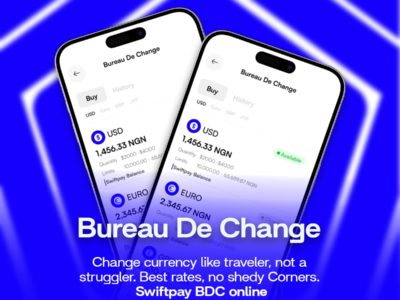
SwiftPay addresses all these needs. Its platform includes real‑time transfers, online money exchange (bureau de change), multi‑currency accounts, and tools to unify both fiat and crypto, making it easier for Africans and the diaspora to manage funds globally.
In contrast, many existing platforms, even well‑capitalized ones , still leave gaps. Some focus on payments but not invoicing; others specialize in cross‑border services but lack core domestic utility; still others offer savings but not seamless billing. SwiftPay’s edge lies in bringing all these elements together under a single, intuitive user experience.
Free Invoicing: A Strategic Advantage.
One of the clearest differentiators for SwiftPay is its free automated invoicing, a feature that is often monetized by competitors. Automated invoicing typically reduces administrative costs significantly (from roughly $6.20 per manual invoice to about $1.83 with automation), yet many platforms still charge for access. SwiftPay’s decision to include this feature at no additional cost is strategic:
- It accelerates merchant onboarding and retention
- It reduces barriers to adoption for micro and small businesses
- It creates a sticky relationship between the user and the platform
- It strengthens SwiftPay’s ecosystem effect , where multiple products benefit from one another
When businesses issue invoices directly within SwiftPay, transactions (payments received), reconciliation, and reporting are more efficient, which drives higher engagement and loyalty.
Real World Impact and Market Dynamics
Beyond domestic borders, Africa’s cross‑border payment space is large and ripe for disruption. Startups like Afriex are expanding payment services into China, India, and Pakistan to facilitate faster and cheaper remittances, highlighting how African fintechs are solving real global problems by bypassing traditional banking rails.
Others, like Juicyway, are enabling African businesses to open virtual USD/CAD accounts and settle transactions with competitive FX rates addressing dollar liquidity bottlenecks that often slow commerce.
SwiftPay’s integrated model positions it well to benefit from these trends by combining competitive money exchange, global remittances, and transparent business finance tools. Instead of charging fees per product, it builds a value engine where each part of the customer journey supports the others.
The Road Ahead: Scaling Financial Inclusion
As Nigeria continues to lead fintech adoption in Africa, platforms like SwiftPay are crucial in bridging gaps left by traditional financial systems. The future points toward:
- Greater automation of business financial workflows
- Regulatory alignment with digital financial reporting
- Lower cost cross‑border transactions
- Integrated platforms that serve both consumers and businesses
In a market where fintech remains the most dynamic segment of technology investment and adoption, SwiftPay’s integrated, cost‑efficient, feature‑rich ecosystem gives it a strategic advantage. By offering money exchange, business payments, and free invoicing under one umbrella, SwiftPay isn’t merely participating in the market’s growth, it’s shaping it.
As Nigeria’s fintech scene evolves, the companies that succeed will be those that solve real-world problems, empower businesses of all sizes, and deliver financial access without friction. SwiftPay stands at that intersection, poised to become not just a player, but a defining force in African financial technology.