By
By 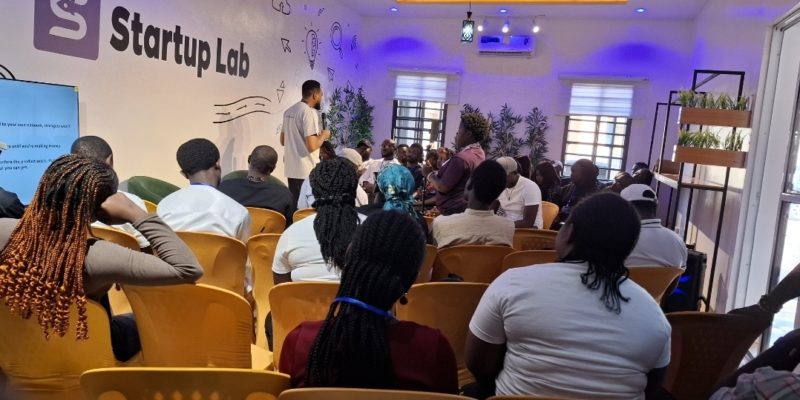
By Nana Theresa Timothy and Anna-Nancy Emma
Startup Lab hosted the first edition of Startup Lab Friday, themed “Early Validation and Market Signals.” The event brought together founders, aspiring entrepreneurs, and product enthusiasts for a practical and deeply insightful conversation about what it truly takes to build products that work in the real world.
Unlike many startup events that focus heavily on hype, funding announcements, or polished success stories, this session went back to the fundamentals. It centered on validation, understanding whether a problem is real, whether people truly care about your solution, and most importantly, whether they are willing to pay for it.
From the very beginning, the tone was clear: this was a builder’s room.
Understanding Early Validation
The theme of the event “Early Validation and Market Signals” shaped every conversation. Speakers stressed that many founders make the mistake of building too much before testing demand.

Moses Amama, The Startup Lab founder explained that founders often believe they need a fully developed product before showing it to the world. But that mindset can be dangerous.
A lot of you believe you need a fully fleshed product before people start paying. You don’t. Define the value proposition clearly and put it out there.” Moses Amama
Early validation, he explained, is not about perfection. It is about learning. Founders were encouraged to test simple versions of their ideas sometimes just a landing page or a structured conversation with potential users to see if people truly care.
The biggest signal? Payment.
“Payments are the ultimate form of validation.”
Moses shared that many people will compliment your idea, promise to use it, and even suggest how much they would pay. But until they actually pay, it is just talk. Real commitment comes with action.

Throwing Away Embarrassment
One of the most powerful moments during the event came when founders were challenged to confront their fears.
If you’ve made up your mind that you’re going to build something, the first thing you must throw out of the door is embarrassment.” Moses Amama
Embarrassment, the speaker explained, is what keeps founders from launching early. It makes them afraid to share unfinished products. It stops them from asking honest questions. It delays progress.
To illustrate this, he shared an example of a founder who launches multiple startup ideas in a year just to see which one gains traction. Rather than becoming emotionally attached to one concept, the founder tests repeatedly, studies the response, and then decides where to invest more time and resources.
That mindset of experiment, observe, adjust, perfectly captured the essence of “market signals.”
Learning to Filter Feedback
Another key discussion focused on how founders interpret feedback.
In today’s social media culture, it is easy to mistake praise for progress. A product post may attract 100 or more positive comments, but do those comments actually improve the product?
The speaker explained that founders must learn to extract meaningful insights from noise. Compliments feel good, but they don’t solve problems.
Instead of accepting generic praise like “This is amazing,” founders were encouraged to dig deeper:
- What exactly did you like?
- What was confusing?
- Would you pay for this?
- Why or why not?
At the same time, they were warned not to be discouraged by harsh criticism.
This balanced approach not overvaluing praise and not overreacting to negativity is critical for interpreting real market signals.
Advice from the CEO: Start with People’s Lives
Moses, delivered sharp, memorable advice that captured the heart of the theme.
You should never ask anyone if your idea is good. Ask about their life instead.”
He explained that when founders ask, “Is this a good idea?” people tend to respond politely. But when you ask about their daily struggles, frustrations, and routines, you uncover real problems worth solving.
He also reminded founders to start close to home:
“If you can’t sell to your own network, strangers won’t buy either.”
This statement pushed many attendees to rethink their strategy. Before chasing a large audience, validate within your immediate circle. If the people who trust you won’t pay, the wider market probably won’t either.
And perhaps the most practical advice of the day:
“Don’t spend money until you’re making money.”
In a startup ecosystem where founders often rush into spending on branding and expansion, this was a grounded reminder to prioritize revenue and sustainability.
Founder Spotlight: Cloove AI
The Founder Spotlight session featured Josiah Ovye Yahaya, Founder of Cloove AI, who shared his journey of identifying and validating a real market problem.
In simple terms, he described the product this way:
We help businesses turn conversations into structured operations without changing how they already work.” Josiah Yahaya
Cloove AI focuses on conversational commerce, helping businesses that sell via WhatsApp, Instagram, and Telegram track sales, inventory, and payments without switching to complex software.
Josiah explained that his team noticed many hardworking small business owners were passionate and consistent, yet losing money because they lacked proper records.
“These people are hardworking and serious, but they’re losing money because they don’t understand how well their business is performing.”
Instead of assuming the problem, he went into markets in Abuja to speak directly with traders. Those real conversations validated the pain point before heavy investment in development.
His story was a practical example of early validation done right.
Internal Founder Showcase: Lotwise
The event also featured an internal founder showcase with Yusuf Gata, Co-founder of Lotwise, a real estate product designed to simplify property processes.
Though still in its early phase, Lotwise represents the kind of locally driven solutions emerging from the ecosystem. The showcase allowed attendees to see what early-stage building looks like imperfect, evolving, but grounded in solving real problems.
A Platform for Continuous Growth
Beyond the conversations, Startup Lab Friday signaled something bigger: the creation of a consistent platform where founders can learn from one another monthly.
Plans were shared to establish a startup advisory channel where builders can access resources and discuss ideas. For now, it remains free, but the long-term impact could be significant.
Why This Event Matters
Startup Lab Friday: Early Validation and Market Signals was more than a theme, it was a mindset reset.
It reminded founders that:
- Validation comes before scaling.
- Payments speak louder than praise.
- Embarrassment kills progress.
- Real feedback is specific.
- Market signals must be studied, not assumed.
As attendees left the event, the atmosphere was not just motivational — it was practical. Builders walked away with clarity, frameworks, and renewed confidence to test, learn, and build smarter.
If this first edition is anything to go by, Startup Lab Friday is poised to become a cornerstone for serious founders who are ready to move beyond ideas and into impact.