By
By 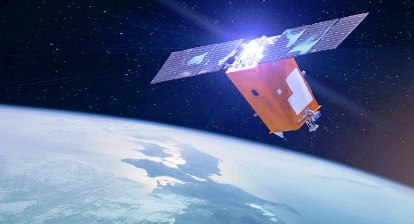
SES Announces meoSphere MEO Network Rollout
SES has announced plans to deploy meoSphere, a next-generation medium Earth orbit (MEO) satellite network targeted for operation by 2030.
RELATED: Will LEO satellite direct-to-cellular networks make traditional mobile networks obsolete?
The new system is designed to significantly expand SES’s MEO capacity, enhance global broadband performance, and support secure, resilient connectivity for governments, enterprises, and mobility markets worldwide.
Strategic Partnership with K2 Space
The meoSphere programme will begin with a close collaboration between SES and K2 Space, focused on accelerating satellite production and reducing supply-chain risks.
Under the first phase of deployment, SES will integrate its software-defined payloads—developed and manufactured in Luxembourg—with 28 high-power satellite platforms built by K2 Space. This approach gives SES tighter control over costs, timelines, and scalability, while laying the groundwork for future network expansion.
Boosting Capacity, Speed, and Efficiency
meoSphere represents SES’s next-generation MEO architecture, engineered to deliver:

- Significantly higher broadband capacity
- Faster user data speeds
- Smaller and lower-cost user terminals
These performance gains are driven by advances in software-defined networking, payload and terminal technologies, 5G non-terrestrial network (5G-NTN) standards, and MEO’s inherent advantages, including low latency, efficient geographic coverage, and flexible capacity steering. The network will also be compatible with Europe’s IRIS2 secure connectivity initiative.
Designed for Government, Mobility, and Telecom Markets
Orbiting at approximately 8,000 kilometres above Earth, meoSphere is being designed as a multi-mission, adaptable network capable of supporting diverse use cases.
For government and defence customers, meoSphere will deliver resilient command-and-control communications, including support for sovereign waveforms and military Ka-band spectrum. Its architecture offers a distinct security profile compared to dense low Earth orbit constellations, with optical intersatellite links (OISLs) ensuring traffic routes through secure gateways.
For aviation and maritime operators, the network will provide fibre-equivalent throughput and low latency across global routes, supporting passenger connectivity, crew communications, and operational systems. meoSphere will also enable multi-orbit solutions in combination with LEO and GEO satellites.
For telecom operators and enterprises, meoSphere will function as a high-performance 5G-NTN connectivity layer, extending network reach and offering path diversity for critical communications.

A Backbone for the Growing Space Economy
Beyond broadband, meoSphere is positioned as a “backbone network in space,” enabling real-time data relay between constellations across all orbital regimes. Its flexible architecture will support hosted payloads, in-space data connectivity, edge computing, and ultra-secure data storage—reducing reliance on ground infrastructure and enabling advanced analytics and AI workloads in orbit.
Phased Deployment and Risk Reduction
Over the next three years, SES plans to launch a series of MEO pathfinder missions with K2 Space. These missions will validate satellite platforms, payload performance, and operational concepts. Thus, progressively increasing complexity while reducing risk ahead of full-scale deployment.
The initiative is included in SES’s previously announced 2026 capital expenditure guidance. It aligns with the company’s policy of disciplined capital deployment. SES also plans to maintain a dual transatlantic supply chain to strengthen resilience against parts, permitting, and logistics constraints.
“Space is the invisible backbone of the global data economy and national security. With meoSphere, we are building essential infrastructure faster, at scale, and with the resilience and security our government and commercial partners depend on,” said Adel Al-Saleh, CEO of SES.
Karan Kunjur, Co-Founder and CEO of K2 Space, said the partnership validates the company’s mission to deliver high-power satellites. Advanced satellite infrastructures capable of supporting next-generation space architectures at speed and scale.
Key meoSphere Specifications at a Glance
- Orbit: 8,000 km altitude
- Phase 1 Architecture: 4 inclined orbital planes, 28 satellites
- Power: 20 kW per satellite
- Connectivity: Optical intersatellite links (OISLs), up to 100 Gbps optical relay
- User Access: Up to 1 Gbps via flat-panel ESAs; up to 4 Gbps via parabolic antennas
- Standards: 5G-NTN and 3GPP compliant