By
By 
Recent moves by executives and major shareholders at NVIDIA, Palantir, and Meta have sparked fresh debate. These companies sit at the top of the market hierarchy, but the insider activity raises questions about their future. The central concern: is the current mega-cap leadership sustainable, or could a realignment be on the horizon?
RELATED: Nvidia revenue surges 85% to $81.6 billion as AI demand soars, but market wants more
BestBrokers have examined this in their latest report on the current mega cap companies, exploring their market capitalisations, sectors, industries, and the evolving dynamics of market leadership.
A lively debate persists over which firms are really calling the shots in global equity markets. To shed light on the matter, BestBrokers turned to the numbers. They examined all 97 mega-cap companies—those with market caps exceeding $200 billion—using data captured on 17 June 2026.
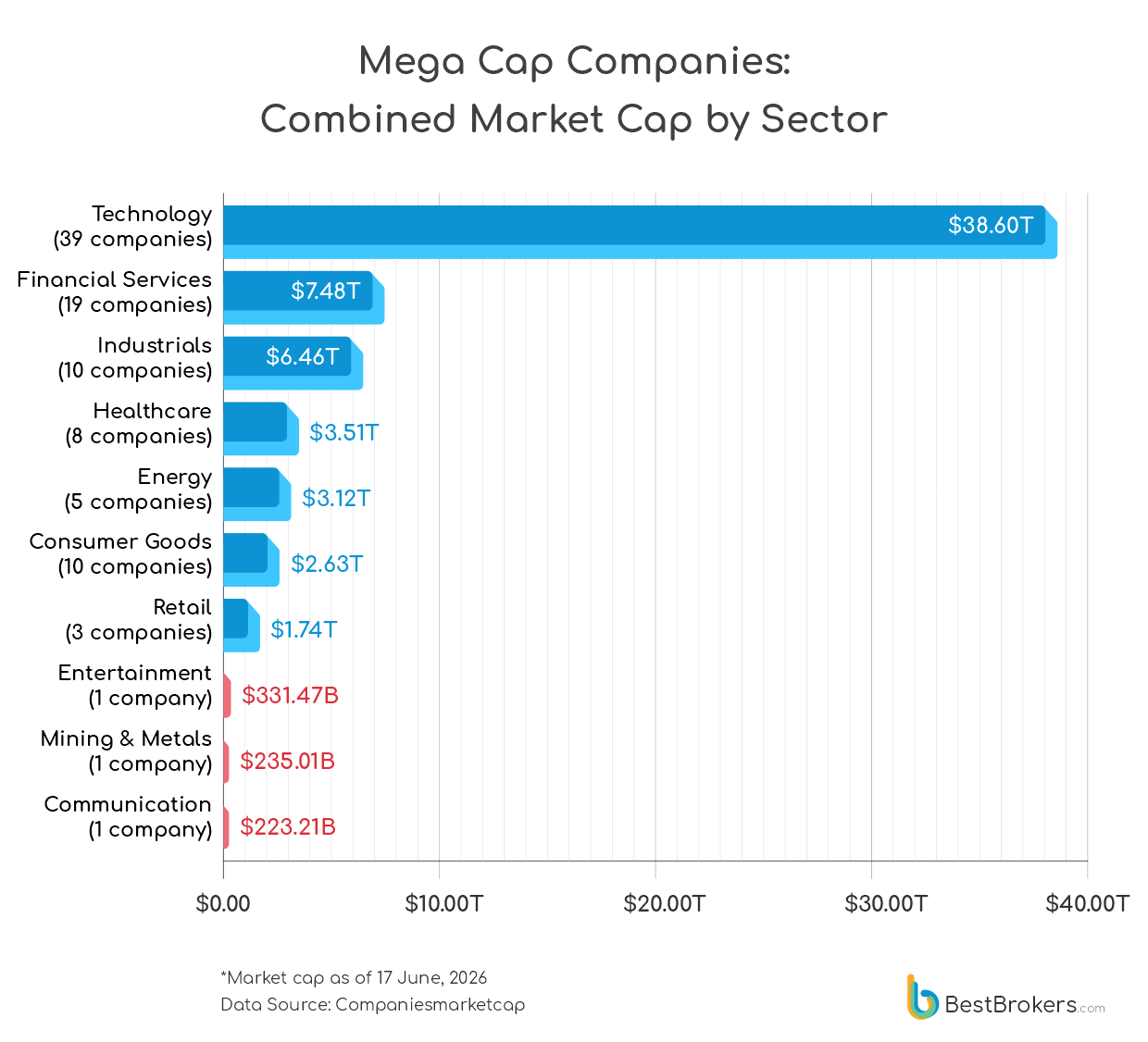
They classified these companies by country, sector, and industry, and calculated both total and average market capitalisation across sectors, enabling cross-sector comparison of size, concentration, and market dominance.
Then, they added three-year (2023-2026) and one-year (2025-2026) shifts to capture recent momentum and structural changes in market leadership. The complete dataset is available on Google Drive via this link.
“NVIDIA is strongest-performing mega-cap company’ Broadcom records exceptional growth”
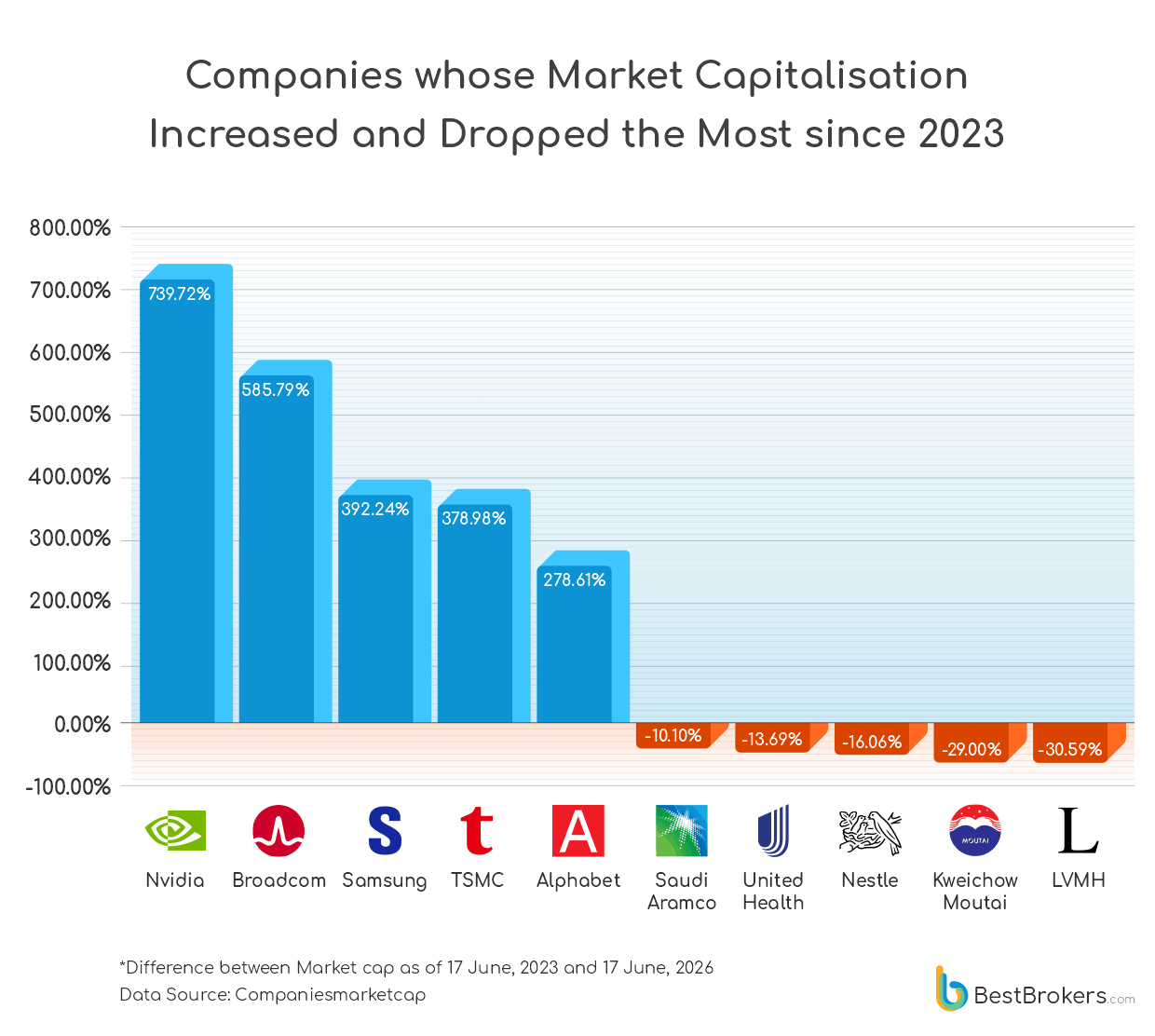
Data shows that NVIDIA has been the strongest-performing mega-cap company since 2023, with its market capitalisation increasing more than eightfold – from $598.25 billion to $5.02 trillion.
Broadcom has also recorded exceptional growth, with its market capitalisation rising by 585.79% to reach $1.79 trillion in June. Samsung has emerged as another major winner, with its market value increasing nearly fivefold since 2023, climbing from $304.96 billion to $1.5 trillion..
“Mega cap companies whose market capitalisation jumped the most”
Here are the mega cap companies whose market capitalisation jumped the most YoY:
(17 June, 2025 -17 June, 2026)
- NVIDIA – from $598.25 billion to $5.02 trillion (+739.72%)
- Broadcom – from $261.34 billion to $1.79 trillion (+585.79%)
- Samsung – from $304.96 billion to $1.5 trillion (+392.24%)
- TSMC – from $461.09 billion to $2.21 trillion (+378.98%)
- Alphabet (Google) – from $1.20 trillion to $4.53 trillion (+278.61%)
- Eli Lilly – from $308.48 billion to $1 trillion (+224.49%)
- Meta Platforms – from $502.14 billion to $1.52 trillion (+203.42%)
- ASML – from $249.92 billion to $695.25 billion (+178.19%)
- Amazon – from $961.45 billion to $2.65 trillion (+175.23%)
- Tesla – from $577.53 billion to $1.52 trillion (+163.15%)
Few key takeaways from the report
- NVIDIA is the clear standout among mega-cap companies, recording the strongest market capitalisation growth since 2023. As demand for its graphics processing units (GPUs) has exploded among cloud providers and technology giants deploying AI models, the company’s value has surged 739.72%, more than eightfold, from $598.3 billion to $5.02 trillion, allowing it to overtake every other listed company and become the world’s most valuable business.
- Broadcom ranks second for market cap growth since 2023, with its valuation increasing 585.79%, from $261.34 billion to $1.79 trillion. This dramatic rise highlights how the AI boom has extended beyond NVIDIA, rewarding companies that supply the networking, connectivity, and semiconductor technologies underpinning AI data centres.
- Samsung has emerged as one of the biggest long-term winners while also leading the most recent growth rankings. Since 2023, the South Korean technology giant has nearly quintupled in market value, climbing from $304.96 billion to $1.5 trillion, becoming the third-fastest-growing mega-cap company over the period. It also recorded the strongest one-year increase of any mega cap, with its market capitalisation soaring 453.12% over the past year alone. The surge was largely driven by soaring demand for Samsung’s AI memory chips, particularly high-bandwidth memory (HBM), which has become a critical component in AI accelerators powering data centres.
- Semiconductor companies dominate the rankings, with four of the top eight fastest-growing mega caps coming from the chip industry: NVIDIA (+739.72%), Broadcom (+585.79%), TSMC (+378.98%), and ASML (+178.19%). Their strong gains suggest that investors have rewarded companies across the AI hardware ecosystem, from chip design and manufacturing to the specialist equipment needed to produce advanced semiconductors.
Exceptional trailblazers
- Alphabet has also recorded exceptional growth, demonstrating that the AI-driven market rally has extended beyond chip designers. Alphabet has almost quadrupled in market value since 2023, rising 278.61% to $4.53 trillion.
- Eli Lilly is the only non-technology company among the fastest-growing mega caps, with its market capitalisation increasing 224.49% since 2023 to surpass $1 trillion. Its performance stands out in a ranking otherwise dominated by technology companies, reflecting strong investor confidence in the pharmaceutical sector, particularly around its blockbuster diabetes and weight-loss treatments.
- Despite more than tripling in value since 2023, Meta is the only company in the top performers to post a decline over the past year. Its market capitalisation is still 203.42% larger than in 2023, but it has fallen 9.68% over the last 12 months, suggesting that investor enthusiasm has cooled relative to other AI-focused mega-cap companies.
- Technology companies overwhelmingly dominate the ranking, accounting for nine of the ten fastest-growing mega-cap companies since 2023. This concentration underscores how AI, semiconductors, cloud computing, and digital platforms have been the primary drivers of market value creation among the world’s largest listed companies over the past three years.
“Next chapter of AI boom will be shaped by evidence of sustainable”

‘Over the past three years, investors have poured unprecedented amounts of capital into the companies building the infrastructure behind the AI revolution, from chip designers and manufacturers to cloud platforms and digital ecosystems. Yet history suggests that markets rarely move in a straight line. As valuations climb to record levels, expectations inevitably rise alongside them, leaving even the world’s most valuable companies under increasing pressure to prove that today’s optimism can translate into tomorrow’s earnings.
This marks a shift from an era where scale alone defined corporate leadership to one where innovation, execution and investor confidence move in lockstep. The companies leading today’s mega-cap rankings are not merely competing for market share – they are competing for belief. Recent market reactions, including muted responses to record financial results and growing investor scrutiny of AI leaders, suggest that the next chapter of the AI boom will not be shaped by excitement over potential but by evidence of sustainable, long-term value creation. In that environment, market leadership is likely to become more fluid, with fortunes determined not only by technological breakthroughs but by the ability to consistently exceed exceptionally high expectations. ’
– comments Alan Goldberg, lead data analyst at BestBrokers.
Get further insights and full report. The raw dataset is also available via the following Google Drive link.