By
By 
Oracle and Meta’s latest job cuts confirm it: thousands of roles are disappearing as the tech industry pivots to AI and automation. This is revealed by RationalFX in its latest report, exploring the scale of global tech industry layoffs in 2026.
RELATED: Amazon accounts for over half of 2026’s global tech layoffs
Mounting warnings from business leaders and economists point to artificial intelligence as a key accelerator of these layoff waves. Companies are restructuring around automation, machine learning, and efficiency gains. The consequence? The transaformation is putting not only individual roles but entire job functions at risk.
To determine which companies led 2026’s biggest job cuts, the team at RationalFX compiled layoff data from multiple verified sources. These include U.S. WARN notices, TrueUp, TechCrunch, and the Layoffs.fyi tracker, covering announcements made since the start of 2026. The full ranking of tech companies by number of layoffs is available on Google Drive via this link.
Oracle, Amazon, and Block Lead the Year’s Biggest Job Cuts
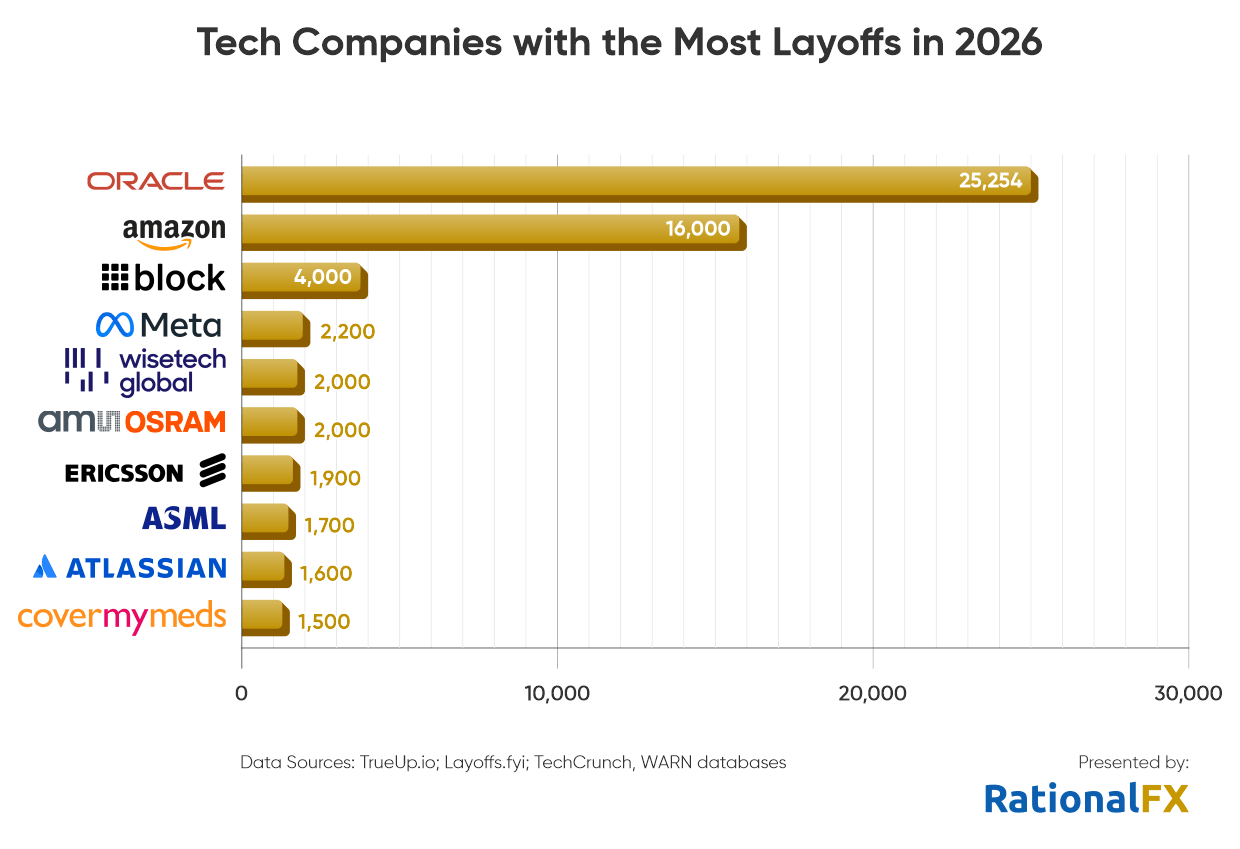
Data shows that so far this year, a total of 78,557 tech layoffs have been recorded globally, with the United States accounting for the vast majority, 59,510 job cuts across 54 companies, or roughly 76.7% of the total. American companies Oracle (25,254), Amazon (16,000), and Block (4,000) account for the most significant workforce reductions so far this year.
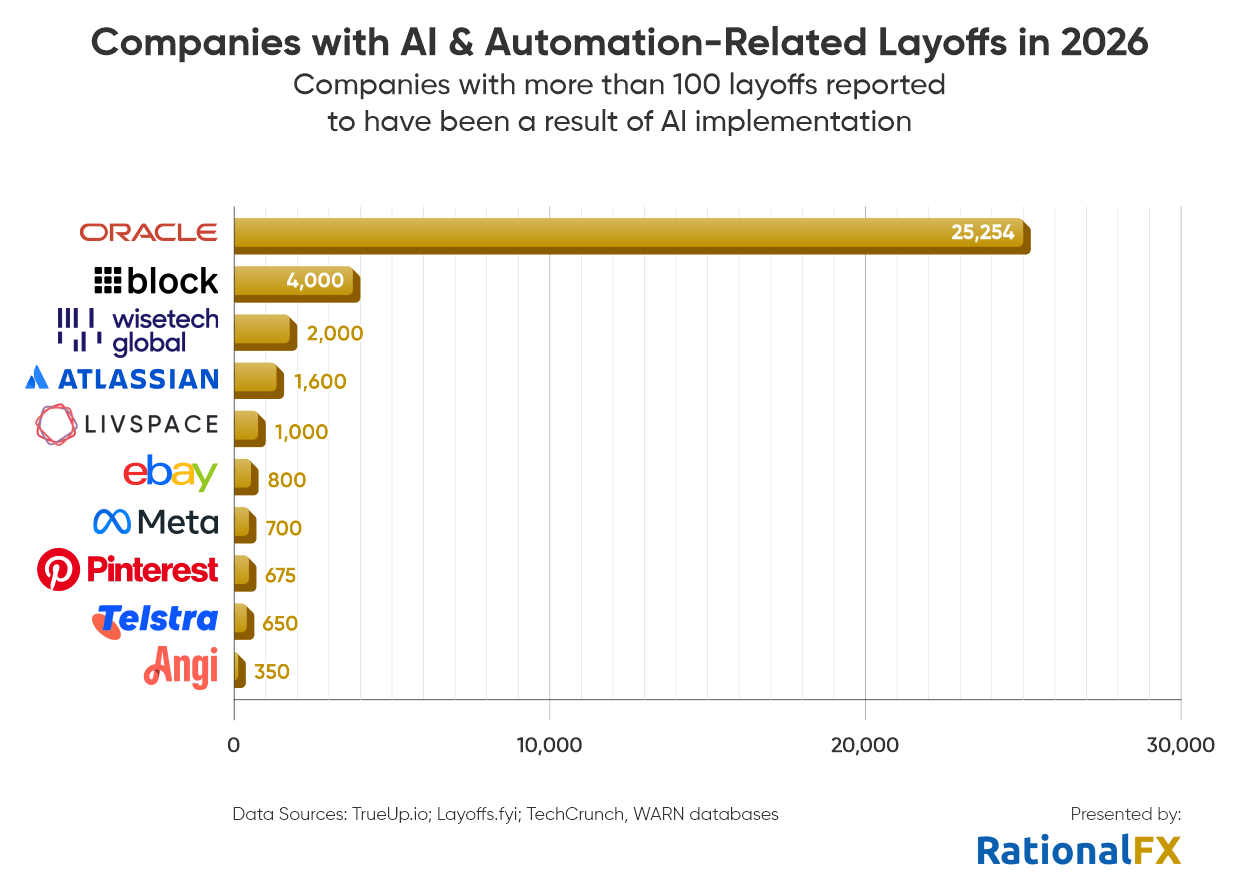
Notably, Oracle’s cuts are entirely AI-driven, reflecting a broader shift towards reallocating resources into automation and AI infrastructure. This has helped propel a wider trend across the industry. AI-related restructuring are now accounting for 37,638 layoffs, close to half of all tech job losses in 2026. According to our calculations, if the current pace of tech layoffs continues, 2026 will end with roughly 318,592 tech layoffs in total. It will come closer to the tech layoff peak in 2023 when an estimated 430,000 people lost their jobs.

These are the Tech Companies With The Most Layoffs in 2026
- Oracle (United States) – 25,254 layoffs
- Amazon (United States) – 16,000 layoffs
- Block (United States) – 4,000 layoffs
- Meta (United States) – 2,200 layoffs
- WiseTech Global (Australia) – 2,000 layoffs
- ams OSRAM (Austria) – 2,000 layoffs
- Ericsson (Sweden) – 1,900 layoffs
- ASML (Netherlands) – 1,700 layoffs
- Atlassian (Australia) – 1,600 layoffs
- CoverMyMeds (United States) – 1,500 layoffs
Other highlights from the report
- Since the start of 2026, 78,557 tech workers have lost their jobs globally, with the vast majority of cuts concentrated in the United States, which accounts for 59,510 redundancies, or roughly 76.7% of the global total, across 54 companies.
- Outside North America, Australia is the hardest-hit country with 4,450 layoffs, driven by just four companies whose restructuring programmes have had an outsized regional impact: WiseTech Global (2,000), Atlassian (1,600), Telstra (650), and Envato (200). What sets Australia apart, however, is not just the concentration but the cause – every single one of these layoffs has been tied to AI integration and automation, a pattern not replicated in any other country in the dataset.
- In Europe, Austria leads with 2,000 cuts, all from semiconductor manufacturer ams OSRAM, followed by Sweden (1,938), driven primarily by Ericsson’s ongoing restructuring, and the Netherlands (1,700), where ASML accounts for the entirety of the country’s total despite reporting record profits in 2025. Further cuts have been recorded in the UK (1,050), Spain (750), France (259), the Czech Republic (250), and Germany (200), with the region’s redundancies concentrated heavily in the semiconductor, telecom, and enterprise software sectors.
Asia Sees a More Fragmented Layoff Landscape Across Diverse Markets
- Asia tells a more fragmented story, with layoffs spread across a wider range of markets and business types. India accounts for 1,620 cuts across six companies, including Flipkart, Ola Electric, and HGS, while Israel follows with 1,539 across seven companies spanning cybersecurity, gaming, and AI development. Singapore accounts for 1,196 layoffs across three companies, including home design platform Livspace and crypto exchange Crypto.com, with further cuts recorded in China (150), Japan (70), and the UAE (5).
- AI has become almost synonymous with the global layoff wave of 2026 in the tech sector. 37,638 job reductions, nearly half of the global total, have been attributed directly or indirectly to AI implementation and workflow automation, though the figure is heavily skewed by Oracle, which alone accounts for more than two thirds of all AI-linked cuts. Beyond Oracle, companies including Block, Atlassian, WiseTech Global, and Telstra have all explicitly framed their reductions as part of a shift toward AI-assisted operations, a pattern that is becoming harder to take entirely at face value. Analysts predict that a big portion of all AI-attributed layoffs will result in quiet rehiring, often offshore and at lower salaries.
Automation Isn’t Ready to Replace Human Labour—Yet
‘What we are seeing in 2026 is the result of several converging trends being reported under the same headline. The post-pandemic correction was always going to play out. Companies hired aggressively into uncertainty and are now unwinding that. But the speed and the framing have changed. Oracle eliminated tens of thousands of roles after posting a 95% jump in net income, Amazon cut 16,000 jobs off the back of record revenues of $716.9 billion, and Meta has been trimming headcount while simultaneously allocating over $100 billion to AI infrastructure. When telecoms, semiconductors, fintech, and logistics software are all citing the same driver at the same time, it suggests something more structural than a sectoral correction: a fundamental reassessment of what human labour is worth relative to automated systems that are, in many cases, still far from ready to replace it.’
– comments Alan Cohen, analyst at RationalFX.
These conclusions were made based on layoff announcements, WARN notices, and independent layoff reports between January and March 2026. More information on the tech sector layoffs, the underlying reasons for job reductions, and our complete research methodology can be found in the full report.
The raw dataset is also available on Google Drive at the following link. Feel free to use the data or graphics, provided proper attribution is given with a link to the original source.