By
By 
With AI now embedded in daily digital life and core professional workflows, public debate in early 2026 is increasingly focused on energy use, safety, and sustainability.
RELATED: ChatGPT Atlas: The first ftep toward AI operating systems
As more and more people use AI, however, its energy demand and environmental impact grows, here is a comprehensive report, revealing OpenAI is on track to join the largest subscription businesses in the world and generate up to $80 billion a year from paying users alone.
To better understand the scale of AI and the most widely used chatbot right now, in particular, BestBrokers took a closer look at what running ChatGPT really consumes – and how that compares with what its developer, OpenAI, earns from paid subscriptions.
“Our analysis estimates ChatGPT’s electricity demand alongside subscription revenues, offering a rare side-by-side view of the economics behind the world’s most widely used AI tool,” BestBrokers stated.
ChatGPT consumes energy close to $2.4 billion per year
Using publicly disclosed figures, media reporting, and conservative assumptions, we tried to put revenues into perspective against the company’s operating and energy costs. We calculated that processing its 2.5 billion daily user queries, ChatGPT consumes energy that, if purchased at regular rates and sourced from the U.S. grid, would cost OpenAI close to $2.4 billion per year. That will be the cost of electricity needed to answer questions, an estimated 17.23 billion kWh per year.
Meanwhile, we estimated that the company is likely generating roughly $955 million from paid subscriptions every month or around $11.46 billion per year – assuming the reported figure of 35 million paying subscribers is correct.
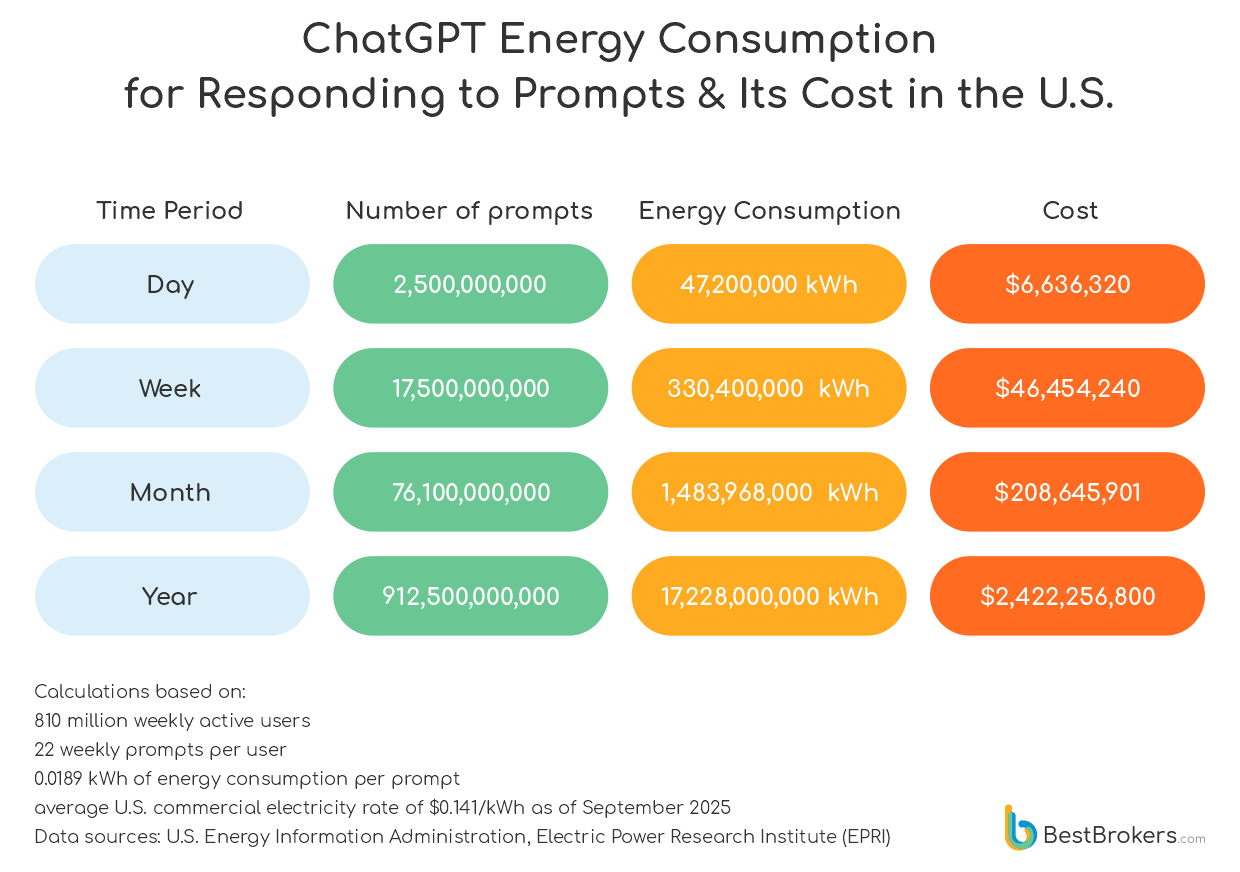
Here are a few key takeaways from the report
- OpenAI reportedly had around 35 million paying subscribers in mid-2025, spanning consumer and business tiers, with internal targets of 220 million by 2030, positioning ChatGPT alongside global subscription giants like Netflix and Spotify.
- Based on reasonable assumptions about plan mix and pricing, paid subscriptions could be generating around $955 million per month, or $11.5 billion annually, dominated by Plus users but materially supported by higher-priced business plans.
- Even with substantial compute and electricity costs, estimated at roughly $2.4 billion per year, subscription revenue alone could cover those expenses in well under a quarter, underscoring the scale and profitability potential of OpenAI’s subscription model.
- Having 220 million paid subscribers by 2030 might be ambitious, but not implausible. At that scale, revenues could be, according to our estimations, upwards of $52 billion annually from subscriptions alone.
The key variable is average revenue per user (ARPU). Using conservative assumptions:
- At $20/month ARPU → ~$4.4 billion per month, ~$52.8 billion per year
- At $25/month ARPU → ~$5.5 billion per month, ~$66 billion per year
- At $30/month ARPU → ~$6.6 billion per month, ~$79 billion per year
OpenAI among the largest subscription businesses in the world
Even at the low end, this would place OpenAI among the largest subscription businesses in the world, on par with or exceeding today’s biggest consumer platforms. Just for reference, Netflix generated $39 billion revenue in 2024, with growth fueled by over 300 million global members, higher prices, increasing ad-tier sign-ups, and strong content. Another massive consumer platform, Spotify, posted €13.82 billion (around $16.96 billion) revenue in 2024, the majority of which came from premium subscribers.

‘Reaching that scale would require ChatGPT to move decisively beyond power users and businesses into mass-market utility territory – embedded in work, education, operating systems, and daily consumer workflows. Given OpenAI’s brand dominance, distribution via Big Tech partnerships, and the growing normalization of paying for AI tools, the target is aggressive but within reach if AI becomes as indispensable as search or productivity software.
This would make ChatGPT a market-defining platform, setting pricing norms, user expectations, and product standards across the AI ecosystem. Smaller AI tools would face intense pressure to differentiate or integrate rather than compete head-on, while Big Tech rivals would be forced into either aggressive bundling or price compression. In effect, a 200 million-plus subscriber ChatGPT would accelerate consolidation, making AI tools less of a fragmented app market and more of a winner-takes-most platform economy.’
– comments Alan Goldberg, data analyst and author at BestBrokers.
Additional information and estimates for the power consumption from ChatGPT’s processing of 2.5 billion daily queries are available in the full report. It also features detailed calculations, sources, and the complete methodology behind the findings. You’re welcome to use any of the data or graphics provided, but please make sure to include proper attribution by linking back to the original work.