By
By 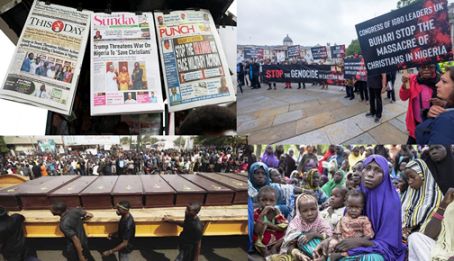
By Osasómé C.O
A fierce online debate has erupted across West Africa and beyond over renewed claims of a “Christian genocide” in Nigeria. It’s a topic that has sharply divided Nigerians along religious, regional, and political lines.
RELATED: UNESCO: Half of Holocaust-related content on Telegram denies or distorts the facts
Some human rights organizations and Christian advocacy groups insist that Christians are being systematically targeted in parts of the country. But the Nigerian government and independent analysts reject the characterization. To them, the crisis is a complex national security challenge affecting both Christians and Muslims.
The issue gained renewed global traction after former U.S. President Donald Trump reportedly claimed he had ordered the Pentagon to prepare for possible military action in Nigeria over alleged atrocities against Christians. Trump’s statement has triggered widespread outrage and diplomatic pushback from Abuja.
Government Denies Claims of Religious Genocide
The Federal Government of Nigeria has categorically dismissed allegations of a Christian genocide, calling them false, misleading, and politically motivated.

Officials insist that violent attacks across the country including those by Boko Haram, ISWAP, and armed bandit groups are not faith-based. These attacks are part of a broader national security failure affecting Nigerians of all religions, they argue.
Government spokespersons highlight Nigeria’s religious diversity at the highest levels of leadership. The First Lady and several military chiefs are Christians, these officials note to underscore the administration’s commitment to protecting citizens regardless of faith.
Religious and Advocacy Groups Disagree
Christian advocacy organizations, including Open Doors, Genocide Watch, and the International Christian Concern (ICC) have severally expressed concerns. These organizations argue that the pattern and frequency of attacks — particularly in the Middle Belt — point to religiously motivated violence.
They cite evidence of church burnings, abductions of clergy, and mass killings of Christian villagers, often blamed on radicalized Fulani militants and Islamist insurgents.
Some reports estimate that tens of thousands of Christians have been killed over the past decade, with thousands more displaced.

According to Genocide Watch, Nigeria is currently at multiple stages of potential genocide, including “Persecution” and “Extermination.”
Analysts Call for a Nuanced Understanding
However, many researchers and security analysts caution against oversimplifying the violence as purely religious.
Data from the Armed Conflict Location & Event Data (ACLED) project and other research bodies show that ethnic tensions, resource competition, and state failure play major roles in fueling the bloodshed.
Conflicts between farmers and herders — often from different ethnic or religious backgrounds — have escalated due to land scarcity, climate change, and weak law enforcement.
Analysts argue that in some regions, Muslim communities have also suffered mass casualties, suggesting that geography, not religion, often determines who becomes a victim.
International and U.S. Reactions
The debate has reached international attention, particularly in the United States. Prominent political figures such as Donald Trump and Senator Ted Cruz have alleged that a Christian genocide is unfolding in Nigeria.
Trump’s statement, threatening possible U.S. military intervention, has drawn condemnation from Nigerian officials. Abuja described it as “external interference” and a violation of Nigeria’s sovereignty.
Nigeria’s Ministry of Foreign Affairs reiterated that while it welcomes international cooperation in combating terrorism, any foreign military intervention without consent would be unacceptable.
Fact-Checkers and Online Debate
Fact-checking organizations and security observers have urged caution. They are warning that some of the data fueling the “genocide” claims are unverified or exaggerated.
They emphasize that both Christians and Muslims remain victims of widespread terrorism, banditry, and communal violence.
On social media, Nigerians remain divided:
- Some argue that global inaction in the face of widespread killings justifies external intervention.
- Others insist that U.S. threats are based on misinformation and risk worsening Nigeria’s already fragile security situation.
A Crisis of Violence — But Not Consensus
What remains indisputable is that Nigeria faces one of the world’s deadliest internal security crises., Thousands are killed annually in insurgent attacks, bandit raids, and communal conflicts.
However, whether this violence constitutes a targeted Christian genocide or a complex national tragedy remains a point of deep contention. It is one that continues to shape public discourse, diplomacy, and faith relations in Africa’s most populous nation.