By
By 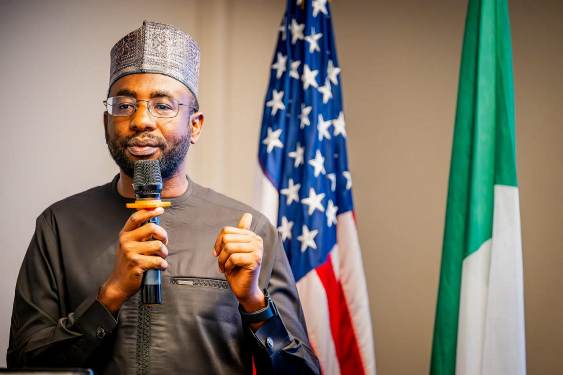
Abdullahi Highlights Trust as the Foundation of Nigeria’s Digital Economy
The Director General of the National Information Technology Development Agency (NITDA), Kashifu Inuwa Abdullahi, has reaffirmed Nigeria’s commitment to strengthening its digital collaboration with the United States. This partnership focuses on building a secure ecosystem through data privacy, AI, cybersecurity, and capacity development.
RELATED: NITDA reaffirms Nigeria’s open governance drive as OGP presents global digital governance awards
Abdullahi made this known while delivering a keynote address at the Nigeria Data Privacy Capacity Building Workshop, organised by the United States Department of State in partnership with the Nigerian Mission and key stakeholders in the digital ecosystem.
He described the workshop as a clear demonstration of the enduring partnership between Nigeria and the United States. Abdullahi noted that both countries are working deliberately to address emerging digital risks and opportunities in a rapidly evolving technology landscape.
Nigeria’s Digital Boom Drives Urgent Need for Stronger Safeguards
According to him, Nigeria’s expanding digital economy has intensified the need for robust data protection and cybersecurity frameworks. He noted that while AI is strengthening digital defence systems, it is also enabling more sophisticated cyber threats, including AI-driven phishing, fraud and data breaches.
“These realities demand stronger regulations, smarter enforcement and the deployment of AI-powered security systems,” Abdullahi said,
He pointed to Nigeria’s Data Protection Act and ongoing reforms as critical steps toward building a safer digital environment.
Growing Nigeria–U.S. Collaboration on AI and Cybersecurity
The NITDA boss recalled that in April 2024, Nigeria and the United States, through the U.S.–Nigeria Binational Commission, agreed to expand cooperation in areas such as data privacy, artificial intelligence, cybersecurity and digital capacity building.
He further highlighted the joint hosting of an Artificial Intelligence Conference by the Nigerian Government and the U.S. Mission in Nigeria, as well as engagements with leading U.S. cybersecurity firms to explore partnerships aimed at strengthening Nigeria’s technology ecosystem.
“These efforts are not isolated initiatives. They reflect a structured and growing partnership designed to position Nigeria as a trusted digital hub in Africa,” Abdullahi said.
Trust as the Cornerstone of Digital Transformation
Abdullahi stressed that NITDA’s strategic focus on data privacy, AI governance and cybersecurity is anchored on a single objective: building trust in the digital ecosystem.
“Trust is the true currency of digital transformation. Without it, innovation slows, costs rise and adoption weakens. With it, progress accelerates and opportunities expand,” he noted.
He explained that the relationship between AI, data and security is inseparable. “Artificial intelligence runs on data. Data requires privacy. Privacy can only be guaranteed through strong security. You cannot address any of these in isolation.”

Plans to Elevate Nigeria’s Cybersecurity Conference to Global Platform
Looking ahead, Abdullahi revealed plans to scale up Nigeria’s National Cybersecurity Conference into an international platform, following the participation of the U.S. Mission in last year’s edition.
The expanded conference will create opportunities for U.S. cybersecurity companies to showcase advanced technologies. It will also allow for building partnerships with Nigerian firms developing local solutions, and jointly strengthen the country’s cyber resilience.
“This will position Nigeria as a serious player in the global cybersecurity conversation,” he said.
Building Local Capacity for Digital Self-Determination
While acknowledging Nigeria’s reliance on foreign technologies, particularly from the United States, Abdullahi emphasised the country’s growing pool of local talent capable of delivering homegrown digital solutions.
He reaffirmed NITDA’s commitment to working with international partners to build indigenous capacity, promote innovation and support Nigeria’s quest for digital self-determination.
“Nigeria and Africa represent the next frontier of the digital economy,” he said. “With our young, tech-savvy population and expanding markets, the opportunities are enormous—if we build the right policies and enabling environment.”
Safeguarding the Future of Nigeria’s Digital Economy
Abdullahi concluded by stressing that digital technology is no longer optional for national development.
“The future of economic growth is digital. No country can afford to be left behind. To fully harness the AI revolution, we must protect privacy, strengthen cybersecurity and lay a solid digital foundation for innovation to thrive,” he said.
He commended the U.S. Department of State and the U.S. Mission in Nigeria for their continued support, expressing optimism that bilateral cooperation will deepen further—particularly in cybersecurity and artificial intelligence—for the mutual benefit of both nations.