By
By 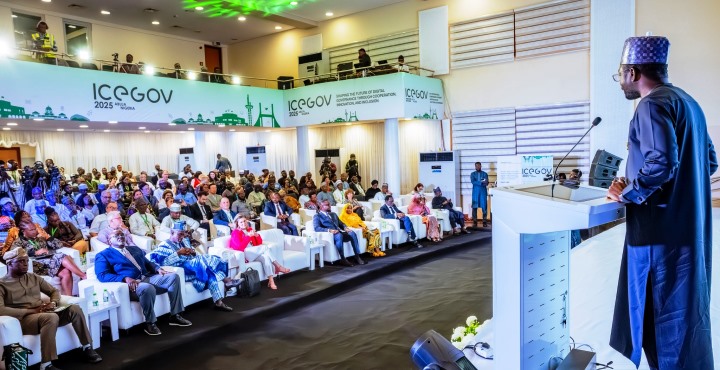
Nigeria Leads Africa’s Digital Transformation Drive
Nigeria has reaffirmed its commitment to digital transformation and good governance for national development. The country made the reaffirmation at the ongoing 18th International Conference on Theory and Practice of Electronic Governance (ICEGOV 2025) in Abuja. ICEGOV 2025, which opened on Tuesday, brought together global leaders, policymakers, and researchers to explore how technology can drive inclusive governance and sustainable development.
RELATED: Nigeria commits N12B to digital economy research as ICEGOV 2025 debuts in West Africa
Leading Nigeria’s delegation were the Minister of Communications, Innovation and Digital Economy, Dr. Bosun Tijani, and the Director-General of the National Information Technology Development Agency (NITDA), Kashifu Inuwa Abdullahi. Both reaffirmed the country’s readiness to shape the future of electronic governance across Africa and beyond.
Hosting ICEGOV 2025 aligns with President Bola Ahmed Tinubu’s Renewed Hope Agenda, particularly in reforming the economy for inclusive growth. It also aligns with the national agenda for enhancing infrastructure, and improving governance through innovation and digitalisation.
AI, Ethics, and Inclusive Innovation Take Centre Stage
Themed “Shaping the Future of Digital Governance through Cooperation, Innovation, and Inclusion”, ICEGOV 2025 is co-chaired by Prof. Tschilidzi Marwala, Rector of the United Nations University and UN Under-Secretary-General, alongside Dr. Bosun Tijani.
In his keynote presentation, Prof. Marwala emphasised the need for responsible and inclusive Artificial Intelligence (AI) development. The prof asserted that AI must serve humanity collectively.

“Artificial intelligence is shaping many areas of our lives, but it must be designed so that it does not leave anyone behind,” he said.
Marwala urged policymakers and technologists to democratise AI, giving people a voice in determining its ethical use. He highlighted the delicate balance between transparency, security, and innovation.
Dr. Bosun Tijani: Innovation Must Serve the Public Good
Minister Tijani, in his address, stressed the importance of balancing innovation, research, and regulation in building a sustainable digital economy.
“Nigeria stands at the intersection of innovation, youth, and digital transformation. When good ideas strike, nations prosper; when bad ideas prevail, nations decay,” he said.
He introduced the “Source Balance Ratio”, a conceptual framework illustrating how ideas from government, academia, civil society, and the private sector shape public policy. According to him, policymaking must be guided by research, ethics, and long-term vision, rather than short-term political or commercial motives.
Tijani also called for stronger collaboration between academia and government to ensure evidence-based policymaking, noting that platforms like ICEGOV are vital for guiding innovation that benefits all citizens.
NITDA’s Strategic Pillars for Digital Prosperity
Echoing the minister’s sentiments, Kashifu Inuwa Abdullahi, Director-General of NITDA, described ICEGOV 2025 as a major milestone in Nigeria’s path to becoming a digital governance powerhouse. He stated that hosting the conference stemmed from Dr. Tijani’s directive after Nigeria’s participation in ICEGOV 2024 in South Africa.

Inuwa outlined the Ministry’s five strategic pillars under the plan “Accelerating the Nation’s Collective Prosperity through Technical Efficiency”:
- Knowledge
- Policy
- Infrastructure
- Trade
- Innovation, Entrepreneurship & Capital
He highlighted major initiatives including:
- The National Digital Literacy Framework, ensuring every Nigerian gains digital skills from early education to adulthood.
- Integration of digital literacy into school curricula through collaboration with the Ministry of Education.
- A partnership with the Head of the Civil Service of the Federation to train public servants, with over 24,000 participants so far.
- The 3 Million Technical Talent (3MTT) initiative, equipping Nigerians with high-demand digital skills.
- Nationwide campaigns targeting market traders, transport workers, older citizens, and faith-based groups for inclusive digital learning.
“Digital transformation is not just about technology. It’s about improving how we serve our citizens. Governance must meet citizens where they are — online,” Abdullahi stated.
He also revealed ongoing projects on Digital Public Infrastructure (DPI), including a National Data Exchange Platform and a Centre of Excellence for DPI, both designed to strengthen Nigeria’s digital governance framework.
Global Leaders Commend Nigeria’s Vision
Notable dignitaries at ICEGOV 2025 included the Minister of State for Education, Prof. Suwaiba Said Ahmad, the Head of the Civil Service of the Federation, Mrs. Didi Esther Walson-Jack, Senator Shuaibu Afolabi Salisu, Chairman, Senate Committee on ICT & Cybersecurity, and Hon. Stanley Adedeji, Chairman, House Committee on ICT.
They praised Nigeria’s visionary leadership in advancing digital governance, ethical innovation, and policy-driven digitalisation. The speakers underscored that the country’s success depends on sustained multilateral collaboration, and institutional capacity-building. Equally important is resilient digital public infrastructures promoting transparency and trust.
Their remarks reinforced ICEGOV 2025 as a catalyst for global dialogue on digital policy, and data-driven governance. No less important is the ethical deployment of emerging technologies like AI and cybersecurity frameworks.
Shaping a Future-Ready Digital Africa
ICEGOV 2025 positions Nigeria as a continental leader in digital governance and innovation. Through partnerships, research-driven policymaking, and inclusive digital strategies, the country aims to build a future where technology empowers citizens and drives prosperity.
As Dr. Tijani aptly noted, “Digital technologies are no longer just economic tools; they reshape our societies and our citizenship. Our responsibility is to ensure that innovation is guided by ethics, inclusivity, and the public interest.”