By
By 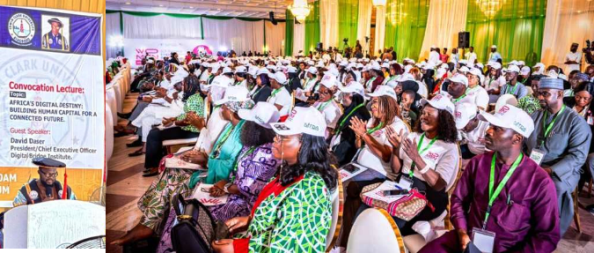
By Nana Theresa Timothy and Elisha Chebwawaza Gideon
Nigeria Positioned to Lead Africa’s Digital Transformation
At the Edwin Clark University convocation in Delta State, Digital Bridge Institute (DBI) President Daser David declared that Nigeria holds the key to Africa’s digital destiny through strategic youth empowerment in the academic sector.
RELATED: DBI commences nationwide ICT capacity training for universities and polytechnics
Digital Skills Replace Visas in Global Economy
Addressing graduates, educators, and policymakers, David emphasized that “young Africans do not need a visa to participate in the global economy—they need digital skills.” He highlighted how remote work has eliminated geographical barriers, creating a world where “talent competes with talent, not nationality.”
With Nigeria accounting for nearly 30% of Africa’s youth population, David stressed that the country must create “digital armies.” This would ensure Africa participates as a creative force, not just a consumer, in the global digital economy.
Academic Institutions Must Embed Digital Literacy
David challenged universities to make digital literacy foundational across all disciplines. “Whether you study agriculture, law, theatre arts, or accounting—the future of your field is digital,” he told the academic community gathered in the university auditorium.

He outlined DBI’s refocused mission as a “national digital skill powerhouse” bridging academia and industry while championing youth digital empowerment.
“We are committed to ensuring Nigerians—students, professionals, public servants—are not left behind in the new global order,” David stated.
Collaborative Framework for Digital Development
The DBI president emphasized that Nigeria’s digital future requires multi-sector collaboration. “Institutions must collaborate. Government must support. Private sector must invest. The digital future is not a solo project,” he asserted.
He called for government policies supporting broadband expansion, digital inclusion, startup ecosystems, and education reform. Daser urged the industry to provide internships, mentorship, and training partnerships for young innovators.
Leadership Qualities for the Digital Age
David outlined three essential qualities for tomorrow’s leaders: curiosity to challenge assumptions, empathy to build solutions with purpose, and urgency to translate ideas into action.
“In a world flattened by technology, urgency separates dreamers from doers,” he explained.
Africa’s Leapfrog Opportunity Through Digital Investment
Noting Africa’s potential to bypass traditional development stages, David cited examples from Kenya’s mobile money revolution to Nigeria’s booming fintech sector.

“Technology has given us a unique chance to leapfrog—to jump over old stages of development,” he said, emphasizing that “human capital—not natural resources—is our true wealth.”
Graduates Challenged to Build Digital Africa
In his charge to graduates, David encouraged bold thinking and continuous skill development. “Your degree is the foundation, not the ceiling. Learn digital skills regardless of your discipline,” he advised, adding that “tech is no longer a sector; it is the new language of opportunity.”
He concluded with a powerful vision: “Africa’s digital destiny will be written in universities like this one, by young Africans who refuse to settle for mediocrity. Africa does not need more spectators—Africa needs builders, thinkers, and innovators. Africa needs you.”