By
By 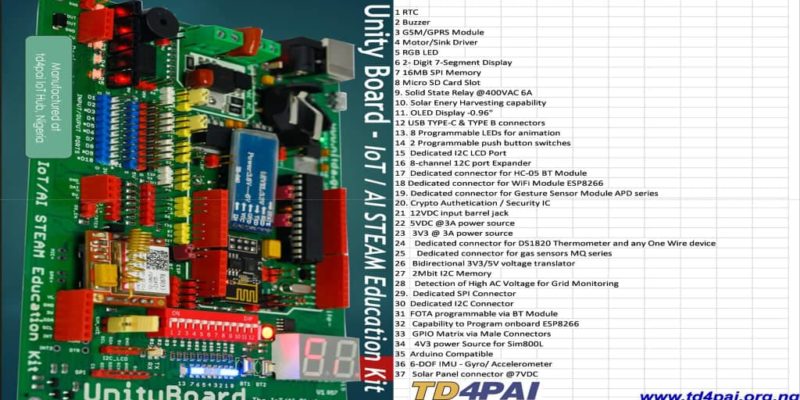
By Osasome C.O
Milestone for Indigenous EdTech and Fourth Industrial Revolution Readiness
Nigeria has recorded a major breakthrough in technical education and skills development with the formal adoption of the Unity Board into the National Skills Qualifications (NSQ) framework. This move is expected to accelerate the country’s drive for STEAM education and future-ready competencies.
RELATED: The 2025 Perspective: Contributing Strategically, Executing Effectively
ALSO READ: Agu Collins Agu on Transformative Integration: Embedded AI on Unity Board
The Unity Board is a made-in-Nigeria education technology platform, designed as a hardware-based research and innovation solution to advance indigenous edtech, digital skills, and workforce preparedness for the Fourth Industrial Revolution (4IR).
A Historic Step for Technical Education and Innovation
Announcing the development, Dr. Agu Collins Agu, Innovative Senior Technology Architect, Technocrat, and former Director of Research and Development at the National Information Technology Development Agency (NITDA), described the move as a defining moment in Nigeria’s skills journey.
“I am pleased to announce a historic milestone in Nigeria’s technical education and skills development journey: the formal adoption of the Unity Board, developed at TD4PAI Hardtech Hub, into the National Skills Qualifications framework for Internet of Things and Robotics,” Agu said.
He noted that the integration of an indigenous AI and IoT-focused hardware platform into national certification standards represents a strategic shift toward homegrown solutions for technology education.
Strengthening Nigeria’s STEAM Ecosystem
The Unity Board, promoted by the Unity Board Initiative by TD4PAI is positioned as a key driver of STEAM (Science, Technology, Engineering, Arts, and Mathematics) education across the country. Designed to support hands-on learning in areas such as:
- Internet of Things (IoT)
- Robotics and automation
- Artificial Intelligence (AI)
- Embedded systems and smart devices
The platform enables learners to gain practical, industry-relevant skills rather than relying solely on theory-based instruction.
Why the NSQ Adoption Matters
Nigeria currently has about 1,500 tertiary and vocational institutions serving an estimated 2.16 million students nationwide. Embedding the Unity Board into the NSQ framework creates a powerful pipeline for standardised, technology-driven skills training across this vast education network.
Experts say the move will:
- Enhance consistency in IoT and robotics training nationwide
- Improve employability of graduates in emerging tech fields
- Reduce dependence on imported training tools
- Strengthen Nigeria’s innovation and manufacturing ecosystem
- Support government efforts to build a digitally skilled workforce
Driving Skills for the Fourth Industrial Revolution
With global economies rapidly transitioning toward automation, data-driven systems, and smart technologies, Nigeria’s decision to mainstream an indigenous hardware innovation reflects a broader ambition to position local talent for global competitiveness.

By aligning the Unity Board with national qualification standards, stakeholders believe Nigeria is laying the groundwork for a new generation of engineers, technologists, and innovators equipped to thrive in the digital economy.
The Unity Board Learning Framework
The approved NSQ Level 3 curricula are available here:
- IoT: https://lnkd.in/d4DBRx4U
- Robotics: https://lnkd.in/dJivwBpd
This achievement was realised through the National Board for Technical Education (NBTE) in the discharge of its statutory mandate to regulate, accredit, and assure quality in technical and vocational education.
Under the NSQ framework, the Unity Board has been validated and embedded as a core national training and assessment platform for digital skills, marking the first formal integration of an indigenous AI/IoT hardware solution into nationally recognised technical qualifications.
Unity Board overview: https://lnkd.in/dRVajRnW
Embracing a Decisive Shift to Competency-Based, Hands-On Education
The adoption marks a decisive shift to a competency-based, hands-on education model aligned with the Fourth Industrial Revolution. This approach enables learners to gain essential practical skills across key domains, including IoT, embedded AI, electronics, and networking. It further prepares them for advanced fields such as cloud integration, cybersecurity, and robotics.
The Unity Board was developed to reduce dependence on expensive, imported training hardware. It provides a scalable, affordable, and locally adaptable solution for hands-on digital skills development. This makes it an ideal educational tool for schools, colleges, universities, R&D centers, and innovation hubs across the nation.
This milestone advances youth empowerment, industrialisation, innovation, and the digital economy, reinforces NBTE’s leadership in technical education, and affirms Africa’s capacity to build globally competitive skills using sovereign technology.
“My sincere gratitude toNBTE and CPN for the recognition and endorsement,” said Agu
Unity Board Presentation – 2026: https://lnkd.in/dgU5cp93