By
By 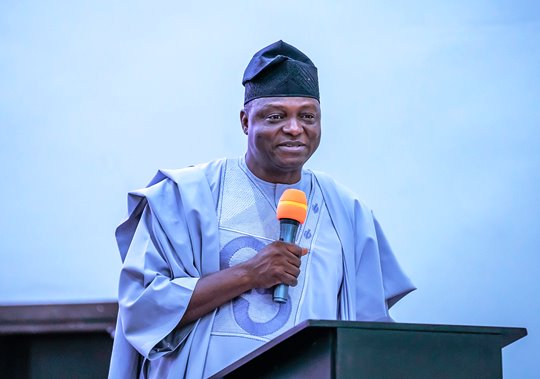


By Professor Nentawe Yiltwada, National Chairman of the All Progressives Congress (APC)
1.0 Introduction
It is a privilege to join this distinguished gathering of business leaders, innovators, investors, regulators, entrepreneurs and policymakers who are helping shape Nigeria’s digital future.
RELATED: WACC 2026: APC outlines bold digital economy blueprint to drive Nigeria’s $1 trillion ambition
I commend Knowhow Media and IT Edge News Africa for creating and sustaining this important platform. Over the years, WACC has evolved into one of the most important fora for dialogue between government, business, technology leaders and investors.
ALSO READ: WACC 2026 and the politics of Nigeria’s digital future
The theme before us today is both timely and strategic.
Technology is no longer a sector of the economy. Technology is now the platform upon which modern economies compete. Technology determines productivity. Technology drives investment. Technology creates jobs. Technology expands inclusion. Technology strengthens governance. Technology accelerates development. The nations that will lead the world over the next decade will be those that successfully deploy technology to unlock economic opportunity and improve the lives of their citizens. Our vision as a government is that Nigeria must be one of those nations.
2.0 Nigeria’s Economic Transformation Story (2023–2026)
Does Macroeconomic Stability Matters to Technology? The answer is a YES. Technology does not thrive in isolation.
Over the last three years, Nigeria has embarked upon significant economic reforms designed to restore confidence and strengthen long-term growth prospects. These reforms have focused on:
- Foreign Exchange Reform
- Creating a more transparent and efficient foreign exchange market.
- Strengthening government revenues and improving fiscal sustainability.
- Restoring Investor Confidence
- Creating a more credible environment for domestic and international investment.
- Infrastructure-Led Growth, and expanding investments in roads, railways, ports, airports, energy and digital infrastructure.
Ladies and Gentlemen, investors do not invest in promises; they invest in trajectories. The question is not whether Nigeria has solved all its challenges. The question is whether Nigeria is moving in the right direction.
Consider where we were in 2023 and where we are today. In 2023, Nigeria recorded a Balance of Payments deficit of over $3 billion. Today, we have recorded a surplus of $6.83 billion. In 2022, net foreign exchange reserves stood at just $8.19 billion. Today, they stand at approximately $34.8 billion. Gross reserves have risen above $50 billion, the highest level in 17 years.
International rating agencies that once expressed concern are now upgrading Nigeria’s sovereign ratings: Moody upgraded Nigeria from Caa1 in 2023 to B3 2026, while S&P upgraded Nigeria from B- in 2023 to B in 2026. Capital inflows have nearly doubled, reaching over $23 billion, while portfolio investment has surged as confidence returns to our markets.
These are not political statistics, they are market signals. They are indicators that the foundations of a stronger, more competitive, and more investable Nigerian economy are being laid by President Bola Ahmed Tinubu.
These developments matter because they create the foundation upon which the digital economy can grow. A trillion-dollar economy requires a trillion-dollar foundation.
3.0 Why Technology Will be Nigeria’s Most Important Growth Sector (2027–2031)
Technology is no longer an emerging sector, rather technology is now one of the primary drivers of economic growth.
Today, ICT contributes approximately 18–19 % of Nigeria’s GDP, and the sector recorded 26.34 % growth in Q4 2025. Government’s target is to increase ICT contribution to 22 % of GDP by 2027.
Ladies and Gentlemen, Nigeria’s digital transformation is not only being recognized at home; it is increasingly attracting global attention. One of the world’s leading technology intelligence platforms, Dealroom.co, recently ranked Lagos as the world’s leading “Rising Star” and the fastest-growing emerging tech ecosystem globally. The ranking assessed startup performance, innovation, investment activity, enterprise value, and ecosystem growth across 288 cities in 69 countries worldwide.
According to Dealroom, Lagos has produced five unicorns: Interswitch, Flutterwave, Jumia, OPay and Moniepoint, and has grown its startup ecosystem value more than elevenfold from 2017 to approximately $15 billion.
This recognition sends a powerful message, and confirms that Nigerian entrepreneurs can compete globally. It demonstrates that international investors increasingly see Nigeria as a destination for innovation and venture capital. And it validates the quality of talent emerging from our technology ecosystem.
“The world identifies Lagos as one of the fastest-growing technology ecosystems on the planet, it reinforces our conviction that Nigeria has the talent, the market, and the entrepreneurial energy required to become Africa’s digital powerhouse.”
When the world identifies Lagos as one of the fastest-growing technology ecosystems on the planet, it reinforces our conviction that Nigeria has the talent, the market, and the entrepreneurial energy required to become Africa’s digital powerhouse. Our task now is to provide the infrastructure, capital, policy stability, and partnerships necessary to sustain and accelerate this momentum.
Nigeria’s Greatest Competitive Advantage is not our oil, solid mineral resources or land. Rather, our greatest resource is our people. Nearly 70% of Nigerians are below the age of 35, which makes Nigeria the largest reservoir of youthful talent on the African continent.
To unlock this opportunity, government has established ambitious targets:
- Digital Literacy: To achieve 70 % digital literacy by 2027, and 95 % digital literacy by 2030.
- Digital Access: The federal government has built 222 ICT Centres nationwide, and the long-term target is to build 1,600.
- Project BRIDGE (Building Resilient Digital Infrastructure for Growth) which is a $2 Billion flagship broadband infrastructure initiative to deploy 90,000 km fibre backbone to connect 33 million Nigerians currently unserved or underserved. It will increase broadband penetration to about 70% by 2030 and create 5 million digital economy jobs.
4.0 Digital Governance as the Foundation of Economic Transformation
4.1 Digital Identity Management System: Building the Foundation of the Digital Economy.
A trillion-dollar economy requires the ability to identify citizens, businesses, assets, and economic activities accurately. Digital identity is therefore not merely a social protection tool but the foundation of modern economic governance.
For Nigeria, a comprehensive digital identity ecosystem has been used to:
- Expand the tax net by linking individuals and businesses to economic activities.
- Improve revenue collection and reduce tax evasion.
- Eliminate ghost workers and pension fraud.
- Facilitate financial inclusion and access to credit.
- Improve land administration and property registration.
- Strengthen border management and national security.
- Support e-government services and ease of doing business.
- Enable targeted support for MSMEs and entrepreneurs.
The economic implication is significant. When citizens and businesses are digitally identifiable, governments can formalize previously informal economic activities, expand the tax base, and improve economic planning. A country cannot effectively grow what it cannot accurately count, identify, and measure.
4.2 Digital Payment System: Creating a Transparent and Efficient Economy.
For Nigeria’s one-trillion-dollar aspiration, digital payments can unlock billions of naira currently lost through inefficiencies, informal transactions, and weak revenue administration. The growth of fintech companies demonstrates how digital payments have become one of Nigeria’s strongest competitive advantages within Africa’s digital economy.
Every digital payment creates economic visibility, and economic visibility creates taxable and investable opportunities.
4.3 Data Analytics: Powering Evidence-Based Economic Growth.
Data has become the most strategic resource of the digital age. Countries that successfully build trillion-dollar economies are increasingly those that leverage data for decision-making. Rather than responding to economic challenges after they occur, predictive analytics enables government to anticipate challenges and intervene early.
For Nigeria, data analytics has been used to improve:
- Revenue Forecasting, identify leakages and predict tax performance.
- Improve fiscal planning, and Economic Planning
- Track investment trends.
- Identify emerging growth sectors.
- Predict weather-related risks.
- Improve food security planning, and precision agriculture.
- Support intelligence-led policing, and strengthen border security.
- Improve transport planning.
- Manage population growth.
Data transforms governance from intuition-driven decision-making to intelligence-driven development.
4.0 The APC Technology Vision For 2031
Ambition One: Building Africa’s Largest Digital Economy.
How We Will Achieve It: To achieve 90% broadband penetration, $2 billion fibre infrastructure, universal digital access and expansion of digital commerce that will connect and give access to communities, schools, healthcare centres, financial services, e-commerce and digital government services to enable participation in the digital economy.
Ambition Two: Building Africa’s Leading Artificial Intelligence Hub.
How We Will Achieve It: FG AI Roadmap called National Artificial Intelligence Strategy (NAIS) aimed at accelerating economic growth, improve public services, create jobs, and position Nigeria as Africa’s AI hub.
It will be hinged on five pillars are:
- AI Infrastructure: Data, broadband and cloud infrastructure. High performance computing capacity.
- AI Ecosystem Development: Startups, Research & development, AI Centres of Excellence, and public-private partnership.
- AI Adoption Across All Sectors: AI deployment in agriculture, education, public service delivery, security, financial services, healthcare, and government services.
- Responsible AI: It must be ethical, transparent, safe, and protects the users.
- AI Governance: Make AI regulatory framework, standards and
The objective is simple: Nigeria must not merely consume Artificial Intelligence, but Nigeria must help create it.
Ambition Three: Consolidating Nigeria as Africa’s Fintech Capital.
How We Will Achieve It: Improve on Regulatory innovation, open banking, expand financial inclusion, develop cross-border payment systems, and enable venture capital mobilisation.
Nigeria already hosts some of Africa’s most successful fintech companies, and 0ur objective is to make Nigeria the undisputed headquarters of African financial innovation.
Ambition Four: Building Africa’s Largest Digital Public Infrastructure Platform
How We Will Achieve It: Digital Identity, digital Payments, e-Government Services, Digital Healthcare Systems, and Digital Education Systems.
Government services should be accessible digitally, efficiently and transparently.
Ambition Five: Becoming West Africa’s Digital Integration Leader.
How We Will Achieve It: AfCFTA Digital Trade, ECOWAS Digital Integration, Cross-border Digital Payments, Harmonised Regulations, and Regional Innovation Partnerships.
Nigeria’s market is large, and West Africa’s market is transformational.
5.0 Financing the Digital Economy: Building a New National Asset Class.
Ladies and Gentlemen, every generation is remembered for the infrastructure it built. The generation that came before us built roads, bridges, seaports, airports, railways and power stations, and our government has also invested in them. Those investments created the foundations of industrial economies.
Our generation faces a different challenge. The infrastructure that will determine economic competitiveness in the twenty-first century is increasingly digital. Today, nations compete through fibre optic networks. They compete through data centres. They compete through cloud infrastructure. They compete through artificial intelligence capabilities. They compete through cybersecurity resilience. They compete through digital public infrastructure. The countries that build these assets successfully will attract investment, create jobs, stimulate innovation and generate prosperity. Those that do not will become consumers of technologies developed elsewhere.
“Digital infrastructure not merely a technology issue but a national development imperative”
That is why we must begin to view digital infrastructure not merely as a technology issue but as a national development imperative. More importantly, we must begin to view digital infrastructure as a new national asset class.
Just as investors once evaluated roads, airports and power stations as long-term infrastructure investments, they must now evaluate data centres, fibre networks, cloud platforms, AI computing facilities and digital industrial parks through the same lens. Because these assets will power economic growth for decades to come.
Indeed, I believe one of the most important investment conversations of the next decade will not be about whether to invest in digital infrastructure. It will be about how quickly we can mobilize sufficient capital to build it at scale.
“Why a new financing architecture becomes necessary”
This is where a new financing architecture becomes necessary.
- Pension Funds: Unlocking Long-Term Domestic Capital. Nigeria’s pension industry has grown into one of the largest pools of long-term domestic capital on the African continent. These funds were created to secure the future of millions of Nigerians, but they can also help build the future of Nigeria itself. Digital infrastructure offers exactly the kind of long-duration assets that pension funds seek: stable returns, long-term cash flows, and national impact. Imagine pension-backed investments supporting fibre networks, data centres, digital industrial parks, cloud infrastructure and smart city platforms. When domestic savings are invested in domestic productivity, everyone benefits. The pensioner receives returns, the economy receives infrastructure, the nation receives growth, and the youths receive jobs.
- Sovereign-Backed Funds: Investing in Strategic National Priorities. Around the world, sovereign investment vehicles play a critical role in financing transformative infrastructure, and digital infrastructure should be no exception. The nations leading the digital economy today did not arrive there by accident, rather they made deliberate, strategic investments in infrastructure long before the market fully appreciated its value. Nigeria must do the same. Sovereign-backed funds can provide catalytic capital that reduces risk, crowds in private investors and accelerates deployment. In doing so, they send a powerful signal to the market: That government is committed to the long-term success of the digital economy.
- Infrastructure Funds: Creating a New Investment Frontier. Infrastructure investors have traditionally focused on transport, energy and real estate. These are the highways, ports and industrial zones of the digital age. As Nigeria’s digital economy expands, infrastructure funds will find significant opportunities to deploy capital into assets that combine commercial viability with national importance. The future belongs to countries that successfully align infrastructure investment with technological transformation.
- Development Finance Institutions: Catalysing Scale and Inclusion. Development Finance Institutions have played an important role in supporting Africa’s economic development. Their role in the digital economy is becoming even more important, and to ensure digital inclusion, rural connectivity, digital literacy, technology-enabled healthcare, and artificial intelligence applications for development. These are areas where DFIs (Development Finance Institutions) can provide patient capital, technical expertise and risk-sharing instruments. The challenge before us is not simply to build digital infrastructure, but to ensure that the benefits of digital infrastructure reach every community, every entrepreneur and every young person with talent and ambition.
- Public-Private Partnerships: The New Development Model. Perhaps the most important financing mechanism for the future is partnership. Government cannot build the digital economy alone, so also the private sector cannot build it alone. The future belongs to collaboration Public-Private Partnerships that combines the strengths of both sectors. Government provides enabling policies, regulatory certainty and strategic direction, while the private sector provides capital, innovation, operational efficiency and execution capability. The next chapter of that success story must be written in broadband infrastructure, data centres, cloud services and artificial intelligence.
6.0 The Role of Mofi: Building The Bridge Between Public Assets and Private Capital
Ladies and Gentlemen, as we think about the future of digital infrastructure financing, one institution occupies a uniquely strategic position. That institution is the Ministry of Finance Incorporated. MOFI sits at the intersection of public assets and private capital. Its mandate places it in a unique position to unlock value, structure investment opportunities and attract long-term capital into strategic sectors of the economy.
In many respects, MOFI can become one of the most important enablers of Nigeria’s digital transformation. Not as an operator or regulator, but as a strategic investment catalyst.
The opportunity before MOFI is enormous:
- To help establish sovereign-backed digital infrastructure funds.
- To mobilize institutional capital.
- To support national data centre expansion, investments in fibre infrastructure, and to catalyse AI computing infrastructure.
- To transform digital infrastructure from a policy aspiration into an investable asset class.
Around the world, successful economic transformations occur when governments create mechanisms that connect national priorities with private capital. MOFI can serve precisely that function for Nigeria.
The scale of infrastructure required to power a one trillion dollar economy cannot be financed by government budgets alone. And that is the opportunity before MOFI.
Ladies and Gentlemen, allow me to leave this section with a thought that I believe captures the challenge of our generation: “The next generation of infrastructure is digital infrastructure, and the next generation of nation-building capital must follow it.”
7.0 A New Digital Economy Compact.
Nigeria’s digital future cannot be built by government alone. It requires a shared commitment between Government, Regulators, Investors, Banks, Telecommunications Companies, Startups, Academia, and Development Partners.
The Five Pillars of the Compact
- Predictability: Stable policies and regulatory certainty.
- Innovation: Encouraging creativity and entrepreneurship.
- Investment: Mobilising long-term capital.
- Talent: Developing world-class human capital.
- Inclusion: Ensuring that no community is left behind.
8.0 Conclusion.
Ladies and gentlemen, I believe the next chapter of Nigeria’s development story will be written through technology. It will be written on our fibre networks. It will be written in our data centres. It will be written in our innovation hubs. It will be written on our fintech platforms. It will be written in our universities. It will be written by millions of talented young Nigerians.
By 2031, I want the world to look at Nigeria and see:
Africa’s digital powerhouse.
Africa’s innovation capital.
Africa’s fintech leader.
Africa’s largest digital economy.
One of the world’s most exciting technology destinations.
That future is within our reach. The talent exists. The opportunity are in abundance, we can raise the capital, and we have the market.
What remains is our collective determination to act.
Let us build together, let us invest together, and let us innovate together. And let us create a digital economy worthy of the aspirations of the Nigerian people.
In closing,
“The great nations of the twenty-first century will not be defined by the resources beneath their soil, but by the knowledge in their classrooms, the innovation in their laboratories, the connectivity of their networks, and the courage of their leaders to prepare for the future. Nigeria has all four. Our task now is to turn that potential into common prosperity.”
God bless you, and God bless the Federal Republic of Nigeria.
The Keynote Address by the National Chairman of the All Progressives Congress (APC) at the 15th West Africa Convergence Conference (WACC 2026) and 50 Most Influential Figures in Nigeria’s Digital Economy Recognition Ceremony in Lagos.