By
By 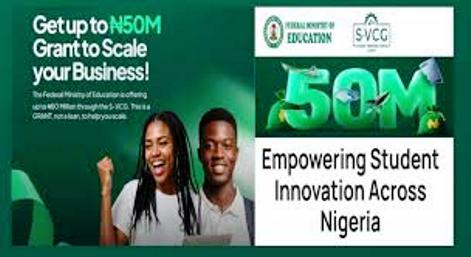
Federal Government Backs Student-Led Innovation with Equity-Free Funding
The Federal Government has disbursed ₦2.25 billion in equity-free funding to 45 student innovators drawn from tertiary institutions across Nigeria. This initiative is reinforcing its commitment to youth-driven innovation and entrepreneurship.
RELATED: Binance, Africell partner to drive blockchain education and crypto services across Africa
The beneficiaries emerged from 65 shortlisted finalists under the Student Venture Capital Grant (S-VCG) initiative of the Federal Ministry of Education. The cheque presentation ceremony took place at the UNDP Innovation Hub in Lagos.
The grants were presented by the Minister of Education, Tunji Alausa, alongside the Minister of State for Education, Suwaiba Ahmad.
45 High-Impact Ventures streamlined from Thousands of Applicants
The S-VCG programme is a flagship initiative designed to identify, support, and scale high-impact, student-led ventures capable of driving Nigeria’s economic growth and technological advancement.
From thousands of applications nationwide, 65 finalists were selected through a rigorous, multi-stage evaluation process. This process combined AI-driven screening with independent human assessment to ensure transparency and fairness.

The finalists subsequently underwent an intensive bootcamp where they refined business models, pitched to expert panels, and received structured feedback to strengthen their market readiness. From this pool, 45 ventures were awarded grants of up to ₦50 million each, with no equity or repayment obligations.
Education Must Shift from Theory to Innovation – Alausa
Speaking at the event, Alausa challenged Nigerian tertiary institutions to move beyond theory-based learning and place innovation at the core of academic training. He also urged governing councils to prioritise the appointment of vice-chancellors and rectors with strong innovation-driven mindsets.
“Students must not only learn theory but operate at the highest levels of critical thinking and problem-solving. Through innovation, upscaling, and commercialisation, they will transform ideas into engines of sustainable growth and economic development,” the minister said.
University of Lagos Leads Beneficiaries
The University of Lagos (UNILAG) emerged as the top beneficiary of the scheme. It had eight students each securing ₦50 million in funding to make it the institution with the highest number of awardees.
Other beneficiary institutions include the University of Ilorin, Federal University of Technology Minna, and Bayero University Kano.
UNILAG’s strong showing reflects its growing reputation as a hub for innovation and research. Student enterprenuership and innovation is supported by UNILAG’s Innovation and Technology Management Office (ITMO). The ITMO facilitates the development and commercialisation of student-led inventions in areas such as medical devices and eco-friendly technologies.

Building Nigeria’s Next Generation of Job Creators
Alausa described the S-VCG as a strategic investment in Nigeria’s future innovators and job creators, aimed at building a robust pipeline of scalable ventures.
“The quality and ambition demonstrated by these student innovators is deeply encouraging. This initiative will position Nigeria as a hub for deep-tech and innovation-led growth,” he said.
The minister also cautioned beneficiaries against focusing solely on profit, urging them to build ventures that deliver tangible social impact.
Whole-of-Government Support for Student Innovation
Minister of Communications, Innovation and Digital Economy, Bosun Tijani, encouraged the students to remain resilient and committed to their ideas, even in the face of failure.
Chairman of the Senate Committee on Tertiary Institutions and TETFund, Muntari Dandutse, stressed the urgency of closing the gap between academic theory and real-world application.
National Programme Coordinator of the initiative, Adebayo Adebajo, disclosed that the Federal Government expects up to 200,000 applications in the next S-VCG cohort, signalling growing interest among Nigerian students.
What this means for Nigeria’s Innovation Ecosystem
The S-VCG programme provides more than funding. It offers mentorship, tools, validation, and national visibility for student innovators. Experts say the initiative represents a major step toward nurturing local solutions in technology, agriculture, healthcare, and sustainability.
By empowering students to transform ideas into viable businesses, the Federal Government aims to stimulate job creation. Government is also aiming to attract investment, and promote inclusive economic growth. The initiative aligns closely with the Renewed Hope Agenda of President Bola Ahmed Tinubu. Under this agenda, goverment positions education as a cornerstone of national development, innovation, and long-term stability.