By
By 
As the SaaS industry heads into 2026 with renewed stability, a deeper structural shift is beginning to take shape. Oracle has announced large-scale global layoffs impacting tens of thousands of employees, while simultaneously committing billions of dollars to AI data centres and Nvidia-driven computing infrastructure.
RELATED: Oracle and Amazon’s AI spending spree coincides with 80,000 global tech layoffs
This strategic pivot signals a clear departure from a purely software-led model, repositioning Oracle closer to hyperscale cloud operators as competition for AI compute capacity accelerates across the global technology landscape.
To better understand the true scale of tech layoffs this year, TradingPlatforms shares its latest report detailing the depth of global tech industry layoffs in 2026.
The team at TradingPlatforms analysed layoffs across the tech sector in 2026 to provide a clearer picture of this shift. Using data from TrueUp, TechCrunch, and multiple state WARN filings, the study identifies the companies behind the largest workforce reductions so far this year, highlighting the most heavily impacted regions and companies in the tech industry.
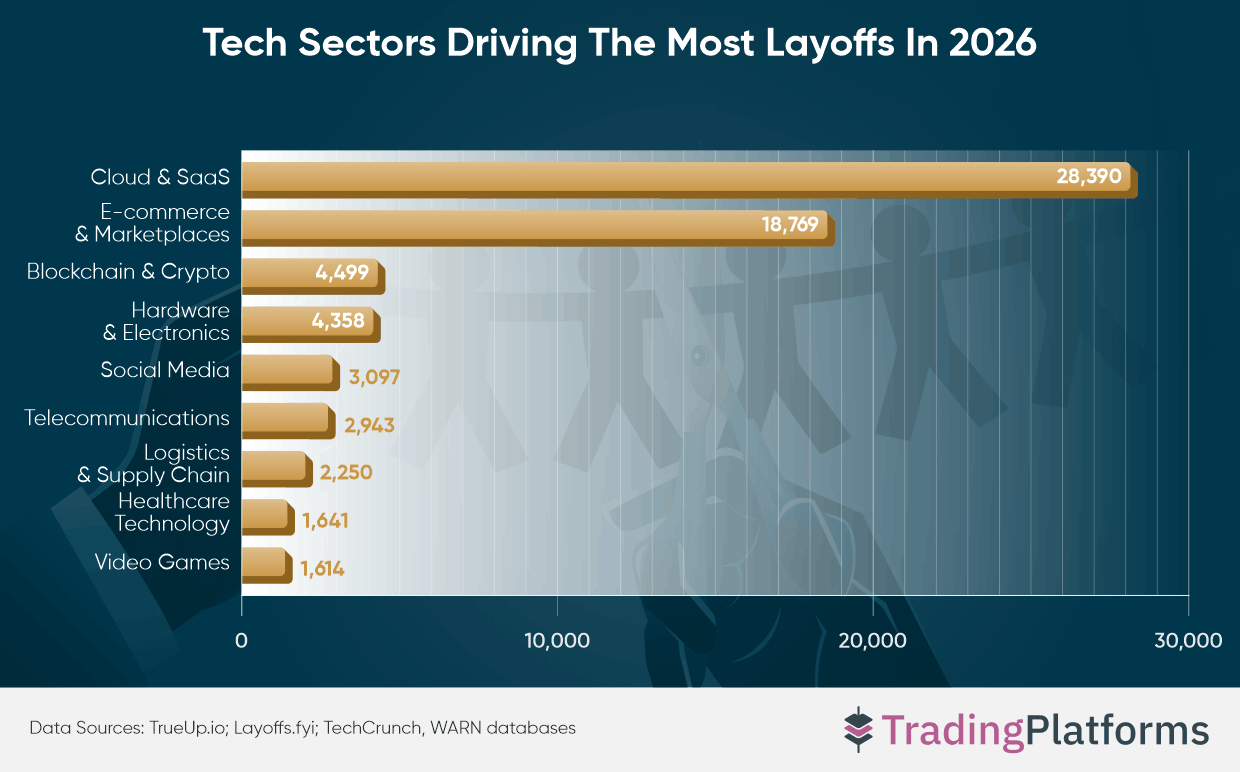
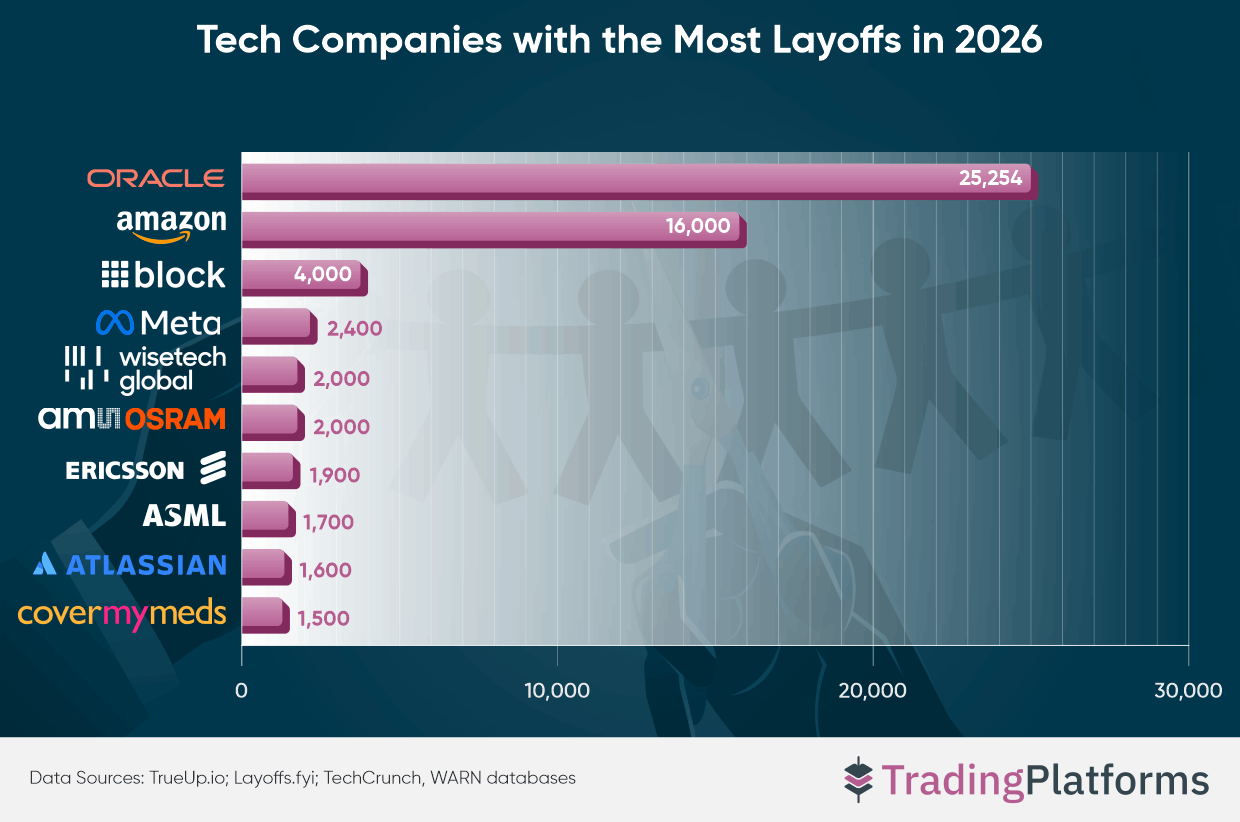
Data shows there have been 80,117 tech layoffs worldwide since the start of the year. Of these, 28,390 roles, roughly 35% of the global total, came from technology companies in the Cloud and SaaS sectors, with Oracle carrying out the largest wave of layoffs this year by far, affecting 25,254 positions worldwide.

These are the Tech Sectors With the Most Layoffs So Far in 2026
- Cloud & SaaS – 28,390 layoffs across 6 companies
- E-commerce & Marketplaces – 18,769 layoffs across 6 companies
- Blockchain & Crypto – 4,499 layoffs across 9 companies
- Hardware & Electronics – 4,213 layoffs across 7 companies
- Telecommunications – 2,943 layoffs across 3 companies
- Social Media – 2,897 layoffs across 3 companies
- Logistics & Supply Chain – 2,000 layoffs in 1 company
- Healthcare Technology – 1,641 layoffs across 3 companies
- Video Games – 1,614 layoffs across 8 companies
- Electric Vehicles – 1,520 layoffs across 3 companies
Other highlights from the report:
- Cloud & SaaS accounts for the largest share of tech layoffs so far in 2026, driven largely by Oracle’s late-Q1 cuts of more than 25,000 roles, as it ramps up spending on AI infrastructure. Australia’s Atlassian is responsible for a further 1,600 layoffs amid increased AI investment. Job losses at San Francisco’s Salesforce (1,000) and Workday (400), though smaller in scale, reflect a broader trend of efficiency-driven restructuring, as both firms streamline teams to focus on AI-powered products and higher-margin enterprise services.
- E‑commerce & marketplaces recorded the second-highest number of job cuts in 2026, totalling 18,769 layoffs across 6 companies. Amazon slashed around 16,000 roles earlier this year amid broader efforts to streamline operations and invest in automation and AI across fulfillment and cloud services. At the same time, eBay announced cuts to roughly 6% of its global workforce, about 800 employees, as it restructures in the wake of its $1.2 billion Depop acquisition and refocuses spending on strategic priorities, including AI‑enhanced buyer/seller tools.
- In the blockchain & crypto space, 9 firms collectively slashed 4,499 positions amid market pressure and a broader pivot toward automation: Block kicked off the year by axing around 4,000 jobs, nearly 40% of its workforce, as CEO Jack Dorsey publicly framed AI as a force for reorganising operations around smaller, more efficient teams. Meanwhile, major exchange Gemini has reduced headcount by roughly 30% as it exits several international markets and refocuses on core U.S. operations amid sustained losses, and Singapore‑based Crypto.com cut about 12% of its global staff in March, tying the reductions explicitly to enterprise‑wide AI integration.
- Hardware & electronics layoffs in 2026 show a push for efficiency even amid strong demand: Europe’s ams OSRAM cut about 2,000 jobs under its ‘Simplify’ program to reduce debt and focus on photonics and automotive semiconductors, while ASML trimmed roughly 1,700 roles in management and IT to free resources for AI‑driven chip equipment development. In the U.S., FormFactor and Western Digital, which let go of 220 and 134 employees, respectively, made smaller reductions tied to supply‑chain pressures.
- AI has emerged as a key driver behind 2026’s tech layoffs, with nearly 38,088 of 80,117 global cuts linked to automation and artificial intelligence implementation. Yet the deeper story goes beyond simple replacement: many of these reductions appear to be part of a broader strategic workforce reset, where layoffs are blamed on AI only to be restructured, rehired offshore, or offered at lower wages. This pattern is becoming increasingly common, revealing that the AI narrative often masks cost-cutting, efficiency drives, or investment signaling. The result is a tech labor market in flux, where the headline number of AI layoffs only tells part of the story, while the real transformation actually lies in how companies are reconfiguring talent to align with automation and new operational priorities.

‘What we’re seeing in 2026 goes beyond the typical corporate layoffs; it’s a complete reshaping of how tech companies operate. Firms are cutting roles under the banner of AI and automation, but the real driver is efficiency: they’re reorganising teams, reallocating talent, and focusing on high-margin, high-growth areas. The narrative of AI often overshadows the fact that many of these jobs aren’t disappearing. They’re being rebuilt differently, sometimes offshore or under new roles. This reflects a broader trend where technology itself isn’t just transforming products, it’s transforming the very structure of work in the industry.’
– comments Stanislava Savisheva, analyst at TradingPlatforms.
These findings are based on layoff announcements, WARN filings, and independent reports since January 2026. For a deeper look at tech sector layoffs, the factors driving job reductions, and our full research methodology, please refer to the complete report. The raw dataset is also accessible on Google Drive at the following link.