By
By 
Artificial intelligence (AI) continues to dominate VC funding in 2026, though the investment landscape has shifted. Foundation models are no longer the main attraction. Instead, investors are chasing the infrastructure that drives the broader AI economy.
RELATED: Leveraging artificial intelligence for business growth: Blending innovation with purpose
Capital is now surging into semiconductors, cloud infrastructure, robotics, defence technology, and aerospace. All of these are critical systems that enable automation, autonomous machines, and large-scale AI deployment.
This trend is well captuted in a recent BestBrokers‘ report exploring the world of private businesses valued at US$1 billion or more, known as unicorns.


For this report, the team at BestBrokers analysed the Crunchbase Unicorn Board’s list of private startups with a valuation of at least US$1 billion, or the so-called ‘unicorns’.
As of May 2026 there are a total of 1,757 private companies valued at $1B or more. Data was also aggregated from PitchBook and several other sources on the largest private company funding rounds and company valuations throughout 2025 and 2026. The full dataset used is available on Google Drive via this link.
98 AI startups have reached unicorn status in 2026
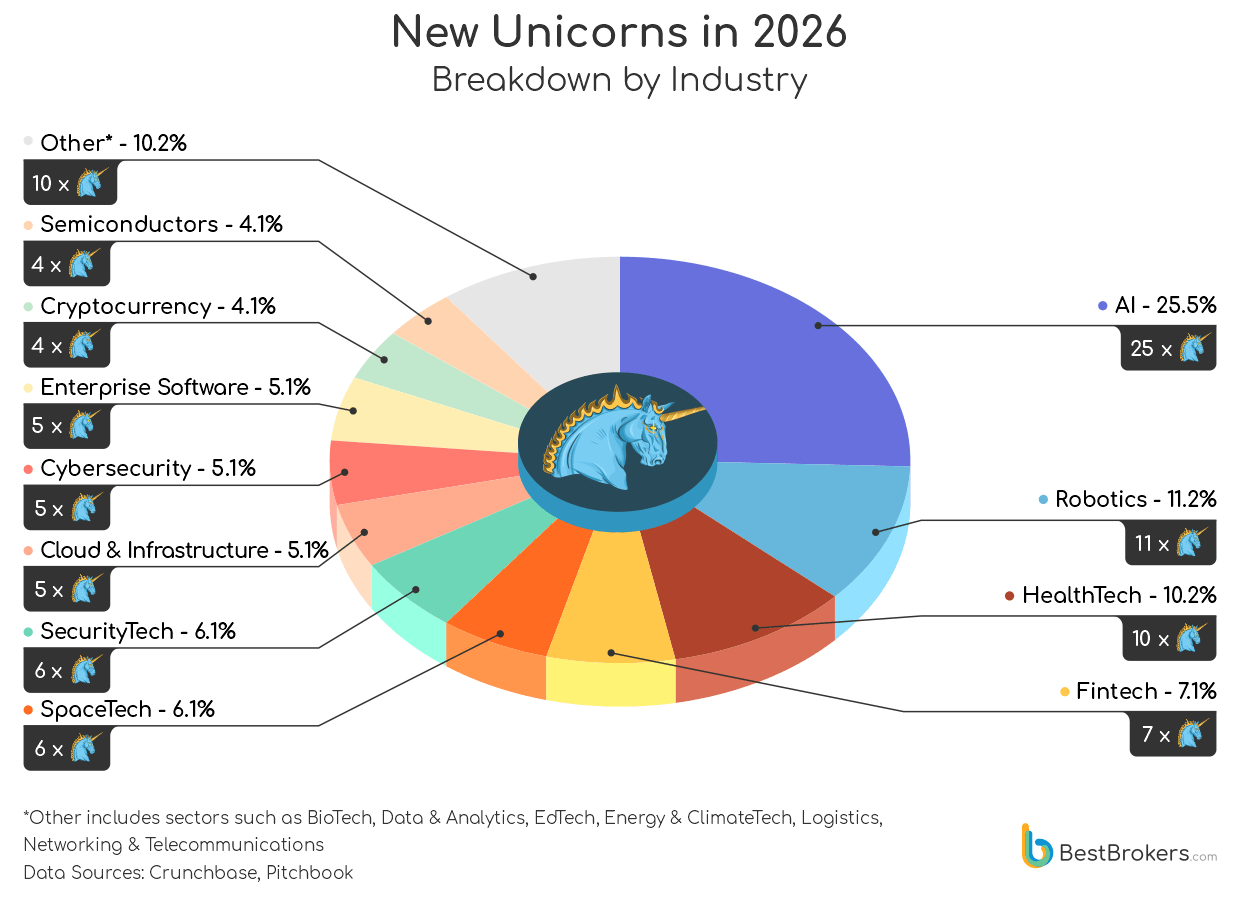
Data shows that 98 startups have reached unicorn status so far in 2026, meaning they attained a valuation exceeding $1 billion. Artificial intelligence companies account for the largest share of new entrants, with 25 AI firms representing just over one-quarter of all newly minted unicorns this year. Robotics ranks as the second-largest category with 11 companies, followed by HealthTech with 10 and Fintech with 7.
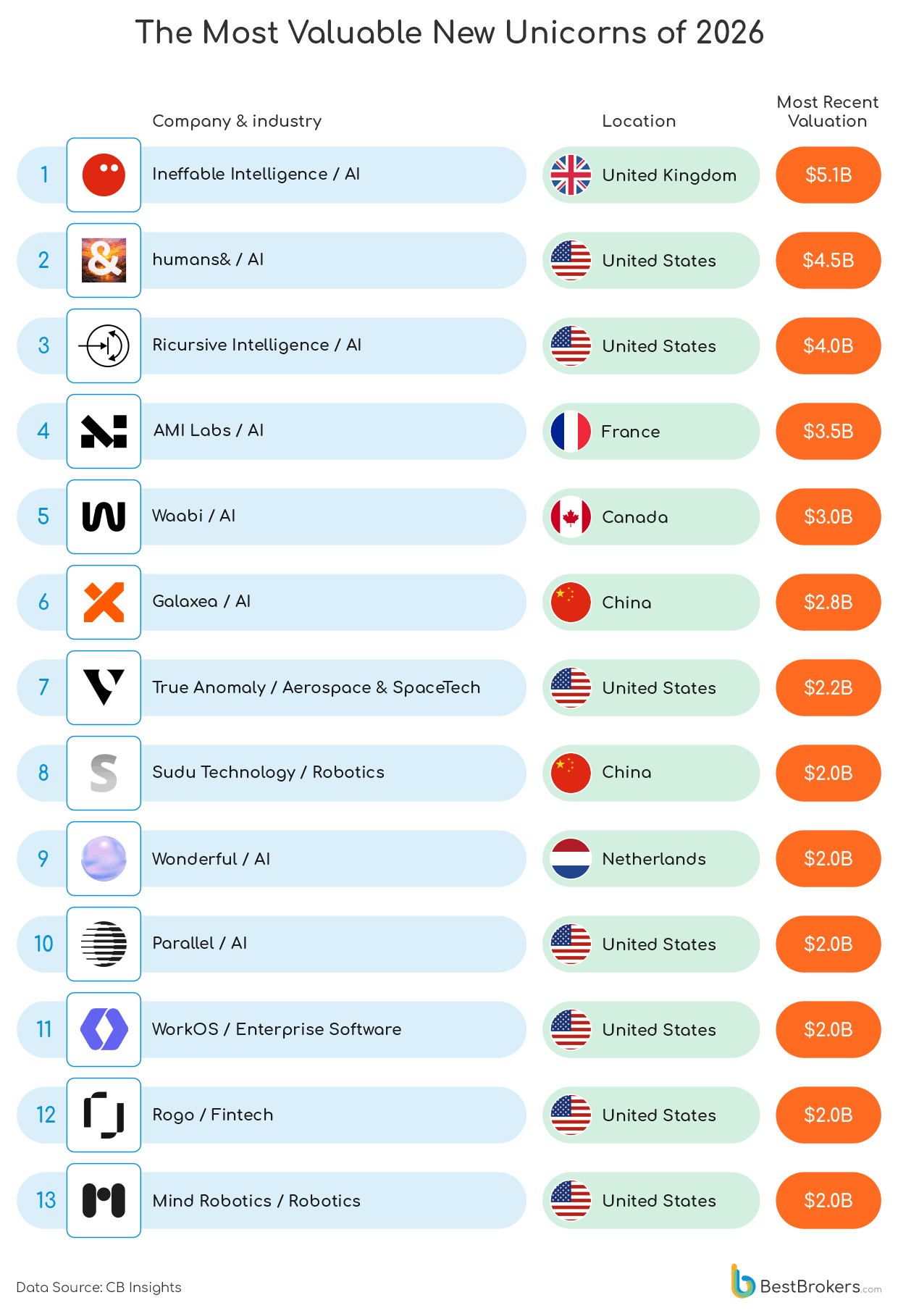
The most valuable new unicorn of 2026 is London-based AI startup Ineffable Intelligence, which reached a valuation of $5.1 billion after securing more than $1.1 billion in funding. It is followed by U.S.-based AI firms humans& at $4.5 billion and Ricursive Intelligence at $4 billion, reflecting continued investor appetite for large-scale AI infrastructure and foundation model companies.
These Are The Most Valuable Startups That Became Unicorns in 2026
- Ineffable Intelligence (United Kingdom, AI) – $5.1 billion
- humans& (United States, AI) – $4.5 billion
- Ricursive Intelligence (United States, AI) – $4 billion
- Advanced Machine Intelligence / AMI Labs (France, AI) – $3.5 billion
- Waabi (Canada, AI) – $3 billion
- Galaxea AI (China, AI) – $2.8 billion
- True Anomaly (United States, Aerospace & SpaceTech) – $2.2 billion
- Mind Robotics (United States, Robotics) – $2 billion
- Sudu Technology (China, Robotics) – $2 billion
- Rogo (United States, Fintech) – $2 billion
These Are The Most Valuable Unicorn Startups as of March 2026
- SpaceX (United States, Aerospace & SpaceTech) – $1.25 trillion
- OpenAI (United States, AI) – $852 billion
- ByteDance (China, Media & Entertainment) – $600 billion
- Anthropic (United States, AI) – $380 billion
- Reliance Jio (India, Telecommunications) – $180 billion
- Stripe (United States, Fintech) – $159 billion
- Ant Group (China, Fintech) – $150 billion
- Databricks (United States, AI) – $134 billion
- Waymo (United States, Robotics) – $126 billion
- Reliance Retail (India, E-commerce) – $101 billion
- Revolut (United Kingdom, Fintech) – $75 billion
- Shein (Singapore, E-commerce) – $66 billion
- Canva (Australia, Enterprise Tech) – $42 billion
- Ripple (United States, Cryptocurrency) – $40 billion
- Checkout.com (United Kingdom, Fintech) – $12 billion
Other highlights from the report
- Artificial intelligence companies account for 25 of the 98 startups that reached unicorn status in 2026, meaning more than one in four newly minted unicorns this year operates in the AI sector. The category is led by the UK’s Ineffable Intelligence, currently valued at $5.1 billion, followed by major U.S. AI players such as humans& ($4.5B) and Ricursive Intelligence ($4B), showcasing the enormous investor appetite for large-scale AI infrastructure and foundation model companies.
- Investment in robotics is accelerating rapidly in 2026 as humanoid machines, industrial automation, and embodied AI systems move into the spotlight. The sector has already produced 11 new unicorns so far this year, making it the second-largest category after AI. Competition is particularly intense between the United States and China, with both countries racing to establish leadership in next-generation robotics technologies. China’s Sudu Technology and U.S.-based Mind Robotics currently stand as the sector’s most valuable newly minted unicorns, each valued at $2 billion.
- HealthTech ranks third with 10 newly created unicorns in 2026, led by U.S.-based Pomelo Care at $1.7 billion, alongside companies such as Eight Sleep and Science (Therapeutic Devices), both valued at $1.5 billion. Meanwhile, Defence & SecurityTech and Aerospace & SpaceTech have each produced 6 unicorn startups this year. The defence category is led by the UK’s Roark at $1.8 billion, while the aerospace sector is topped by U.S.-based True Anomaly, currently valued at $2.2 billion.\
USA is dominant global hub for unicorns
- The United States remains the dominant global hub for unicorn creation, accounting for 60 of the 98 new unicorn companies this year. China ranks second with 11 new unicorns, many operating in robotics, semiconductors, and artificial intelligence. The United Kingdom follows with 7 new unicorns, led by AI company Ineffable Intelligence at a $5.1 billion valuation and defence technology startup Roark at $1.8 billion.
- UK-based Ineffable Intelligence stands as the most heavily funded among all of 2026’s newly minted unicorns, having raised a record-breaking $1.1 billion seed round, the largest in European startup history, at a $5.1 billion valuation. Other unicorn startups to capture substantial funding this year include U.S. defence and aerospace startup True Anomaly with $650 million raised, Varda Space Industries at $578.3 million, and robotics company Mind Robotics with $500 million in venture funding. Several AI startups, including humans&, Ricursive Intelligence, and China’s Spirit AI, have also secured substantial backing in recent months as investors continue concentrating capital into large-scale AI infrastructure and frontier model development.

‘Unlike previous years when consumer apps and fintech platform startups received the biggest investments, the current unicorn wave is increasingly centred around strategic infrastructure. Investors are now deploying capital into sectors viewed as foundational to long-term technological and geopolitical competitiveness, including AI compute, robotics, defence systems, semiconductors, and aerospace.
What stands out in 2026 is how capital-intensive the unicorn economy has become. Today’s venture market is rewarding companies building physical systems, compute infrastructure, and industrial-scale AI capabilities, suggesting the next decade of private market growth may look far more like advanced industry than traditional Silicon Valley software.’
– comments Alan Goldberg from BestBrokers.com.
The report was based on the latest data from the business analytics platform Crunchbase as of May 2026. Additional data on VC investments, funding rounds, and company valuations was collected from Pitchbook.
More information on private companies and their valuations, as well as the complete methodology, can be found in the full report. The raw dataset is also available on Google Drive via the following link. Feel free to use any data or graphics for publication by providing a proper link attribution to the original report