By
By 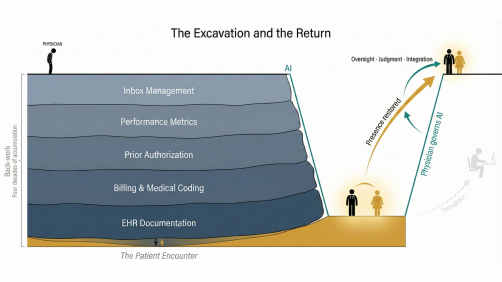
By Sbarro Health Research Organization (SHRO)
A new perspective published Wednesday in JAMA challenges the growing narrative that artificial intelligence (AI) is poised to replace physicians, arguing instead that the technology exposes deeper structural failures in modern healthcare.
“This is not really a story about the end of the doctor. It is a story about what kind of doctor, and what kind of medicine, we want to preserve and strengthen,” says Canio Martinelli, MD, OB/GYN, MSc, and lead author of the article.


RELATED: Transformative role of AI and data science in advancing global health in Africa
Recent findings show that AI can outperform physicians in perceived empathy during text-based evaluations by patients, fueling claims that even the most human aspects of medicine may be replicable. But Martinelli argues those results should be interpreted as a warning sign about what has happened within healthcare systems, not as evidence that machines have become compassionate.
Artificial Intelligence Is Not the End of the Physician
The JAMA Viewpoint paper, “Artificial Intelligence Is Not the End of the Physician,” is written by researchers working with the Sbarro Health Research Organization (SHRO), under the leadership of Antonio Giordano, MD, PhD, Director of the SHRO, Professor at Temple University, in collaboration with Siena University, Italy.
“AI is sometimes described as outperforming humans even in areas such as empathic communication. That should not be read as a triumph of machines, but as a signal of how far clinical practice has drifted from the conditions that make empathy possible,” Martinelli says.
“Clinicians have been pushed further from the bedside and buried under expanding administrative demands,” adds Giordano, “and this has created a real fracture in the doctor-patient relationship.”
AI’s apparent strengths reflect not a systemic imbalance
Against this backdrop, AI’s apparent strengths reflect not a technological endpoint, but a systemic imbalance.
“AI should not be framed primarily as a tool to replace clinicians. It should be framed as an opportunity to restore what medicine has progressively lost: time for reasoning, time for presence, time for human connection, and time for better teamwork around the patient,” Martinelli said.
The article situates AI within the broader evolution of medicine itself, raising a pivotal question for healthcare systems: whether the technology will be used to further industrialize care, or to help free physicians from mechanical and bureaucratic burdens so they can become more thoughtful, more available, and more human in their work.
Martinelli also emphasizes that clinicians must play an active role in shaping how AI is integrated into care delivery.
Clinicians cannot be passive observers of this transition
“Clinicians should not remain passive observers of this transition. Physicians need to be part of the conversation both as users of AI, and as people helping shape how it is implemented,” says Martinelli.
Ultimately, the perspective calls for a reframing of the debate away from replacement and toward restoration.

“AI is not the end of the physician,” Martinelli says. “It is a test of whether medicine will use technology to replace human presence, or to finally make room for it again.”
“The real question is not whether AI can act like a doctor, but whether healthcare systems will use AI to absorb administrative tasks, and restore the doctor’s uniquely human functions,” concludes Giordano.
About Sbarro Health Research Organization (SHRO)
The Sbarro Health Research Organization conducts groundbreaking research in cancer, diabetes, and cardiovascular disease. Based in Philadelphia, Pennsylvania, on the campus of Temple University, SHRO’s programs train young scientists from around the globe, accelerating the pace of health research and innovation.
Source: Newswire