By
By 
With investment in HealthTech accelerating, Sweden’s Neko Health recently secured a $700 million funding round that valued the AI-powered body-scanning company at nearly $7 billion. In this context, BestBrokers is sharing its recent report exploring the world of private businesses valued at US$1 billion or more, known as unicorns.
RELATED: How Big Tech’s new health AI assistants are redefining care
The team at BestBrokers analysed the Crunchbase Unicorn Board’s list of private startups with a valuation of at least US$1 billion, or the so-called ‘unicorns’.
Data was also aggregated from PitchBook and several other sources on the largest private company funding rounds and company valuations throughout 2025 and 2026. The full dataset used is available on Google Drive via this link.

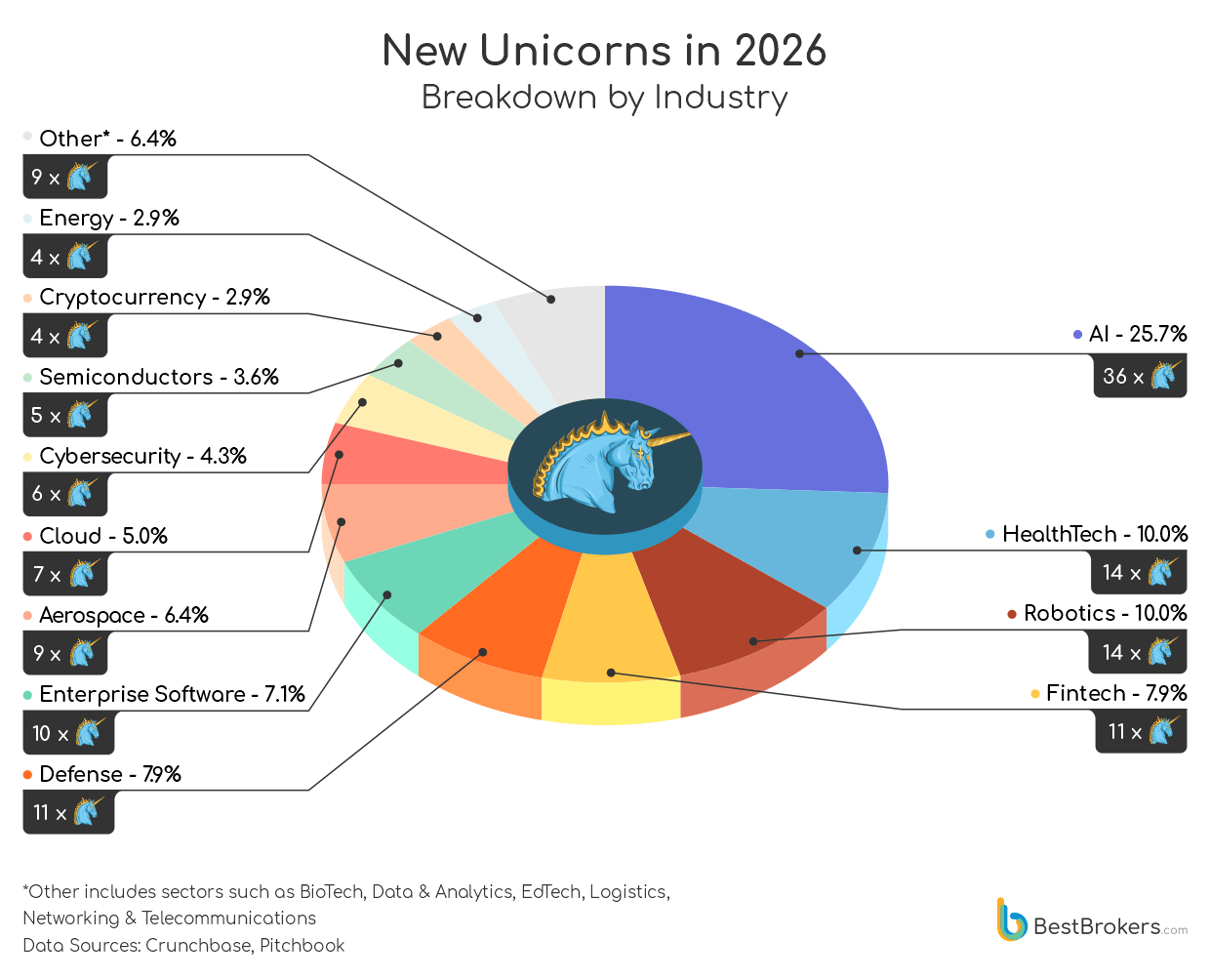
Data shows that out of the 140 new unicorn startups born in 2026 so far, the HealthTech sector has produced 14 in total, trailing only the AI sector with 36 startups. Together, these 14 companies have added $22 billion in private value to the sector in a little over half a year, making HealthTech the joint second-largest producer of new unicorns this year alongside Robotics and surpassing Fintech in both number of new billion-dollar startups and value.
The sectors producing the most unicorns in 2026
- AI – 36 startups worth $73.5 billion
- Robotics – 14 startups worth $23 billion
- HealthTech – 14 startups worth $22 billion
- Fintech – 11 startups worth $15.8 billion
- Defense & SecurityTech – 11 startups worth $16.6 billion
- Enterprise Software – 10 startups worth $11.9 billion
The most valuable newly minted HealthTech unicorns
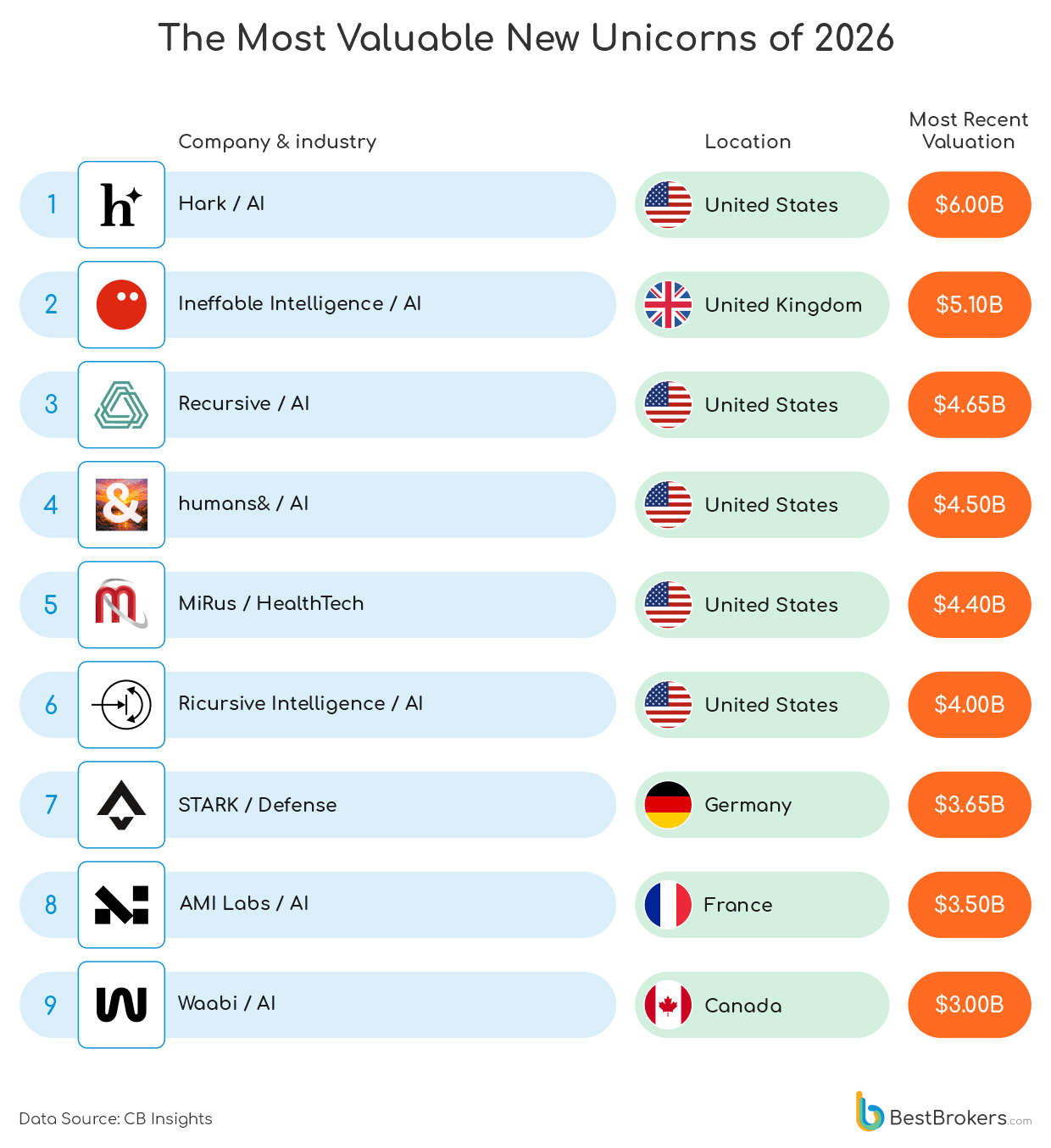
- MiRus – $4.40 billion valuation
- Garner – $2.70 billion valuation
- Pomelo Care – $1.70 billion valuation
- Vi Labs – $1.60 billion valuation
- Eight Sleep – $1.50 billion valuation
- Science (Therapeutic Devices) – $1.50 billion valuation
- Talkiatry – $1.40 billion valuation
- Assort Health – $1.20 billion valuation
Other highlights from the report
- HealthTech has emerged as one of the biggest drivers of new unicorn creation in 2026. The sector produced 14 new billion-dollar startups, adding $22 billion in private value and matching Robotics which also added 14 new unicorn startups so far this year.
- The United States dominates the latest wave of HealthTech unicorns. U.S.-based companies account for 13 of the 14 startups that have reached unicorn status, with Swiss dental technology company vVardis ($1B valuation) being the only non-American company in the group.
- U.S. orthopaedic and cardiovascular implant developer MiRus became the most valuable of 2026’s newly minted HealthTech unicorns after Boston Scientific invested $1.5 billion for an approximately 34% stake, valuing the company at around $4.4 billion.
- Artificial intelligence is emerging as a defining feature among healthtech companies, with nearly half of this year’s newly minted unicorns incorporating AI into their products and services. Rather than focusing solely on diagnostics, these companies are using AI across the healthcare ecosystem, from Garner’s AI-powered healthcare navigation platform and Assort Health’s patient scheduling agents to Vi Labs’ AI-driven drug discovery technology.
- Specialised healthcare has also attracted significant investment, with startups targeting specific areas of patient care reaching billion-dollar valuations. Pomelo Care reached a $1.7 billion valuation through its virtual maternity care platform, followed by Eight Sleep at $1.5 billion, which combines connected hardware with sleep monitoring and recovery technology. Talkiatry reached a $1.4 billion valuation with its nationwide mental healthcare platform, while Midi Health and Tandem, both valued at $1 billion, focus on menopause and women’s midlife healthcare, and diabetes management technology, respectively.
‘AI is changing the economics of healthcare startups’
‘AI is changing the economics of healthcare startups, just as technology has transformed nearly every corner of the tech industry in recent years. Instead of simply moving existing healthcare services online, the next generation of HealthTech companies are using AI to automate labour-intensive processes, improve patient access, and build scalable healthcare infrastructure. By reducing operational costs and accelerating areas such as drug discovery and treatment development, AI is making healthcare startups more attractive investment opportunities and helping fuel the creation of a new wave of billion-dollar companies.’
– comments Alan Goldberg lead data analyst at BestBrokers.com.
The report was based on the latest data from the business analytics platform Crunchbase as of June 2026. Additional data on VC investments, funding rounds, and company valuations was collected from Pitchbook.
More information on private companies and their valuations, as well as the complete methodology, can be found in the full report.