By

Nigeria is moving to strengthen control over its digital infrastructure and the data generated within its borders. A new class of artificial intelligence is emerging to position itself at the centre of this shift. This AI operates at the intersection of financial fraud detection, sovereign computing, data localisation, and critical infrastructure management.
RELATED: FG urges Nigerians to embrace made-in-Nigeria digital solutions, strengthen data sovereignty
Rhiagano Consulting Global Ltd is an African technology company headquartered in Kigali, Rwanda. It believes its deterministic and agnostic artificial intelligence platform could address some of the challenges facing Nigerian businesses and public institutions. This comes as Nigeria tightens its digital sovereignty requirements.
ALSO READ: Ayotunde Coker: CBN data localisation deadline is early migration key to Nigeria’s digital economy and data sovereignty
The company’s proposition has gained particular relevance following recent policy developments around Nigeria’s National Sovereign Cloud Initiative (NSCI) and requirements within the financial sector for transactions to be not only detected when fraudulent but also traceable and auditable long after they occur.
For Rhiagano, these developments have brought into sharper focus a technology originally developed to tackle one of Africa’s persistent digital-economy problems: financial fraud.
Nigeria’s Sovereign Cloud Push Creates New Demand for Home-Grown AI
The National Sovereign Cloud Initiative, signed by the Director-General of the National Information Technology Development Agency (NITDA), Kashifu Inuwa Abdullahi, on August 4, 2026, incorporates four core governance instruments: They include National Cloud Computing Guideline, National Cloud Technical Guideline, National Digital Infrastructure Assurance Framework and National Cloud Investment Strategy.
Together, the instruments are designed to strengthen governance around Nigeria’s cloud infrastructure and the handling of data generated within the country.
For technology companies such as Rhiagano, Nigeria’s policy direction reinforces a compelling argument. That argument favours computing and AI infrastructure capable of operating within Nigeria, rather than relying entirely on offshore processing environments.
Kodit Owens Oghenovo, General Manager, Rhiagano Consulting Global (West Africa) Ltd, told IT Edge News.Africa that the company’s technology was initially driven by the need to tackle financial fraud while also addressing the question of where sensitive transactional data is processed.

Kodit Owens Oghenovo
“What led us to develop this AI is fraud detection, which I believe is a major problem in Nigeria.”
According to Oghenovo, financial institutions increasingly need systems capable not only of identifying suspicious transactions but also of providing an audit trail that remains reliable over time.
“Being able to audit, it means you can return in 10 years to check the data and it will remain the same.”
He added that the issue of data residency was another factor behind the technology’s development.
“The other thing is that the CBN wants our data to remain in Nigeria. Most cloud-based AIs are all foreign. Data is not meant to be leaving the country.”
Why Deterministic AI Is Different From Generative AI
At the heart of Rhiagano’s proposition is a distinction between deterministic AI and the more familiar generative, agentic and predictive AI systems increasingly being deployed by businesses.
Rhiagano is described by the company as both deterministic and agnostic, with its architecture built around two foundational engines, Rhiebo and Declare.
The objective is to create a unified platform where operational intelligence can be translated into consistent and defensible decisions.
That distinction is particularly important in financial services.
Large language models can generate different responses to similar prompts because they are designed to produce flexible, probabilistic outputs. Rhiagano argues that such variability can be problematic when an institution needs a consistent answer to a question such as whether a transaction is fraudulent.
Akeni Adeyinka, Head of Technology, Nigeria, Rhiagano, explained the difference.
“Rhiagano will consistently tell what is fraudulent and why it is fraudulent without deviating from the answer it gives when you ask some other time.”
For banks dealing with ATM, BVN, account and other transactional fraud, the company believes this consistency could make deterministic AI more suitable for automated decision-making.
Rhiagano’s Sovereign AI Proposition for Nigerian Banks
Nigeria’s commercial banks are among the largest users of cloud computing and data-processing infrastructure in the country. Much of the hyperscale cloud infrastructure they rely on is operated by global technology companies headquartered outside Africa.
Rhiagano believes the combination of Nigeria’s sovereign-cloud ambitions and the financial sector’s growing need for auditable fraud detection could create a market for locally deployed AI infrastructure.
Oghenovo said the company’s proposition is not simply about keeping Nigerian data within the country.
It is also about ensuring that the infrastructure processing the data can be located within the Nigerian enterprise environment.
This, according to the company, could reduce dependence on offshore processing while also limiting exposure to connectivity disruptions associated with subsea fibre cuts.
Adeyinka said the technology could provide banks with a different approach to computational infrastructure.
“The banking industry needs this software to checkmate ATM, BVN and other transactional fraud.”
He added that Rhiagano believes its architecture could significantly reduce the cost associated with offshore data processing.
From Fraud Detection to Fraud Prevention
One of the company’s strongest claims is that its technology can move fraud management from a largely reactive process towards proactive intervention.
Oghenovo said Rhiagano can process transactions at a speed that enables institutions to identify suspicious activity before a transaction is completed.
He claimed that while some technologies available in the market detect fraud at about 150 transactions per second, Rhiagano can detect fraud at 36,000 transactions per millisecond.
The company says this speed allows its system to assess the reliability or trustworthiness of transactions and alert institutions before potentially fraudulent transactions are completed.
The significance of such capability lies in the difference between preventing financial loss and investigating it after the money has already moved.
For Nigerian banks operating enormous transaction volumes, milliseconds can potentially make a difference in whether a suspicious transaction is stopped or becomes another case for post-transaction investigation.
One Server Instead of Multiple Data Racks
Adeyinka said another differentiator is the system’s ability to coordinate large volumes of data through a single server architecture rather than requiring several data racks.
According to him, Rhiagano can coordinate millions of data points and automate analysis within sub-millisecond execution.
The company sees potential applications in institutions such as the National Bureau of Statistics (NBS), where large volumes of economic and administrative data must be processed and interpreted.
The same architecture, it argues, could be relevant to revenue administration.
Adeyinka cited the potential application for the Nigerian Revenue Service, saying the system could identify patterns associated with potential tax evasion far faster than conventional investigative processes.
He said the platform can ingest as many as 14 million data points, analyse them through a vector matrix and generate an inference rapidly.
Insurance is another potential market, where the technology could be applied to analysing the value and timing of claims.
Deterministic AI Moves Into Nigeria’s Power Sector
Perhaps one of the more significant aspects of Rhiagano’s proposition is that its application is not limited to financial services.
The technology was originally developed around fraud detection, but the company says its deterministic architecture can identify patterns and anomalies in several other complex systems.
Power generation and grid stability are among them.
Nigeria’s electricity system has long struggled with instability, equipment failures and unexpected disruptions. Rhiagano believes an AI system capable of detecting anomalies could help utilities identify potential failures before they result in a wider system collapse.
Oghenovo said:
“Before the grid collapses, it can tell you that the grid is about to break down.”
The system, he explained, could also potentially pinpoint the location of a fault after a disruption occurs.
This could shift AI’s role in the power sector from simply analysing historical performance to providing early warnings about emerging system failures.
Logistics, Drones and Security Expand the AI Use Case
The company also sees applications in logistics and fleet management.
According to Oghenovo, Rhiagano can coordinate drones and identify activity within defined geographic areas, potentially creating applications in security and surveillance.
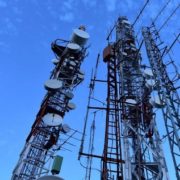
The company says the platform could also be positioned between communication masts to monitor activity within a particular field.
These applications illustrate the broader proposition behind the technology: Rhiagano is not presenting itself as an AI designed for one industry but as a computational intelligence platform that can analyse patterns across different operational environments.
That is what the company means by describing the technology as agnostic.
Why Europe’s Technology Is Being Adapted for Africa
Although Rhiagano is an African-based company, its technology development has strong European roots.
Oghenovo said the company’s Co-Founder and Chief Technology Officer, Palle Simonsen, is a Danish entrepreneur with four decades of experience in information technology and is responsible for developing the product.
The company says the technology is designed to compete with advanced European and American technologies while being adapted to African operating conditions.
“What we are doing is taking the best of the best European technology and adapting it for our local needs,” Oghenovo said.
That positioning is important because the company is attempting to challenge the assumption that advanced AI infrastructure for African markets must necessarily come from the global hyperscalers.
Instead, Rhiagano is presenting a hybrid proposition: globally developed technology, adapted for African problems and deployed closer to the data it is intended to analyse.
Nigeria’s Data Sovereignty Agenda Could Accelerate Local AI
The significance of Rhiagano’s proposition extends beyond fraud detection.
Nigeria is increasingly treating data as strategic digital infrastructure. As more government agencies, banks, telecom operators, healthcare organisations and businesses digitise their operations, the question is no longer simply how much data is generated.
It is increasingly about where that data is stored, who processes it, how decisions derived from it can be audited and how quickly those decisions can be made.
This is where sovereign cloud and deterministic AI intersect.
A sovereign-cloud architecture provides the infrastructure and governance framework for keeping critical data and computing resources under appropriate national or institutional control.
A deterministic AI system can then provide a layer of intelligence capable of producing repeatable, auditable outcomes from that data.
For sectors such as banking, taxation, insurance, electricity and public statistics, that combination could become increasingly important.
From Cloud Sovereignty to AI Sovereignty
Nigeria’s emerging cloud policies also raise a broader question about the country’s future AI architecture.
If sensitive Nigerian data increasingly needs to remain within Nigerian-controlled infrastructure, organisations will need more than local storage. They will require sufficient compute capacity, cybersecurity, data governance, AI infrastructure and technical expertise to process that data domestically.
This is where companies such as Rhiagano see an opportunity.
Rather than competing solely on the basis of being another cloud provider, the company is positioning its technology as an intelligence layer that can operate close to an organisation’s data.
For financial institutions, that could mean faster fraud detection. For government agencies, it could mean faster analysis of large datasets. For utilities, it could mean earlier detection of system anomalies.
The common denominator is the ability to turn large volumes of data into consistent operational decisions.
The Real Test Will Be Adoption
For all its claimed capabilities, the next challenge for Rhiagano is moving from technological promise to large-scale institutional deployment.
The company has been operating in Africa since 2021, with headquarters in Kigali and offices in South Africa, Sofia in Bulgaria and London in the United Kingdom.
It entered the Nigerian market about five months ago and, according to the company, has held discussions with the Transmission Company of Nigeria (TCN) and other prospective partners.
Its immediate focus, however, remains the banking sector.
That may prove to be an important testing ground for the technology. Financial institutions have both the data volumes and the financial incentives to deploy systems capable of detecting fraud rapidly and producing an auditable record of decisions.
If the technology can demonstrate those capabilities at scale, its applications could extend well beyond banking.
Africa’s AI Opportunity Is About Solving African Problems
Rhiagano’s proposition ultimately reflects a larger shift taking place across Africa’s technology landscape.
The continent is no longer simply asking how it can consume technologies developed elsewhere. Increasingly, African technology companies are attempting to adapt advanced computing, AI and digital infrastructure. These are essential to resolving problems that are particularly acute in African markets.
For Nigeria, the combination of financial fraud, unreliable infrastructure, connectivity disruptions, data sovereignty requirements and the growing volume of digital transactions creates a substantial technology challenge.
It also creates a market opportunity.
Rhiagano’s deterministic AI is entering that space with a proposition built around one central idea: data becomes more valuable when organisations can turn it into consistent, explainable and timely action without surrendering control of the underlying infrastructure.
Will the proposition translate into widespread deployment across Nigeria’s banks, power infrastructure, government agencies and other critical sectors? This will ultimately depend on institutional adoption, technical validation, regulatory alignment and the ability to demonstrate measurable value.
But as Nigeria’s digital economy becomes increasingly data-intensive, the demand for AI that is not merely intelligent. It is also sovereign, auditable, predictable and locally deployable. Equally, it is likely to become an increasingly important part of the country’s technology conversation.