

 By

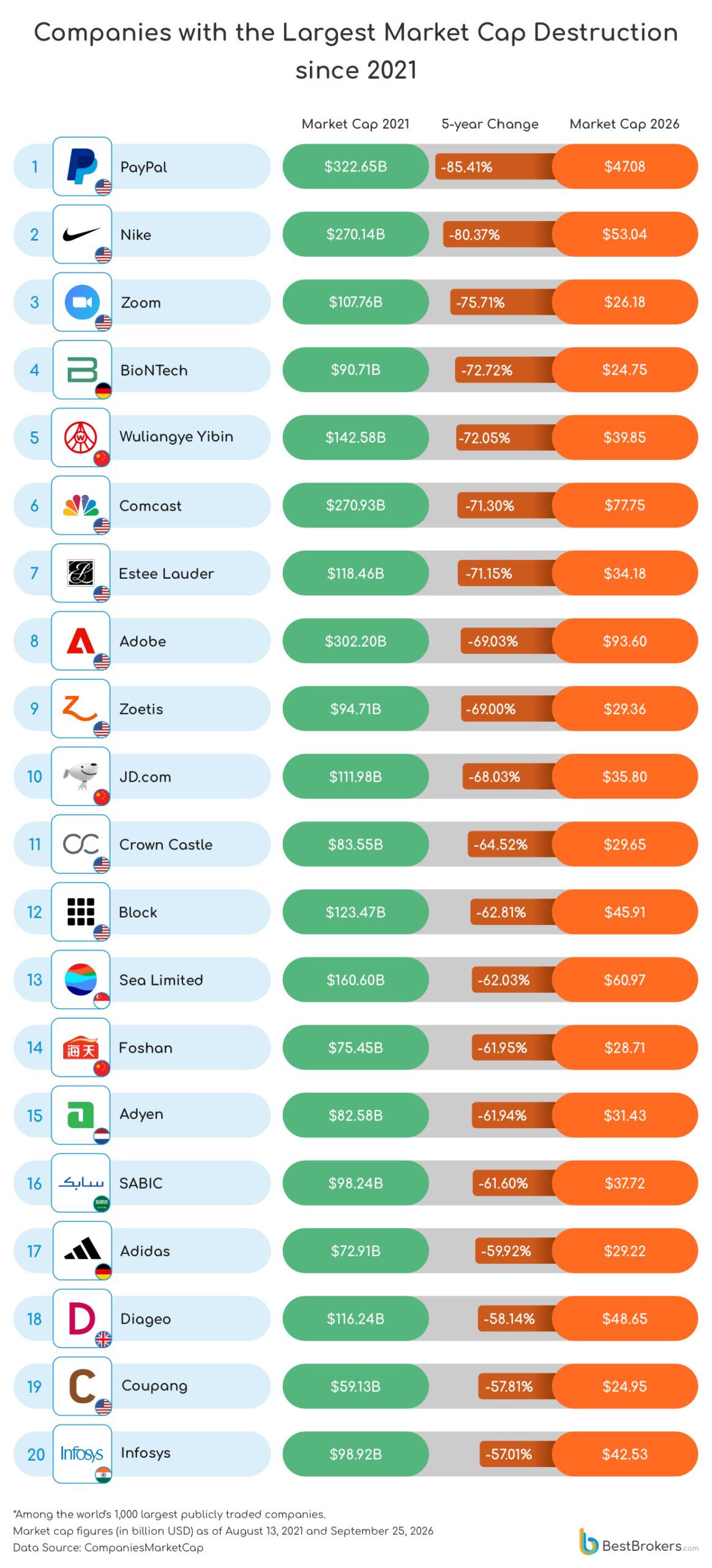
PayPal has raised its profit outlook as its new chief executive presses ahead with a turnaround—a signal of operational progress. Yet the market remains unconvinced, and the numbers tell a starker story. Since the pandemic-era peak in 2021, more than 85% of the payments giant’s market value has evaporated.
RELATED: PayPal goes live in Nigeria through Paga partnership, unlocking seamless international payments in naira
The gap between what PayPal is doing and what investors believe it can become is now the central question of its turnaround. A raised outlook is a start, but confidence, once lost at this scale, is not rebuilt by guidance alone.
To see which fintech and financial companies lost the most market value, BestBrokers has published a recent report that tracks the five-year changes in the market capitalisation of the world’s 1,000 largest publicly listed companies.


Market capitalisation changes
BestBrokers analysed market capitalisation changes among the world’s 1,000 largest publicly listed companies between 13 August 2021 and 25 September 2026.
After excluding companies affected by major corporate restructurings and other changes that could distort comparisons, the company identified companies that lost market value over these five years and grouped their losses by industry.
All data and calculations are available on Google Drive via this link.
Analysis shows that of the 1,000 publicly listed companies, 172 lost market value over the past five years. Among them are several major fintech and financial companies, with PayPal, Block, and Adyen among the biggest losers. Fintech was the fourth-largest contributor to losses across all sectors, with a combined market capitalisation decline of approximately $420 billion.
Fintech and financial companies with largest market cap losses over past five years
- PayPal: down $275.57 billion to $47.08 billion (-85.41%)
- Block: down $77.6 billion to $45.9 billion (-62.81%)
- Adyen: down $51.15 billion to $31.43 billion (-61.94%)
- Ping An Bank: down $26.92 billion to $32.67 billion (-45.17%)
- Bank Rakyat Indonesia: down $12.16 billion to $26.37 billion (-31.57%)
- EQT: down $13.75 billion to $36.29 billion (-27.48%)
- Macquarie Group: down $22.95 billion to $65.57 billion (-25.93%)
- Truist Financial Corporation: down $19.9 billion to $58.2 billion (-25.45%)
- Hong Kong Exchanges & Clearing: down $21.28 billion to $62.63 billion (-25.37%)
- Experian: down $10.44 billion to $31.06 billion (-25.15%)
Other highlights from the analysis
- PayPal recorded by far the largest market capitalisation loss among the companies analysed, shedding $275.57 billion over the five years. The American payments giant saw its market value plunge by 85.41%, from $322.65 billion in August 2021 to just $47.08 billion in September 2026.
- Dutch fintech company Adyen also suffered a substantial decline, losing $51.15 billion in market value. Its capitalisation fell by 61.94%, from $82.58 billion to $31.43 billion.
- Among traditional financial institutions, China Merchants Bank recorded the largest absolute loss, shedding $34.80 billion, or 17.48%, of its market value. Its capitalisation declined from $199.11 billion in August 2021 to $164.31 billion in September 2026.
- Chinese commercial bank Ping An Bank experienced a much steeper percentage decline, losing 45.17% of its market value, equivalent to $26.92 billion. Its capitalisation fell from $59.59 billion to $32.67 billion over the same period.
- Australia’s Macquarie Group lost nearly $23 billion, with its market value declining by 25.93% to $65.57 billion. Hong Kong Exchanges & Clearing also saw its capitalisation shrink by more than $21.28 billion, or 25.37%, to $62.63 billion.
- Across all industries, Technology recorded the largest combined loss, at $637.3 billion, followed by Food & Beverage (down $545.6 billion) and Fashion & Apparel (down $472.7 billion). Fintech followed with a combined loss of approximately $420 billion, with PayPal accounting for the largest share of the decline. Another 15 banks and financial services giants lost $203.5 billion in market value.
‘Gap between disrupting an industry and building a business that can sustain its market valuation’
‘The past five years have exposed the gap between disrupting an industry and building a business that can sustain its market valuation. PayPal’s 85% decline is particularly striking because it shows how quickly investor expectations can change when a once-dominant payments platform faces intensifying competition and questions about its growth prospects. Adyen’s losses underline that this is not simply a problem for established American players, while the declines among banks and financial groups suggest that pressure on valuations has extended well beyond fintech. At the same time, the figures should not be mistaken for evidence that digital payments or financial services are becoming less important. Rather, investors are reassessing how much growth and profitability they can reasonably expect from these businesses, and whether their market valuations still reflect those prospects.’
– comments Stanislava Savisheva, data researcher and author at BestBrokers.
Read the full report and complete dataset created for analysis via this link.
























